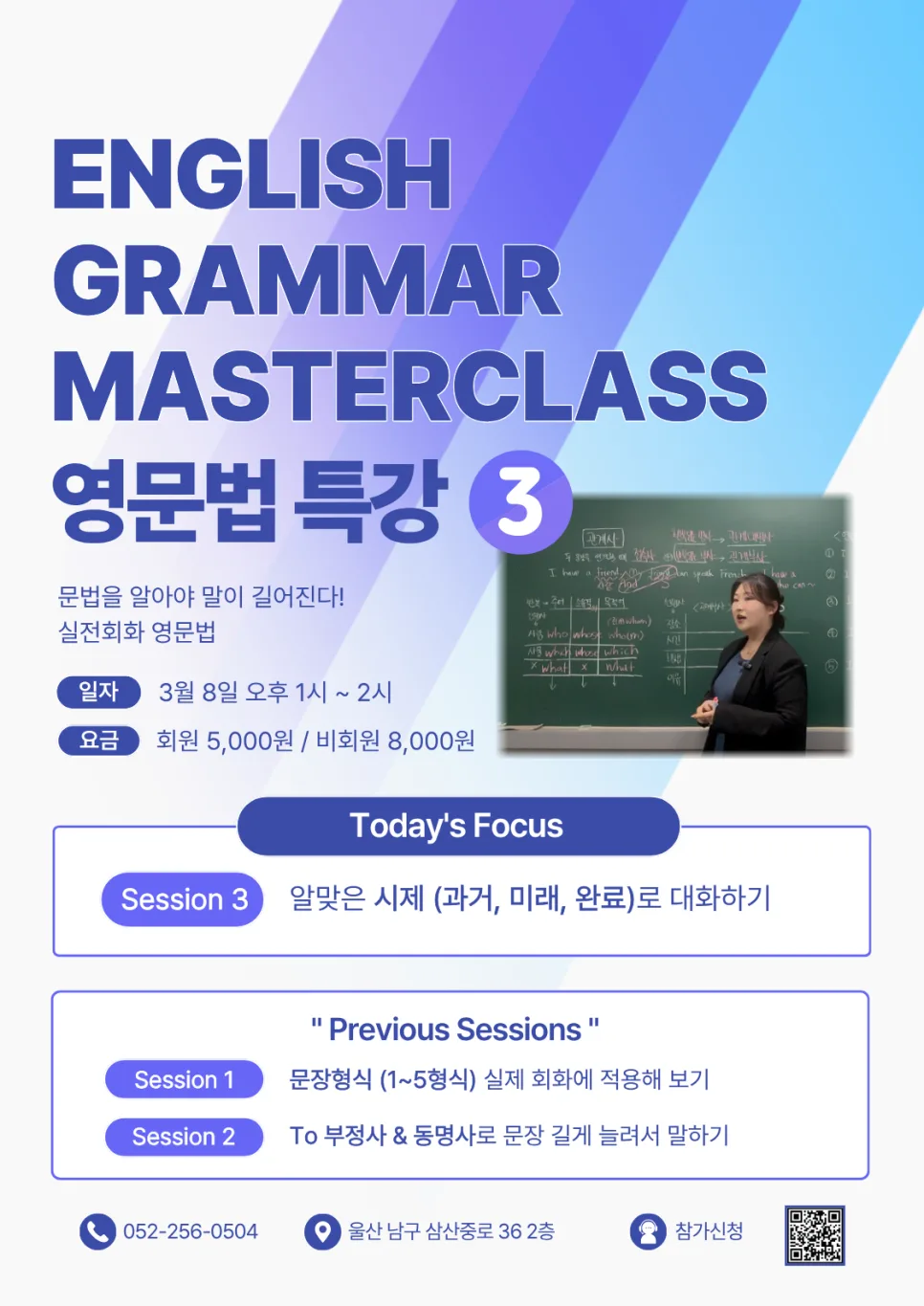
Many learners find English tenses like the present perfect ('Have p.p.') challenging, but they are essential for clearly conveying experiences and influences that span from the past to the present. A special grammar workshop led by a seasoned instructor with 9 years of experience broke down these concepts into easy-to-understand explanations, focusing on practical application in conversation.
Why This 9-Year Expert's Grammar Workshop Stands Out
On March 8th, the Ulsan Mal-lang Lingo Club hosted a unique English grammar workshop led by an instructor with over 9 years of experience in college admissions preparation. This wasn't just about test scores; it focused on empowering students to express themselves clearly in real conversations with native speakers. The workshop particularly resonated for its in-depth explanation of various tenses, including the often-confusing present perfect ('Have p.p.'), presented from a conversational perspective. Attendees praised the session for providing practical tips that can elevate their English speaking skills to the next level, drawing on the instructor's proven expertise.
Understanding Present, Past, and Present Perfect Tenses
English tenses can be broadly categorized into present, past, and the connecting present perfect. The present tense, as in 'I drink coffee every morning,' is used for recurring habits or universal truths, while the past tense, like 'I drank coffee yesterday,' describes a completed action in the past. The present perfect tense, which often confuses learners, is used when an action started in the past and continues to affect the present, as in 'I have lived in Ulsan for 3 years,' or to discuss experiences from birth up to now, such as 'Have you ever been to Europe?' Mastering these distinctions makes your intended meaning significantly clearer.
When to Use Past Perfect and Future Perfect Tenses
The past perfect tense ('Had p.p.') is crucial for clarifying the sequence of two past events, indicating which one occurred earlier. For instance, the sentence 'When I arrived at the station, the train had already left' clearly establishes that the train's departure happened before my arrival. The future perfect tense ('Will have p.p.') is used to express an action that is expected or certain to be completed by a specific point in the future. An example is 'I will have finished the report by tomorrow,' indicating the completion of the report by the following day. Accurate use of these tenses adds depth and sophistication to your English expression.
Beyond the Workshop: Tips for Improving English Fluency
After gaining a solid understanding of tenses from this workshop, the next step is practicing them confidently in real conversations. To express that you've fully grasped the material, useful phrases include 'It makes perfect sense!' or 'I got it!' Incorporating these expressions can lead to more natural interactions with native speakers. Mal-lang Lingo Club plans to continue hosting various classes and events that foster cultural and linguistic exchange, so stay tuned for more exciting opportunities!
Tags
Original Source
Read the Korean original