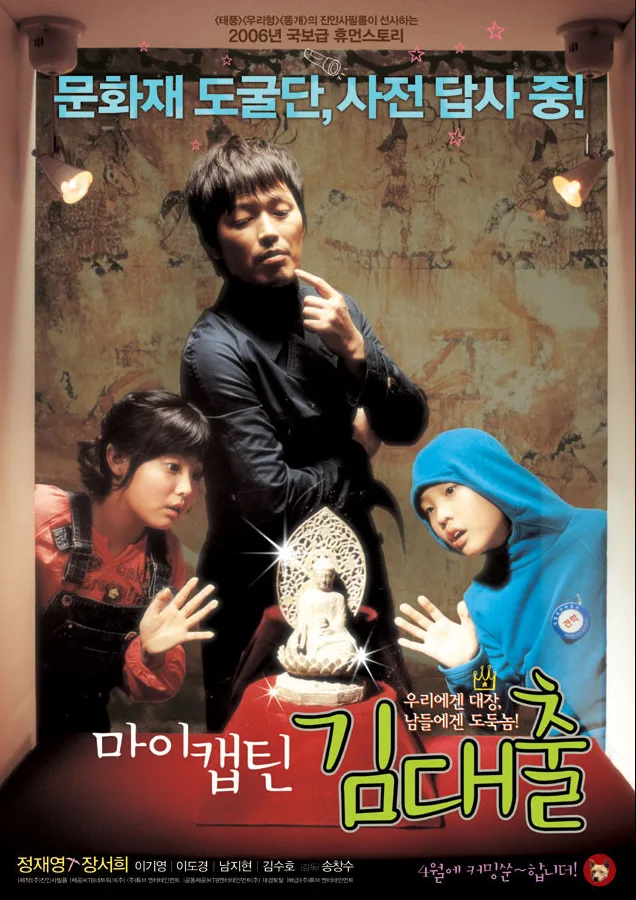
The 2006 Korean film 'My Captain Kim Dae-chul' tells the heartwarming story of a hardened treasure hunter who unexpectedly becomes a 'captain' to a group of innocent children. This human drama deeply resonates with audiences by emphasizing the profound value of human connection over material wealth, offering a touching narrative that remains relevant today.
What is the core plot of the Korean movie 'My Captain Kim Dae-chul'?
The plot of 'My Captain Kim Dae-chul' centers on Kim Dae-chul (played by Jung Jae-young), a ruthless treasure hunter on the hunt for a national treasure—a priceless Buddhist statue. His quest leads him to Gyeongju, where he encounters two children, Byung-oh and Ji-min. Initially intending to use them for his own gain, Dae-chul gradually finds his hardened heart softening due to their pure innocence. The film beautifully chronicles his transformation as he begins to realize what truly constitutes a treasure. Jung Jae-young's performance, portraying a gruff exterior with underlying sincerity, brings the character to life, making his emotional journey compelling for viewers. The narrative powerfully contrasts his initial greed with his eventual rediscovery of humanity through his bond with the children.

What is the ending of 'My Captain Kim Dae-chul'?
In the film's conclusion, Kim Dae-chul finally obtains the coveted golden Buddha statue. However, this success comes at the cost of the children's safety, forcing him to make a critical choice. Ultimately, he abandons his pursuit of material riches and surrenders to the police to protect the children. Years later, after his release from prison, the children reappear in his life, leading to a heartwarming reunion that underscores the true meaning of 'family' and 'connection.' The movie reveals that the real treasure Dae-chul was searching for wasn't the cold, ancient statue, but the warmth and shared moments he experienced with the children. This poignant ending leaves audiences reflecting on what truly holds value in life, prioritizing human relationships over material possessions.
What are the key viewing points for the Korean film 'My Captain Kim Dae-chul'?
To fully appreciate 'My Captain Kim Dae-chul,' consider these viewing points. First, Jung Jae-young's 'tsundere' performance is a standout. His rough demeanor and gruff speech mask a growing warmth that makes his character's transformation believable. The gradual breakdown of his tough exterior as he connects with the children feels organic, not forced. Second, the film masterfully explores the theme of 'material treasure vs. emotional treasure.' By contrasting the coldness of the unearthed statue with the warmth of human interaction, the movie highlights the importance of emotional bonds, something easily overlooked in modern society. Lastly, the film's visual aesthetic, set against the backdrop of Gyeongju, the ancient capital of the Silla Kingdom, adds a layer of historical mystique and charm. The blend of historical sites with the simple beauty of the rural landscape enhances the movie's fairy-tale-like atmosphere and emotional depth.

What should viewers be aware of in 'My Captain Kim Dae-chul'?
While 'My Captain Kim Dae-chul' is celebrated as a heartwarming human drama, some viewers might find certain elements leaning towards sentimentality, a common characteristic in some Korean dramas. The emotional climax, in particular, may feature slightly exaggerated direction or predictable plot developments. Additionally, audiences seeking fast-paced action or flashy visuals might find the film's pacing a bit slow. Although the movie's message about the value of human connection is clear, its delivery style can be subjective and may not appeal to everyone. It's best suited for viewers who appreciate a more gentle, character-driven narrative rather than high-octane entertainment.
For more details, check the original source below.