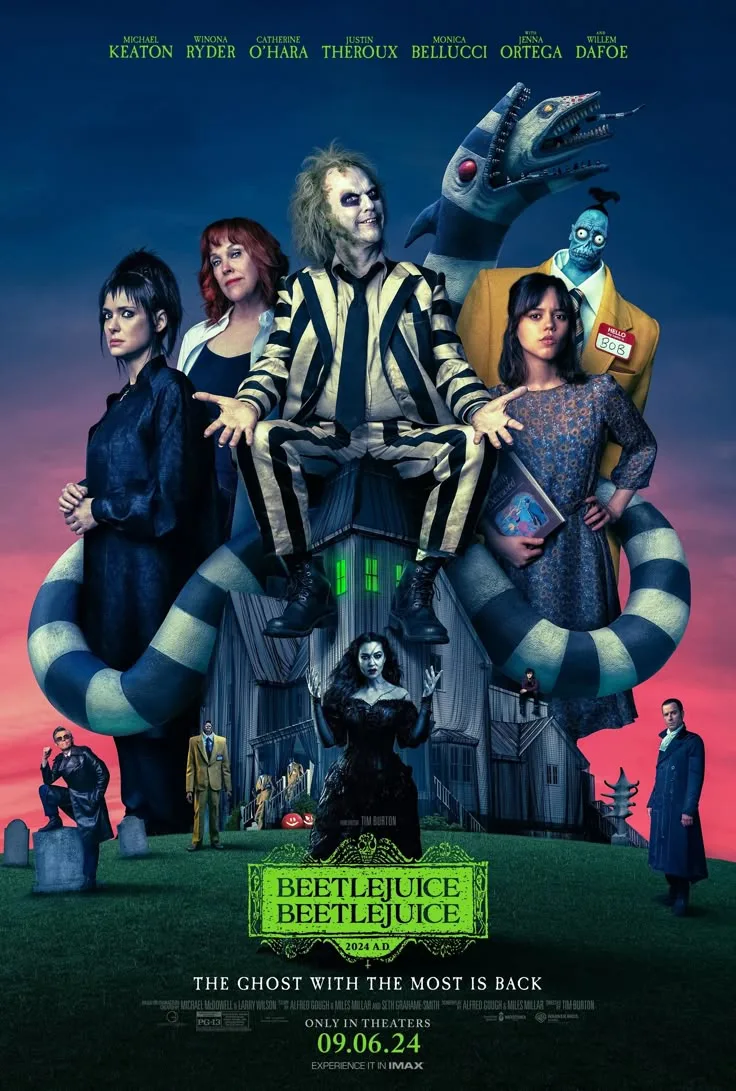

Watching the highly anticipated sequel, 'Beetlejuice Beetlejuice,' and understanding over 90% of the dialogue without subtitles is a remarkable achievement, showcasing the power of consistent English learning. For many, experiencing a beloved childhood movie, once only available dubbed, in its original language as an adult is a profound testament to improved language skills.
'Beetlejuice Beetlejuice': A Nostalgic Return with a Language Learning Twist

After a 36-year hiatus, Tim Burton's unique vision returns to the screen with 'Beetlejuice Beetlejuice,' the sequel to the 1988 cult classic. A delightful surprise for fans is the return of the original cast, evoking a strong sense of nostalgia. Like many, I revisited the first film, which I remembered watching dubbed on TV as a child, before heading to the theater for the sequel. The new film retains Burton's signature quirky and captivating directorial style, but the most striking aspect for me was the ability to comprehend over 90% of the dialogue without relying on subtitles. This wasn't just about the film's inherent entertainment value; it was a tangible demonstration of significant progress in my English learning journey.
From Dubbed Childhood Classic to Original Dialogue: The English Learning Secret
The journey from watching a dubbed version of a movie as a child to understanding its original dialogue as an adult is a powerful indicator of language proficiency. The key to this transformation lies in consistent and dedicated English study. For three years, I diligently followed programs like 'Speak Like a Native English' ('입이 트이는 영어') and 'Listen Like a Native English' ('귀가 트이는 영어'), actively practicing speaking along with the audio. This method goes beyond simple memorization of words and sentences, focusing instead on developing natural conversational fluency. As a result, the movie's dialogue became clear and easily understandable, significantly boosting my motivation to continue learning.
Leveraging 'Beetlejuice Beetlejuice' for English Language Acquisition
Movies like the recently released 'Beetlejuice Beetlejuice' serve as excellent tools for English language learners. Firstly, watching a sequel to a film you enjoyed in childhood in its original language provides a unique sense of accomplishment. Secondly, the dialogue within the movie offers a rich source of practical English expressions and vocabulary. For instance, the phrase 'vividly remember' is useful for describing past experiences with clarity, meaning 'to remember something very clearly.' Similarly, 'dubbed into Korean' can be used when discussing the localization of films or animations, meaning 'to have been translated into Korean through voice acting.' By actively identifying and practicing such expressions encountered in the film, learners can significantly enhance their English skills.
Mastering Film English with 'Speak Like a Native English'
If you're looking to improve your English using the dialogue from 'Beetlejuice Beetlejuice,' consider utilizing resources like 'Speak Like a Native English.' For example, a sentence like 'I still vividly remember watching Beetlejuice on TV during my childhood' effectively uses 'vividly remember' to describe a clear childhood memory. Another useful phrase is 'dubbed into Korean,' as seen in a sentence like 'The 1988 movie was directed by Tim Burton and dubbed into Korean,' which explains the film's localization. By studying these expressions alongside the program's explanations and practicing them consistently, you can gain the confidence to speak English fluently in various situations, not just while watching movies.
For more details, check the original source below.