Many investors miss the opportunity to buy Bitcoin around the $75,000 support level after breaking its downtrend channel. This guide analyzes the current market, key news, and provides an optimal investment strategy ahead of a potential bull run in late 2026. This is not financial advice. Consult a licensed financial advisor.
Bitcoin Price: Will It Reclaim $75,000 After Breaking the Downtrend?
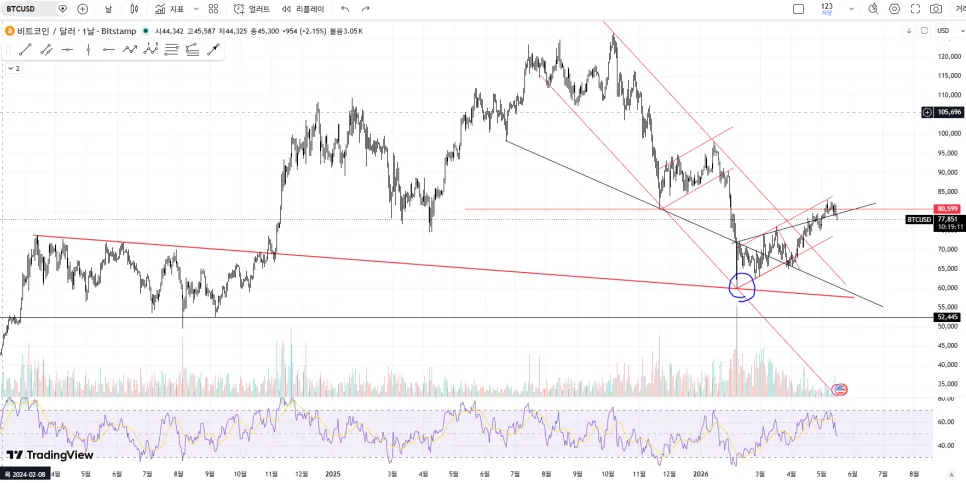
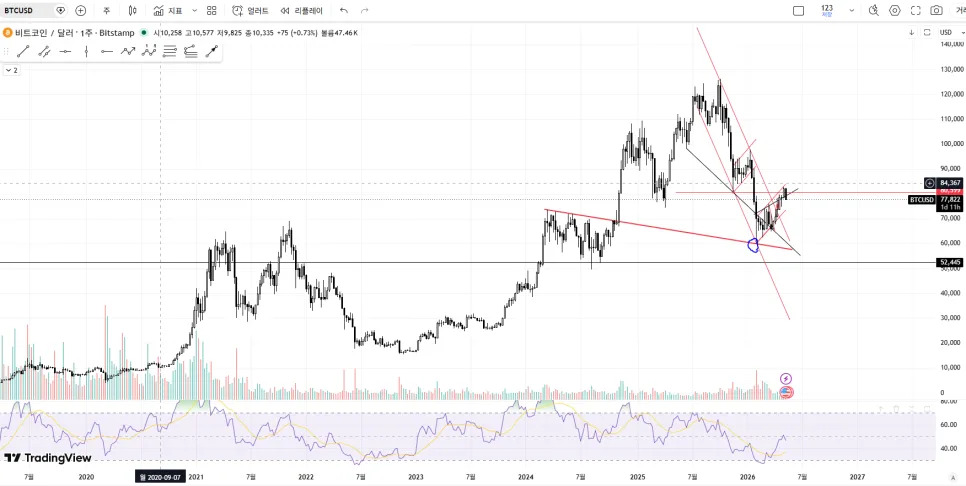
Predicting Bitcoin prices is more challenging than traditional stocks or indices due to frequent volatility, sharp price swings, and high leverage positions that can confuse traders. Analyzing Bitcoin's weekly chart reveals a downtrend following its late 2025 peak, with recent signs of a rebound. The current bounce originated from two clear support points: a descending channel and a support line. While Bitcoin successfully broke through the descending channel, it momentarily stalled at the $80,600 resistance level. However, the successful upward breakout from the descending channel signals a potential buying opportunity. The $75,000 mark, where previous highs and lows converge, is a critical price level that could also align with the lower boundary of an ascending channel. Personally, I believe a buying opportunity may arise around late May if the price dips to the $75,000 vicinity, offering a strong entry point after confirming support. The estimated entry price is $75,000. This is not financial advice. Consult a licensed financial advisor.
Top 3 Catalysts for Bitcoin's Bull Run in 2026
The cryptocurrency market is currently in a consolidation phase, influenced by global macroeconomic conditions. Rising US Treasury yields, surging oil prices fueling inflation concerns, and escalating geopolitical tensions in the Middle East are fostering caution across risk assets. However, on-chain data indicates that Bitcoin supply held on exchanges remains at historic lows (around 5.6%), suggesting strong long-term holding sentiment among investors. Amidst this backdrop, three key catalysts are poised to drive Bitcoin's bull run in late 2026: First, the advancement of the 'Clarity Act' through the US Senate Banking Committee. This legislation aims to provide clear guidelines for crypto and stablecoins, mitigating regulatory risks and paving the way for increased institutional investment. Second, sustained Bitcoin accumulation by major institutions, including global asset managers and companies like MicroStrategy. Consistent inflows into spot ETFs are creating long-term supply-demand imbalances, reinforcing price support. Third, major crypto analytics firms have signaled a full bullish transition, with their 'Bull-Bear Market Indicators' turning green. This technical indicator suggests a potential shift from short-term consolidation to a medium-to-long-term upward trend. This is not financial advice. Consult a licensed financial advisor.
Key Market Points and Risks for Bitcoin Investors
Currently, Bitcoin's market dominance hovers around 60%, indicating that market liquidity is concentrating in Bitcoin rather than dispersing into altcoins. This trend suggests that a conservative portfolio strategy focused on the leading cryptocurrency may be advantageous. However, the US Federal Reserve's potential for prolonged high interest rates and the direction of inflation indicators like the Consumer Price Index (CPI) remain significant variables that could trigger short-term market volatility. Unexpected external shocks, such as escalating geopolitical tensions in the Middle East, also pose a risk. Therefore, a comprehensive assessment of macroeconomic indicators and geopolitical risks is essential before making investment decisions. This is not financial advice. Consult a licensed financial advisor.
Common Bitcoin Investment Mistakes and Precautions
The most common mistake in Bitcoin investing is reacting impulsively to short-term price fluctuations, leading to hasty trading decisions. Over-leveraging can amplify losses significantly, even with minor price movements, necessitating extreme caution. Investing without closely monitoring regulatory developments like the 'Clarity Act' or institutional investor activity is also risky. Given Bitcoin's high dominance, understanding its supply dynamics is more crucial than diversifying into altcoins. With the potential for increased institutional adoption following regulatory clarity in late 2026, a long-term perspective is advisable. Optimal investment strategies vary based on individual risk tolerance and financial goals, making professional consultation recommended. This is not financial advice. Consult a licensed financial advisor.
For more details, check the original source below.