For investors interested in Physical AI ETFs, understanding the 2026 market outlook and key companies is crucial. Hyundai Motor Group and other robot automation firms are central to this emerging investment landscape.
What is Physical AI and Why is it the Next Growth Engine Beyond Semiconductors? 2026

Artificial intelligence (AI) is evolving beyond mere performance enhancements into a phase of tangible profit generation. Specifically, 'Physical AI' and 'AI Agents' are poised to create significantly larger markets than previous AI trends. Much like the internet during the 1999 dot-com bubble, where business models were uncertain, AI now has clear pathways to monetization. Companies like Samsung Electronics are already demonstrating profitability, while others with the potential to shape future markets and generate revenue are growing alongside them, potentially forming a long-term bubble. In terms of stock price appreciation, companies with a compelling 'dream' often outperform those focused solely on current earnings. Despite robots not yet generating substantial profits, their rapid integration into daily life is undeniable, fueling high investor expectations.
AI Portfolio Strategy: Beyond Semiconductors, What Sectors Should Investors Focus On? 2026
An effective AI investment portfolio requires a balanced approach across semiconductors, power infrastructure, and Physical AI sectors. While the semiconductor industry remains promising, the market is currently exploring efficiency gains by reducing memory usage, which could introduce a temporary slowdown. In contrast, the Physical AI sector, particularly robotics, is experiencing a surge of proactive investment with a 'build it first' mentality. This sector is often outperforming semiconductor stocks in terms of actual returns. If geopolitical discussions, such as those concerning the Strait of Hormuz, lead to a peak in inflation, it could signal future price decreases, potentially fueling further market rallies based on anticipated lower inflation. Within this economic context, Physical AI ETFs present an attractive investment alternative.
Choosing the Right Physical AI ETF: Key Considerations for 2026
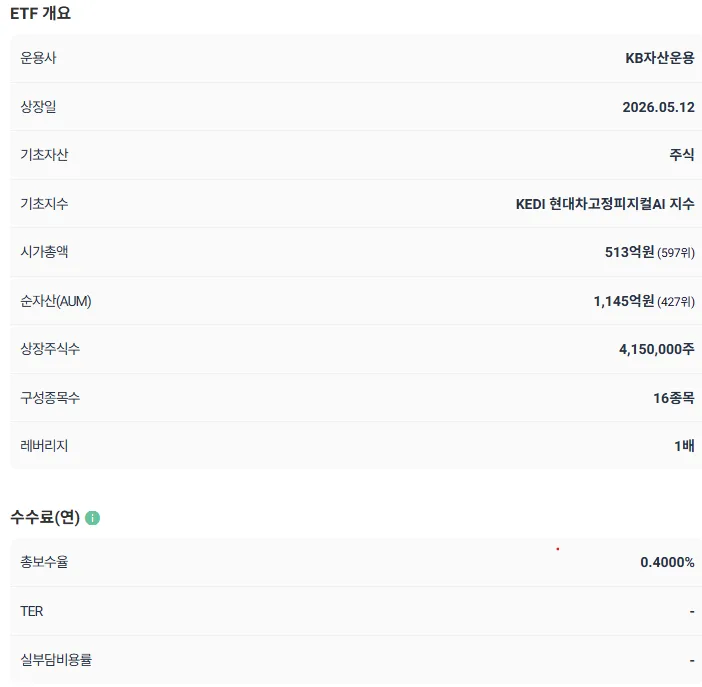
Several Physical AI ETFs are available, and the best choice depends on individual investment goals and risk tolerance. The 'RISE Hyundai Motor Group Physical AI' ETF focuses heavily on Hyundai Motor and its affiliates, along with robot automation stocks. Despite being a newer ETF, its significant weighting in Hyundai Motor ensures substantial trading volume. The 'HANARO Global Physical AI' ETF includes companies in humanoid robots, autonomous driving, robotics, and AI devices, with a strong US market focus. However, it suffers from low Assets Under Management (AUM), limited daily trading volume, and high expense ratios. The 'KODEX Robotics Active' ETF is the largest robotics ETF in Korea, boasting the highest trading volume and AUM. It includes major players like Rainbow Robotics and Doosan Robotics, alongside large-cap stocks like Samsung Electronics and Hyundai Motor, offering relatively lower volatility. The 'TIGER Korea Humanoid Robot Industry' ETF specializes in humanoid robot components and actuators, exhibiting higher volatility but benefiting from the Tesla Optimus theme. Lastly, the 'RISE AI & Robot' ETF invests in both robotics and AI software, with a notable concentration in small to mid-cap robotics companies.
Understanding Robot-Related ETFs and Investment Criteria for 2026
When selecting a robot-related ETF, several factors are critical for maximizing returns and managing risk. Key metrics include management fees (expense ratios), liquidity (AUM and daily trading volume), and the concentration and volatility of the investment sector. For instance, ETFs like 'KODEX Robotics Active' offer broad exposure to the Korean robotics market with substantial liquidity. 'TIGER Korea Humanoid Robot Industry' ETF, while potentially more volatile, targets the high-growth humanoid robot sector, which could see significant upside if themes like Tesla's Optimus gain traction. Investors should also consider ETFs that balance established players like Hyundai Motor with emerging innovators such as Rainbow Robotics and Doosan Robotics. Diversification across different segments of the AI and robotics value chain, from component manufacturers to software providers, can help mitigate risk and capture various growth opportunities in the evolving Physical AI landscape.
For more details, check the original source below.





