The KOSPI index hitting 7000 is largely fueled by a 'fake boom' driven by real estate capital inflows and increased retail investor borrowing (known as 'bitu'). Experts warn of structural risks, urging investors to exercise caution.
Why Is Real Estate Capital Flowing into the Stock Market?
The KOSPI index has surged past 7000, with market capitalization exceeding 6000 trillion KRW (approx. $4.5 trillion USD). However, this rally isn't driven by a robust real economy or improved corporate fundamentals. Instead, stringent real estate regulations and high interest rates are forcing hundreds of trillions of KRW (approx. hundreds of billions USD) from the property market into the stock market, with few other investment avenues available. Record-high investor deposits and margin loan balances ('bitu') support this trend, creating a 'fake boom' where capital is artificially channeled into the market due to regulatory pressures. This influx risks overheating the market and could lead to unexpected volatility.
The Risks of KOSPI 7000: 'Winner-Take-All' and 'Bitu'
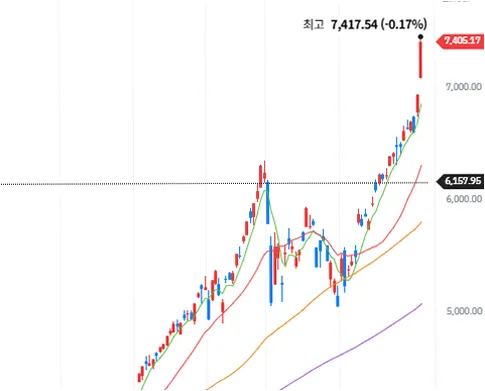
The current KOSPI rally is characterized by extreme polarization. Foreign investors are concentrating their investments in a few major semiconductor stocks like Samsung Electronics and SK Hynix, driving the index up. Meanwhile, most other sectors remain sluggish, leaving individual investors holding underperforming stocks unable to feel the market's gains. More critically, individual investors' margin loan balances ('bitu') have reached over 35 trillion KRW (approx. $26 billion USD), exposing a structural vulnerability to market volatility. If global macroeconomic shocks trigger foreign investors to sell, shallow support levels could collapse instantly. This could lead to forced liquidations ('bandae-maemae') for heavily leveraged retail investors, resulting in massive losses.
How Can Individual Investors Prepare for Short Sellers' Counterattacks?
The history of the stock market shows a harsh truth: someone profits by selling at the peak while others are left holding the bag. Foreign and institutional investors can leverage powerful tools like short selling to profit even in a downturn if they believe a stock's price has exceeded its intrinsic value. Should even minor global economic shocks occur, triggering foreign selling, retail investors' forced liquidations could plunge the market into a panic sell-off. During such events, large capital players can use short selling to secure astronomical profits, while leveraged individual investors risk buying at the market's peak and incurring substantial losses. In times like these, the discipline of 'preserving current gains' is more crucial than the desire for 'greater profits'.
What 'Defensive Lines' Must Investors Maintain?
In this seemingly euphoric market, adhering to the following principles is essential. First, 'bitu' (margin or credit trading) is strictly prohibited. The only force that can withstand market volatility is 'your own money' and sufficient emergency funds. Second, do not blindly chase rallies just because the index is rising. You might end up buying shares from foreign and institutional investors who are already cashing out. Third, a stock price surge not supported by the real economy is a warning sign that the bubble could burst at any moment. Maintain a sufficient cash position and wait for the market storm to pass; this is true investment skill. Outcomes vary based on individual circumstances, so consider consulting a professional if needed.
For more details, check the original source below.