
New to stock investing in 2026? This guide breaks down the key differences between the US and Korean stock markets (like the NYSE vs. KOSPI/KOSDAQ), explains essential financial metrics such as P/E and P/B ratios, and covers practical trading strategies, including dividend investing and chart analysis, along with crucial risk management tips for beginners.
What's the Fundamental Difference Between the US and Korean Stock Markets in 2026?
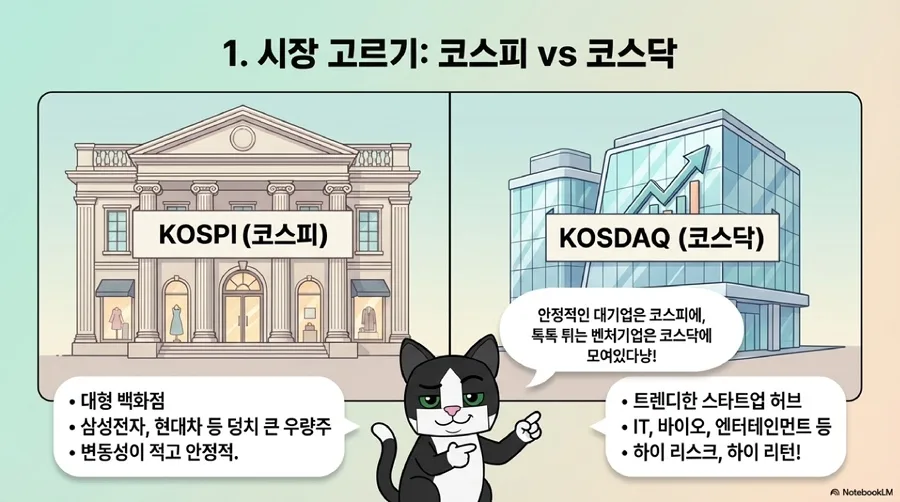
For new investors, understanding the distinctions between major stock exchanges is crucial. In the US, the New York Stock Exchange (NYSE) and Nasdaq are home to a vast array of companies, from established blue-chips to high-growth tech firms. Similarly, South Korea has its KOSPI and KOSDAQ markets. The KOSPI is generally dominated by large-cap, financially stable companies, akin to the Dow Jones Industrial Average components. In contrast, KOSDAQ focuses more on small and medium-sized enterprises (SMEs) with high growth potential, particularly in sectors like IT, biotech, and entertainment, similar to the Nasdaq's tech focus. When evaluating a company's true value, it's vital to look beyond just the stock price and consider its market capitalization (stock price multiplied by the number of outstanding shares). This provides a clearer picture of the company's overall size and market influence. In 2026, this fundamental market segmentation remains the bedrock of any investment strategy.
What Are the Key Financial Metrics for Assessing Company Value and Growth Potential?
Accurately assessing a company's financial health and profitability is essential for successful stock investing. Key metrics like the Price-to-Earnings (P/E) ratio, Price-to-Book (P/B) ratio, and Return on Equity (ROE) are indispensable tools. The P/E ratio indicates how much investors are willing to pay for each dollar of a company's earnings; a lower P/E may suggest the stock is undervalued. The P/B ratio compares a company's market value to its book value; a P/B below 1 can imply that the company's assets are worth more than its stock price. ROE measures how effectively a company generates profits from shareholder equity, with a higher ROE generally signaling better performance. Additionally, Earnings Per Share (EPS) shows the profit attributable to each outstanding share. By analyzing these metrics comprehensively, investors can make more objective judgments about a company's current valuation and future growth prospects. Mastering these fundamental indicators will be a critical skill for investors in 2026.
How Can You Leverage Dividends and Basic Chart Analysis for Stock Investing?
Beyond potential capital appreciation, stock investing offers supplementary income through dividends. Dividends are a portion of a company's profits distributed to shareholders. To receive dividends, you must own the stock before the ex-dividend date. The dividend yield, which is the annual dividend per share divided by the stock's price, is a key indicator of the return on investment from dividends. For chart analysis, understanding Moving Averages (MA) is fundamental. The 5-day MA can reflect short-term investor sentiment, while the 20-day MA often indicates the short-term trend. A 'golden cross,' where a shorter-term MA crosses above a longer-term MA, is often interpreted as a bullish buy signal, whereas a 'death cross' (the opposite) can signal a sell-off. These technical analysis tools can provide valuable insights for timing investment decisions in 2026.
What Are the Crucial Settlement Systems and Risks to Be Aware of in Real Stock Trading?
The stock market operates with settlement systems and inherent risks that every trader must understand. A primary example is the T+2 settlement cycle, meaning that when you sell a stock, the cash proceeds won't be available in your account for two business days. Equally critical is the risk of 'forced liquidation' (known as 'bandae-maemae' in Korea). This occurs when a brokerage firm forcibly sells your holdings to cover margin calls if you fail to repay borrowed funds (known as 'misugeum' or margin) by the deadline, potentially leading to significant losses. Therefore, it's crucial to avoid excessive margin trading and only invest within your financial capacity. While Exchange-Traded Funds (ETFs) and Exchange-Traded Notes (ETNs) trade like stocks, they carry different risks based on their issuer, so thorough due diligence is essential before investing. These practical trading considerations remain paramount for safe investing in 2026.
What Market Safeguards Exist for Price Volatility, and What Are the Core Principles for Successful Investing?
To mitigate extreme market fluctuations, several safeguards are in place. Circuit breakers are designed to temporarily halt trading when stock indices experience sharp declines, preventing panic selling. A 'sidecar' is a mechanism that temporarily pauses trading in futures markets to curb excessive volatility that could spill over into the stock market. These measures help stabilize markets during periods of high stress. Successful stock investing is not about luck but a strategic endeavor grounded in objective data and clear principles. Choosing markets aligned with your risk tolerance, identifying undervalued quality stocks using P/E and P/B ratios, and employing chart analysis for optimal entry points are key. Crucially, avoiding risky practices like excessive margin trading is vital. Adhering to these fundamental principles will lay the groundwork for successful investing in 2026. Individual investment outcomes may vary, and consulting with a financial advisor is recommended when needed. This is not financial advice. Consult a licensed financial advisor.
English crawl path
Next English reads from this pilot cluster
Continue through the category hub, latest English stories, and related posts so this translated article is not an isolated URL.
Tags
💬Frequently Asked Questions
What should I check first in Stock Investing for Beginners 2026: US vs. Korean Markets?
Does this Finance article link back to the Korean source?
Where can I find similar English stories?
English discovery path
Explore more English K-culture stories
Keep browsing the indexed English pilot cluster so Google and readers can move between this story, the category hub, and fresh discovery pages.
Original Source
Read the Korean original





