If you're wondering whether to invest your 22 million KRW (approx. $16,000 USD) windfall from a youth savings account into an ISA (Individual Savings Account) or a pension savings account, the key is to align your choice with your income level and spending plans, considering tax benefits and withdrawal flexibility. This guide will help you navigate the best option for your financial future in 2026.
Why Pension Savings/IRP First for Salaried Workers? 2026 Tax Benefits Explained
For employed individuals, pension savings accounts (like a traditional pension or an IRP - Individual Retirement Pension) are often recommended first due to a guaranteed return: a tax credit of up to 16.5% on your contributions during year-end tax settlements, regardless of investment performance. For example, contributing 6 million KRW (approx. $4,500 USD) annually can result in a tax refund of up to 990,000 KRW (approx. $750 USD), equivalent to an 16% return on investment. In uncertain market conditions, leveraging these government-provided tax benefits is a smarter financial strategy than chasing unpredictable investment gains. Using your 22 million KRW windfall to max out your pension account contributions can secure these annual tax refunds, offering a practical way to benefit even if you don't get additional tax breaks for transferring funds from an ISA.
Why ISA is Better for Early Career Professionals: Flexible Withdrawal Strategies
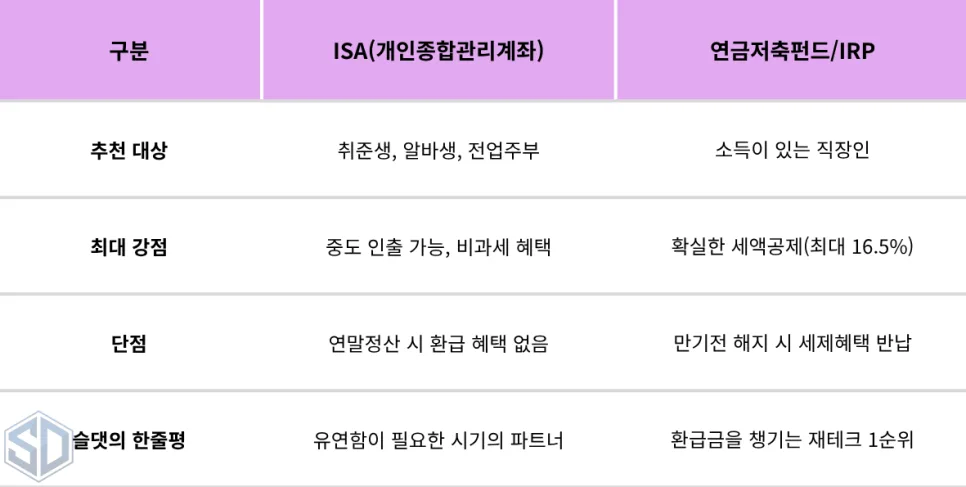
For those just starting their careers, earning a modest income, or planning for significant expenses in the near future (like a wedding, down payment, or new car), an ISA (Individual Savings Account) might be a more suitable choice. Unlike pension accounts, ISAs don't offer tax credits but provide tax-exempt or low-tax benefits on investment gains. Crucially, after a mandatory 3-year holding period, you can withdraw your principal funds freely without penalty. This flexibility is invaluable for life events requiring readily accessible cash, such as moving to a new apartment or upgrading a family vehicle. For individuals facing potential unexpected expenses, an ISA offers a more practical way to manage funds compared to the locked-in nature of pension accounts.
ISA vs. Pension Savings: Pros, Cons, and Key Considerations
Both ISA and pension savings accounts offer distinct advantages and disadvantages, requiring careful consideration based on your personal financial situation. Pension savings accounts provide a clear tax credit benefit but restrict access to funds until retirement age (typically 55 or older). Conversely, ISAs offer less in tax credits but provide tax-exempt or low-tax growth on investments and the significant advantage of being able to withdraw your principal after three years. Therefore, it's crucial to evaluate your current income level, your need for year-end tax deductions, and your plans for accessing funds in the near future to determine which account best fits your goals. In some cases, utilizing both accounts strategically might be the optimal approach.
Common Mistakes When Choosing Between ISA and Pension Savings
A frequent mistake people make is blindly following others' success stories without assessing their own needs. For instance, a high-earning professional who could greatly benefit from pension tax credits might opt for an ISA solely for its flexibility, or an early-career individual needing accessible funds might choose a pension account for the tax benefits. Another common pitfall is failing to fully understand the terms and conditions, such as mandatory holding periods, early withdrawal penalties, and specific tax regulations. These missteps can lead to unexpected financial losses. Before opening an account, clearly define your financial situation and goals, and thoroughly understand each product's features. Consulting with a financial advisor is highly recommended to ensure you make the best choice for your unique circumstances.
For more details, check the original source below.