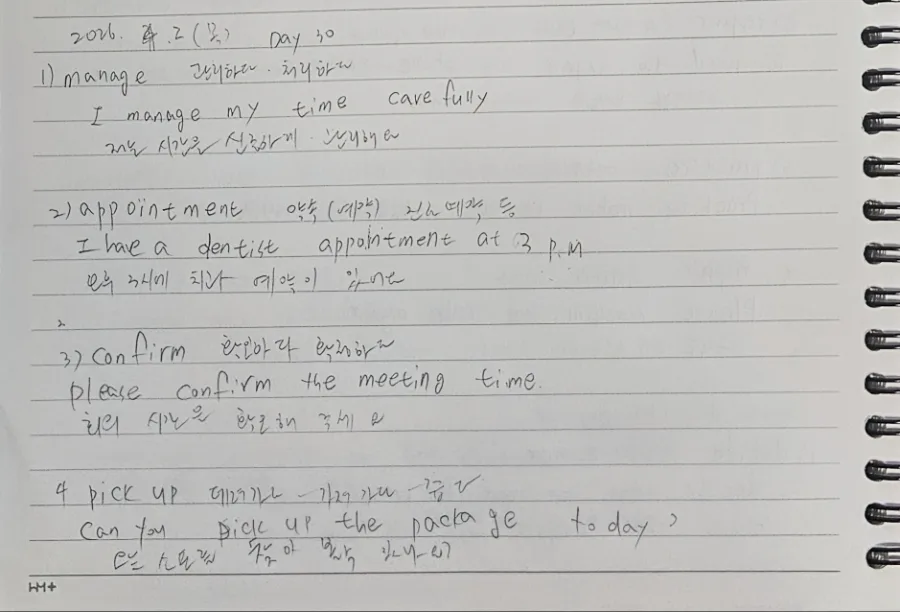

Want to effectively master essential English words for 2026? This guide breaks down five key vocabulary terms—manage, appointment, confirm, pick up, and explore—with clear definitions, memorable tips, and practical example sentences to boost your English fluency.
How to Learn Essential English Words for 2026: A Proven Method

Consistent vocabulary building is the cornerstone of improving your English. Even dedicating a short amount of time daily to learning and reviewing new words can yield significant long-term benefits. If you're aiming to elevate your English skills in 2026, focusing on high-frequency words used in everyday life is crucial. Today, we'll dive into five essential words: manage, appointment, confirm, pick up, and explore, providing examples and memorization tips to enhance your learning efficiency. Understanding the precise meaning and nuances of each word, and how they function in real sentences, is key. By following along, you'll undoubtedly see great results. For instance, 'manage' can mean more than just 'to handle'; it can also imply 'to succeed in doing something,' making context vital for accurate understanding.
Understanding 'Manage' and 'Appointment' in English
Let's start with 'manage.' This word is most commonly used to mean 'to handle' or 'to be in charge of.' For example, 'I manage my time carefully' illustrates its use in contexts like time management or task execution. A helpful memorization tip is to associate 'manage' with successfully handling daily responsibilities. Next, we have 'appointment,' which signifies a 'scheduled meeting' or 'reservation.' It's frequently used for specific arrangements like a doctor's visit. An example is, 'I have a dentist appointment at 3 p.m.' Understanding its root, 'appoint' (to designate), can help you remember it signifies a 'set meeting.' This connection aids in recalling its meaning more easily.
Mastering 'Confirm' and 'Pick Up': Nuances and Usage
'Confirm' means 'to verify' or 'to make certain.' It's useful for re-checking details like meeting times or reservations. 'Please confirm the meeting time' is a practical application. You can quickly get familiar with this word by using it in sentences, perhaps alongside terms like 're-' prefixes or the verb 'check.' Next, 'pick up' is a versatile phrasal verb with several common meanings. Most frequently, it means 'to collect someone' or 'to retrieve/gather an item.' For instance, 'Can you pick up the package today?' demonstrates its use. Since its meaning can shift based on context, practicing with the two main scenarios—collecting a person and retrieving an item—is essential. Phrasal verbs like this require careful attention to context for accurate comprehension.
'Explore': Meaning and Related English Expressions for Better Recall
Finally, let's look at 'explore.' Beyond 'to venture into' or 'to investigate,' this word also means 'to look into new things.' For example, 'I want to explore new hobbies this month' shows its use when seeking new experiences or activities. To better grasp 'explore,' try associating it with words like 'travel' or 'try.' This linkage can expand its application. For instance, you can 'explore a new city' or 'explore new possibilities,' showcasing its diverse usage. Learning related words in this manner is a highly effective strategy for broadening your vocabulary.
Common Pitfalls in English Vocabulary Learning and How to Avoid Them
A common mistake many English learners make is memorizing word definitions without understanding how they are used in actual sentences. This is particularly true for phrasal verbs like 'pick up,' which can be easily misused without context. Another oversight is neglecting pronunciation practice. Correct pronunciation not only improves listening comprehension but also boosts speaking confidence. Therefore, it's crucial to read example sentences aloud and learn the usage of words in various situations. For challenging words, create your own mnemonic devices or group them with related terms. By establishing a consistent review routine, you can prevent these common errors and maximize your learning effectiveness.
For more details, check the original source below.





