
Mastering just five English words daily can significantly boost your fluency by 2026. This guide provides practical methods, including specific example sentences and a quick review routine, to effectively learn and use essential vocabulary like 'schedule,' 'remind,' 'grocery,' 'energy,' and 'calm' in real-life situations.
Unlock English Fluency: The 5-Minute Daily Word Mastery Method

Consistency is key in language learning. Dedicate just five minutes each day to master five essential words that remain relevant in 2026. Moving beyond simple definitions, it's crucial to grasp the nuances and practical applications of these words through example sentences. For instance, 'schedule' isn't just a noun meaning 'plan'; it can also function as a verb, 'to schedule,' highlighting the importance of understanding context. This guide offers effective memorization tips and real-world examples for each word, maximizing your learning efficiency.
Consistent practice transforms short-term memory into long-term retention. Establish a daily routine, even if it's brief, for reviewing vocabulary. Speaking words aloud, including their pronunciation, greatly aids accurate English enunciation. Memory techniques, such as understanding word origins or associating words with personal experiences, make learning more engaging and effective. For example, breaking down 'remind' into 're-' (again) and 'mind' (to place in one's thoughts) helps connect it to the meaning of 'to recall' or 'to prompt someone,' making it easier to remember.
Mastering Real-Life English: 'Schedule' and 'Remind' in Action
Related Articles
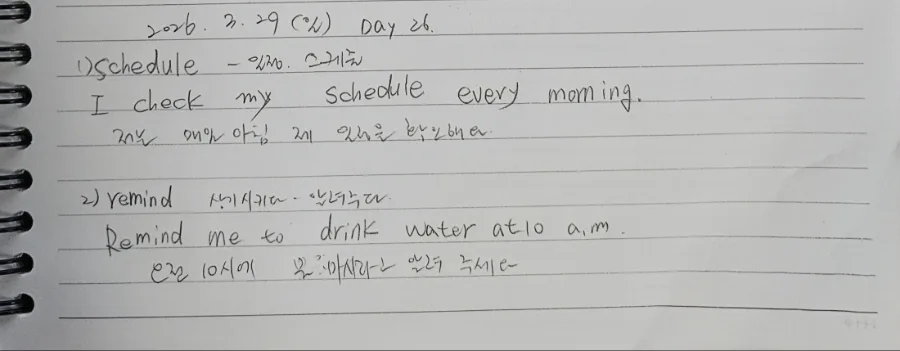
'Schedule' and 'remind,' frequently used in daily life, require a clear understanding of their meanings and contexts. As a noun, 'schedule' refers to a plan of times and events, while as a verb, it means 'to arrange or plan something.' For example, 'I check my schedule every morning' demonstrates its use in planning. 'Remind' means 'to cause someone to remember something' or 'to prompt.' A practical application is: 'Remind me to drink water at 10 a.m.' Mastering these words will significantly enhance your English communication skills.
Understanding Essential Words: 'Grocery,' 'Energy,' and 'Calm' in Context
'Grocery' pertains to food items or a place where they are sold. You might say, 'I need to buy groceries for dinner,' indicating a trip to the supermarket. 'Energy' refers to vitality or the power to do things, whether physical or mental. 'I have more energy after a good breakfast' illustrates its use in describing one's state of being. Finally, 'calm,' an adjective, describes a state of being tranquil or free from agitation. The phrase 'Take a deep breath to feel calm' is a perfect example of its application in managing stress. These words are highly useful in everyday conversations, making them essential for learners.
The 5-Minute Review Routine: Maximizing Vocabulary Retention
To solidify your learning of these five words, implement this effective 5-minute review routine. For the first minute, say each word, its pronunciation, and its definition aloud to engage your senses. In the second minute, read the example sentences aloud to understand their usage in context. During the third minute, test yourself by looking at the word and recalling its meaning. The fourth minute involves filling in blanks in sentences with the target words to reinforce recall. Finally, dedicate the last minute to reviewing any words you found particularly challenging, using memorization tips. Consistently following this routine will significantly boost your vocabulary acquisition.
Frequently Asked Questions (FAQ)
Q1: What is the exact meaning of 'energy'?
A1: 'Energy' refers to vitality or the power to do things, encompassing both physical and mental vigor. For example, you might feel more energy after adequate rest.
Q2: What word fits in the blank: "Take a deep breath to feel ___."?
A2: The word that fits the blank is 'calm.' 'Calm' means peaceful or not agitated, describing a state of mental tranquility often achieved through deep breathing.
Q3: Are there any memorization tips for the word 'remind'?
A3: Yes, you can break down 'remind' into 're-' (again) and 'mind' (to place in one's thoughts). This helps connect it to the meaning of 'to bring back to mind' or 'to prompt someone,' making it easier to remember. Practicing with example sentences further enhances understanding.
Q4: In what situations is 'grocery' used?
A4: 'Grocery' refers to food items or a store selling them. It's commonly used in contexts related to shopping for food, such as 'going to buy groceries for dinner.'
Q5: What is the most crucial aspect of learning English vocabulary?
A5: The most important aspects of vocabulary learning are consistency and practical application. Regular, even brief, review sessions and understanding word usage through examples are vital. Incorporating pronunciation practice and personal memorization techniques can also significantly improve learning outcomes.
Discover more English learning tips in the original article.





