The KnK English learning method aims to help children acquire English naturally, just like they learn their native language. This approach is grounded in the science of language acquisition, focusing on understanding English as a language rather than a subject to be studied. In 2026, this method remains a key strategy for effective English proficiency development.
How the KnK Method Applies Native Language Acquisition Principles

Children naturally acquire their mother tongue by being exposed to sounds and language from birth. From around six months of gestation, they begin to distinguish the rhythm and intonation of speech. After birth, they differentiate vowels and consonants and learn the typical sequence of language development. By three months, they start babbling, and between six to nine months, they can discern meaning through subtle phonetic differences, utilizing the statistical patterns of their native language. By nine months, their babbling can even indicate which language they are learning. Around one year old, they begin to understand word meanings and produce accurate pronunciations. After 1 year and 9 months, they start speaking in two-word phrases, and by two years, their ability to combine words into sentences explodes. The KnK method applies these native language acquisition stages to English learning, guiding children to embrace English as a 'living language' rather than 'study material.' This approach boosts interest in learning English and contributes to long-term language proficiency.
English Learning Environment: The Difference Between 'Study' and 'Language' Perception
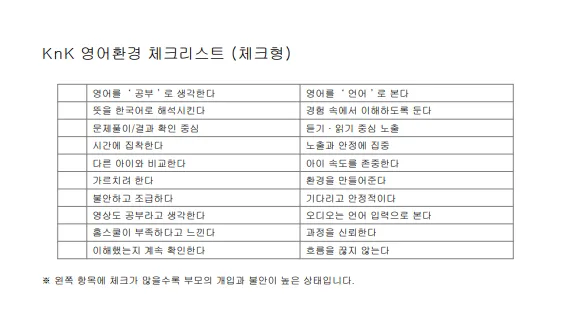
The KnK method highlights the crucial difference between perceiving English learning as 'study' versus 'language.' When English is seen as 'study,' children tend to focus on Korean translations, problem-solving, and outcome-focused activities, often fixating on 'how many hours' they've studied. They may also feel anxious comparing themselves to others. Conversely, when English is perceived as a 'language,' children understand meaning within context, are naturally exposed through listening and reading, and value consistent exposure and a sense of security. Respecting a child's pace and creating an environment where they can absorb English is paramount. Utilizing audio content as 'language input' and focusing on the process rather than the outcome, with parental trust and observation, is the core of the KnK philosophy. This environment helps children embrace English more easily and joyfully.
What Are the Core Principles of the KnK Method and Its Benefits?
The core principle of the KnK English learning method is to apply native language acquisition principles to English learning, enabling children to acquire English naturally as a language. This isn't about rote memorization of words or grammar rules; instead, it mimics the natural process by which children absorb and use language. The most significant benefit of this method is that children can participate in learning English with enthusiasm and without resistance. Furthermore, it fosters a long-term perspective where English is seen as a 'lifelong usable language,' effectively improving real communication skills. KnK utilizes patented learning methods to support this process, helping children follow the natural flow of language acquisition.
What Should Be Considered When Applying the KnK English Learning Method?
To effectively apply the KnK English learning method, several points require attention. Firstly, parents should avoid transferring their own impatience or anxiety to their children. Since language acquisition speed varies among children, it's crucial to respect their individual pace rather than comparing them to others. Secondly, focus on creating an environment where English is perceived as a 'language,' not 'study.' Prioritize natural exposure to English through various content over simply logging study hours, and help children absorb English within a context they understand. Lastly, parents should act as observers and encouragers rather than direct instructors. By keeping these considerations in mind, children can acquire English more effectively through the KnK method.
Discover more details about the KnK English learning method in the original article.





