
Mastering essential English vocabulary is crucial for fluency, and a focused 5-minute daily routine can significantly boost your word retention. This guide presents a 2026-updated strategy to learn five key English words—'awaken', 'ritual', 'nourish', 'clarity', and 'commit'—efficiently. By understanding their meanings, context, and applying a structured review method, you can enhance your English vocabulary quickly and effectively.
How to Master 5 English Words in Just 5 Minutes?
Consistent daily study is the quickest path to improving your English vocabulary. Even short, focused review sessions can make a big difference in long-term memory. Today, we're focusing on five powerful words: 'awaken', 'ritual', 'nourish', and 'commit'. We'll break down a specific 5-minute strategy designed for maximum retention. This method is favored by many learners for its efficiency and practical application. We'll cover the precise definitions, example sentences, and handy memorization tips for each word to ensure you truly grasp their usage.
Understanding 'Awaken', 'Ritual', and 'Nourish'
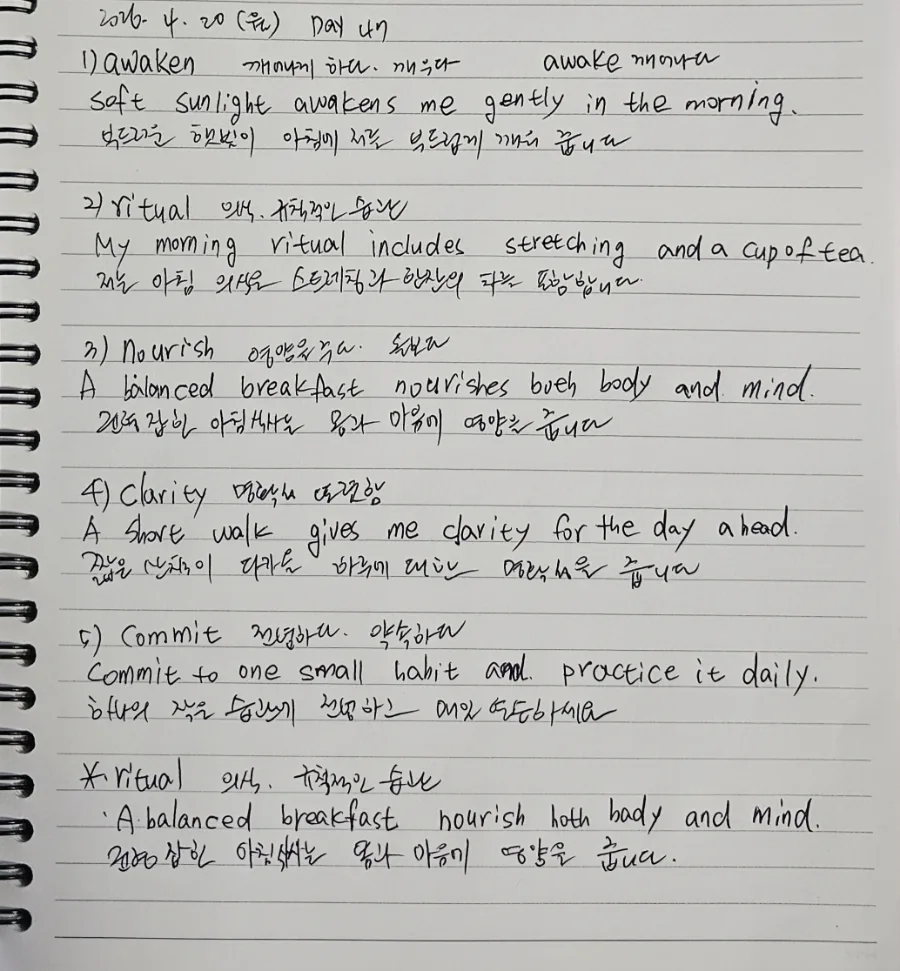
'Awaken' is a verb meaning 'to wake up' or 'to cause to become aware.' Think of it like this: 'Soft sunlight awakens me gently in the morning.' This paints a picture of waking up naturally. 'Ritual' refers to a 'ceremony' or a 'regularly followed procedure or habit.' For example, 'My morning ritual includes stretching and a cup of tea.' This highlights a consistent, almost ceremonial, daily habit. 'Nourish' means 'to provide with the food or other substances necessary for growth, health, of life; to sustain or foster.' A great example is, 'A balanced breakfast nourishes both body and mind.' This emphasizes how good food sustains you. Connecting these words to everyday actions and experiences makes them much easier to remember and use.
Mastering 'Clarity' and 'Commit' with Context
'Clarity' is a noun meaning 'the quality of being clear and easy to understand.' It's derived from the adjective 'clear.' Consider the sentence: 'A short walk gives me clarity for the day ahead.' This illustrates how a brief activity can lead to clear thinking. 'Commit' is a versatile verb meaning 'to pledge oneself to a course of action' or 'to dedicate.' An example is, 'Commit to one small habit and practice it daily.' This encourages dedication to a consistent practice. Understanding these words in the context of personal goals, clear thinking, and daily habits makes them more impactful and memorable for English learners.
Common Mistakes to Avoid in English Vocabulary Learning
A frequent pitfall for English learners is memorizing word definitions without understanding their context. Words gain their true meaning and power when used in sentences. Therefore, always study vocabulary with example sentences. Another common mistake is neglecting pronunciation; without correct pronunciation, using a word in conversation becomes challenging. For words like 'awaken,' understanding its relationship to 'awake' helps. When you encounter a word you've studied before, like 'nourish,' treat it as a valuable review opportunity. The key to effective learning is consistency—dedicate a short, set amount of time each day. This structured approach, focusing on meaning, context, and pronunciation, prevents common errors and builds a stronger vocabulary foundation.
For a detailed 5-minute review routine and quiz, check the original source below.





