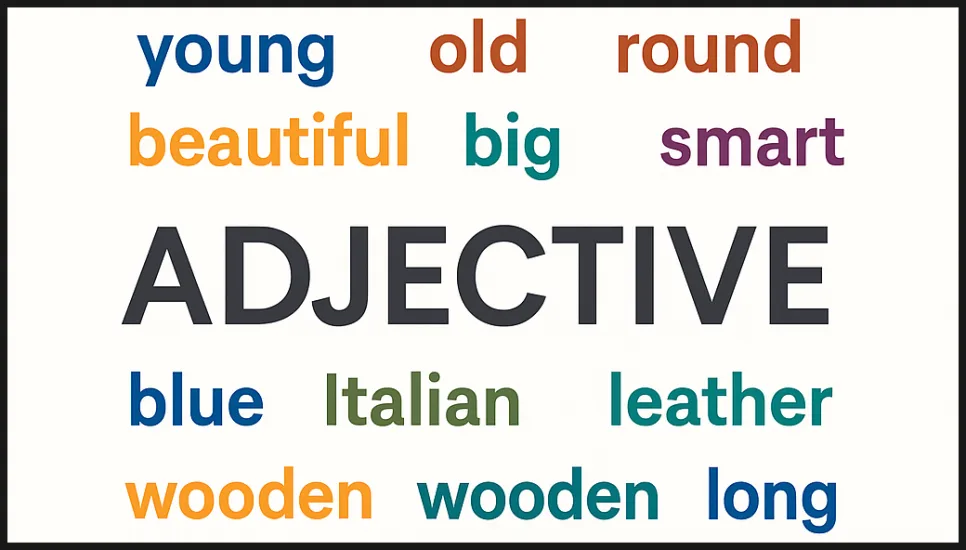
Confused about when to use commas or a specific order when stringing together multiple English adjectives? Mastering English adjective order is key to clear and natural-sounding sentences. The 2026 updated rules dictate that adjectives from the same category are separated by commas or 'and,' while adjectives from different categories follow a strict, established sequence.
When Adjectives Are in the Same Category: Using Commas and 'And'
Many English learners struggle with the correct usage of commas and 'and' when listing adjectives. If all the adjectives in your list belong to the same category—for instance, all expressing opinion—you should separate them with commas or use 'and' before the final adjective. For example, you can write 'a smart, funny, confident girl' or 'a smart, funny, and confident girl.' Using commas or 'and' in these cases is crucial for clarity and proper expression.
What's the Correct Order for Adjectives from Different Categories?

When adjectives come from different categories, you should list them without commas or 'and,' strictly following a predetermined order. This order is generally: opinion → size → age → shape → color → origin → material → purpose. For instance, 'a beautiful big old red Italian leather handbag' exemplifies this rule. Here, 'beautiful' (opinion), 'big' (size), 'old' (age), 'red' (color), 'Italian' (origin), and 'leather' (material) each belong to a different category and are listed sequentially without any connecting words. Adhering to this sequence allows for more natural and accurate English phrasing.
Common Mistakes and Pitfalls in Adjective Order
The most frequent errors learners make include using commas between adjectives from different categories, such as writing 'a big, red, Italian handbag,' which sounds unnatural because 'big' (size) and 'red' (color) are distinct categories. Another common mistake is overusing 'and,' like in 'a smart and confident and funny girl.' It's essential to maintain the correct order. If you find the sequence confusing, practice identifying the category each adjective belongs to. Paying attention to these details will significantly enhance your English writing skills.
Why Does Adjective Order Matter, and How Can You Practice?
The order of adjectives in English is vital for sentence clarity and natural flow. Deviating from the standard sequence can distort meaning or make sentences sound awkward. The most effective way to master this rule is by encountering and actively using various examples. Try constructing sentences by combining adjectives from different categories, such as 'a small round blue plastic toy.' Observing how adjectives are used in English books, articles, or even song lyrics can also provide valuable insights and reinforce your understanding.





