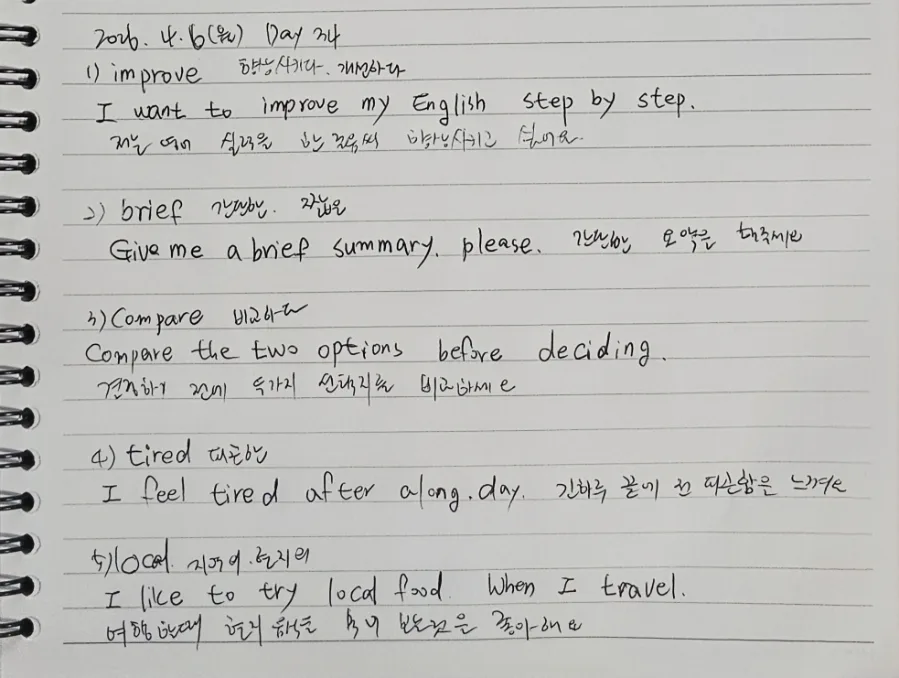

Want to master 5 essential English words quickly and effectively? This guide reveals a fun and easy memorization technique and a 5-minute review routine for 2026, focusing on 'improve,' 'brief,' 'compare,' 'tired,' and 'local.' Boost your English skills with just a few minutes of daily practice.
How to Master 5 English Words in Just 5 Minutes

Consistent English study is a fantastic goal, and even busy schedules can accommodate short, focused review sessions that lead to real improvement. Today, we'll dive into memorizing five key words: 'improve,' 'brief,' 'compare,' 'tired,' and 'local.' These words are frequently used in everyday conversations and professional settings, making them invaluable additions to your vocabulary. We'll share practical, experience-based methods to help you lock them into your memory effectively.
Understanding 'Improve,' 'Brief,' and 'Local'
Let's start with the core meanings and pronunciation. 'Improve' means 'to make better or enhance.' You can use it like, 'I want to improve my English step by step,' expressing a desire for gradual skill development. Think of 'im-' as 'more' and 'prove' as 'making something good' to remember its meaning. 'Brief' signifies 'short or concise.' It's often used when requesting a summary, such as, 'Give me a brief summary, please.' It's perfect for when you need to shorten time or simplify content.
Memorizing Words for Comparison, Fatigue, and Locality
'Compare' means 'to examine or note the similarities and differences between things.' A great way to practice is by saying, 'Compare the two options before deciding,' emphasizing the importance of weighing choices. Visualizing the act of comparing two items can aid recall. 'Tired' describes the feeling of needing rest or sleep, as in, 'I feel tired after a long day.' Understanding its root 'tire' (to make weary) helps solidify its meaning. Finally, 'local' refers to 'belonging to or relating to a particular area.' It's commonly used when discussing experiences, like 'I like to try local food when I travel,' highlighting an interest in regional cuisine. Associating 'local' with 'travel' can boost its practical application.
Creating an Effective 5-Minute English Word Review Routine
To truly master these words, developing a personalized review routine is key. Simply memorizing definitions isn't as effective as engaging with the words in different ways. Try saying the words and their meanings aloud, practicing with example sentences, or using flashcards for quick quizzes. These methods deepen your understanding and improve your ability to use the words in real-life situations. Consistency is crucial, so find a routine that works for you and stick with it.
Key Considerations for English Word Review
When reviewing English vocabulary, keep a few things in mind. First, avoid overwhelming yourself by trying to memorize too many words at once. Focusing on a small set of essential words, like the five discussed here, and reviewing them consistently is more productive. Second, go beyond just memorizing definitions; understand how each word functions within various sentences and contexts. This contextual learning is vital for natural conversation and writing. Third, don't neglect pronunciation practice. Clear pronunciation builds confidence and ensures effective communication. Finally, leverage personal memorization tricks or associations to make the learning process more enjoyable and effective.
Benefits of the Daily 5-Minute Review Routine
The 5-minute review routine outlined here provides a structured approach: learn the meaning and pronunciation, practice with example sentences, and test your recall through quick quizzes. Spend a minute saying the word and its definition aloud, another minute repeating example sentences, and another practicing recall by looking at the word and stating its meaning or vice versa. You can also use a minute for fill-in-the-blank exercises or to focus on words you find particularly challenging. Consistently applying this routine allows for significant vocabulary improvement with minimal time commitment.
For more details, check the original source below.





