
Starting May 27, 2026, single-stock leveraged and inverse ETFs/ETNs will become available, offering the potential for high returns but also carrying significant risks like negative compounding and leverage effects that can lead to rapid losses. Investors must exercise extreme caution.
What Are Single-Stock Leveraged & Inverse ETFs/ETNs? (2026 Launch Info)
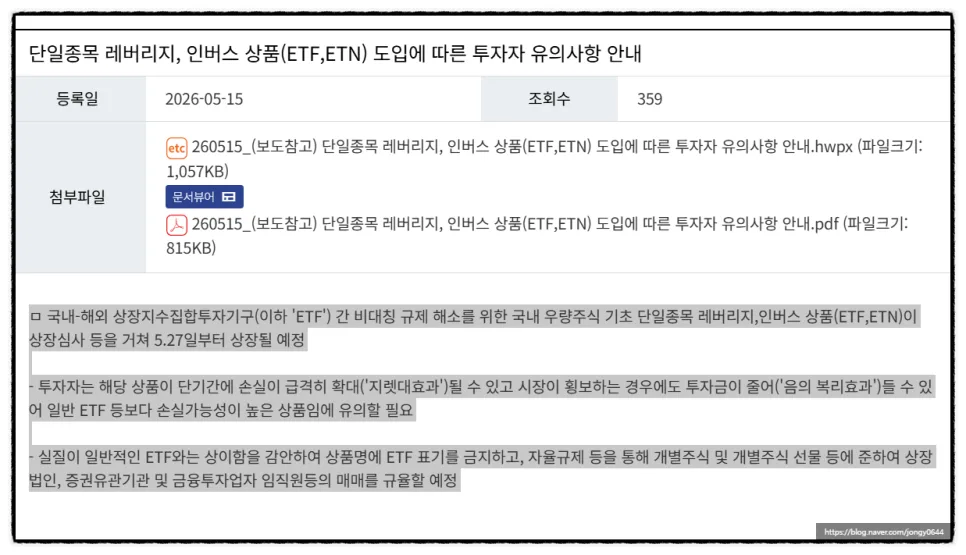
Single-stock leveraged and inverse ETFs/ETNs are designed to track the daily performance of a specific stock. Leveraged products aim to multiply a stock's daily returns (e.g., 2x or 3x), while inverse products aim to profit from its decline. These instruments are set to launch in the US on May 27, 2026, as part of efforts to harmonize regulations with international markets and boost domestic capital markets. Previously, US investors faced limitations on such products due to diversification requirements. This regulatory shift, driven by the SEC, aims to make these products more accessible to US investors, mirroring offerings already popular in markets like the US and Hong Kong, and to retain capital within the domestic ETF market.
What Is the 'Leverage Effect' Risk with Leveraged Single-Stock Products?
The primary characteristic of single-stock leveraged products is the 'leverage effect.' This means the product's daily return is a multiple of the underlying stock's daily return. Consequently, if the stock price moves against the investor's position, losses can be magnified significantly and rapidly. Considering the typical daily price limits in the US market (often around ±20% for ETFs, though individual stock limits can vary), a 10% drop in the underlying stock could theoretically lead to a 20% loss in a 2x leveraged ETF. In extreme scenarios, losses could approach 60% in a single day. For example, if a stock drops 10%, a 2x leveraged ETF tracking it would likely fall around 20%. Investors must be fully aware of this potential for rapid and substantial asset value decline.
Understanding Negative Compounding and How It Erodes Principal
Another significant risk associated with single-stock leveraged and inverse products is 'negative compounding.' This phenomenon occurs when the underlying asset's price fluctuates, even if it ends up back at its starting point over a longer period. In such scenarios, the value of the leveraged product can steadily decrease. For instance, imagine an underlying asset drops 20% (from $100 to $80) and then recovers 25% (back to $100). While the asset is breakeven, a 2x leveraged product would have dropped 40% (to $60) and then gained 50% (to $90), resulting in a net 10% loss. Real-world examples from international markets have shown leveraged ETFs losing value even when their underlying assets posted positive annual returns. Therefore, these products are best suited for very short-term trading strategies.
Key Risks and Considerations for Single-Stock Leveraged/Inverse ETFs/ETNs
Investing in single-stock leveraged and inverse products requires careful consideration of several key risks. High volatility is inherent, amplified by the leverage effect which can cause swift and severe losses. The negative compounding effect can erode your principal over time, even if the underlying asset doesn't move significantly. Furthermore, investors should be aware of potential tracking errors, where the ETF's market price deviates from its Net Asset Value (NAV) due to supply and demand dynamics. These products are complex and generally not suitable for buy-and-hold investors. They are best utilized by experienced traders with a deep understanding of their mechanics and risks, and only for short-term tactical plays.
This is not financial advice. Consult a licensed financial advisor before making any investment decisions.





