Curious about where South Korea's massive National Pension Service (NPS) is investing? As of February 2026, the NPS manages a staggering $1.2 trillion USD (1,610.4 trillion KRW) in assets. This analysis breaks down its stock portfolio, revealing the top domestic and international holdings, investment strategies, and what US investors can learn.
How is the National Pension Service (NPS) Portfolio Structured?
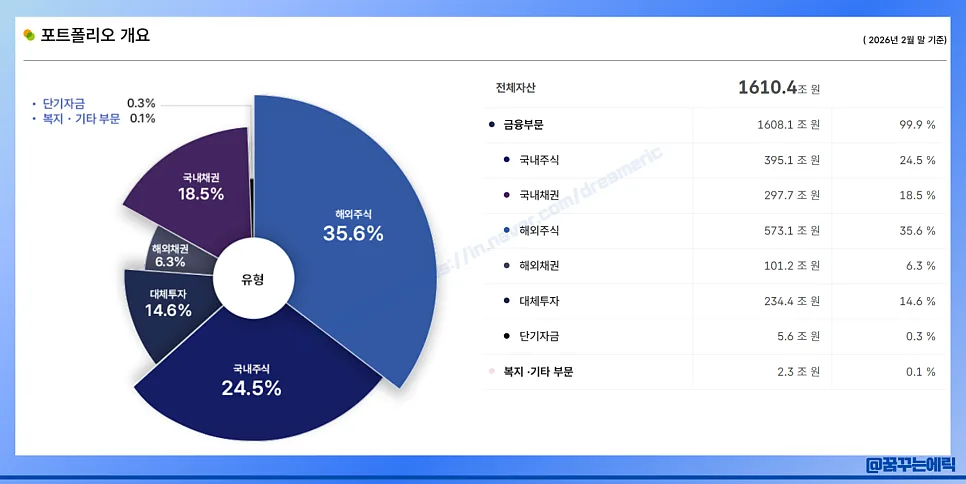
The NPS portfolio is designed to ensure the stable provision of future pensions for its contributors. The Fund Management Committee oversees asset allocation, with preliminary monthly operational scale and asset class proportions publicly available. Detailed holdings are disclosed annually, with a time lag, typically in the third quarter of the following year. As of February 2026, the total managed assets reached approximately $1.2 trillion USD (1,610.4 trillion KRW). To mitigate risk and enhance long-term returns, the NPS is increasingly diversifying into overseas assets. Currently, the asset allocation breaks down as follows: overseas stocks (35.6%), domestic stocks (24.5%), domestic bonds (18.5%), alternative investments (14.6%), and overseas bonds (6.3%). This strategic allocation aims for sustainable fund growth over the long haul.
What Are the NPS's Top 10 Domestic Stock Holdings (as of late 2024)?
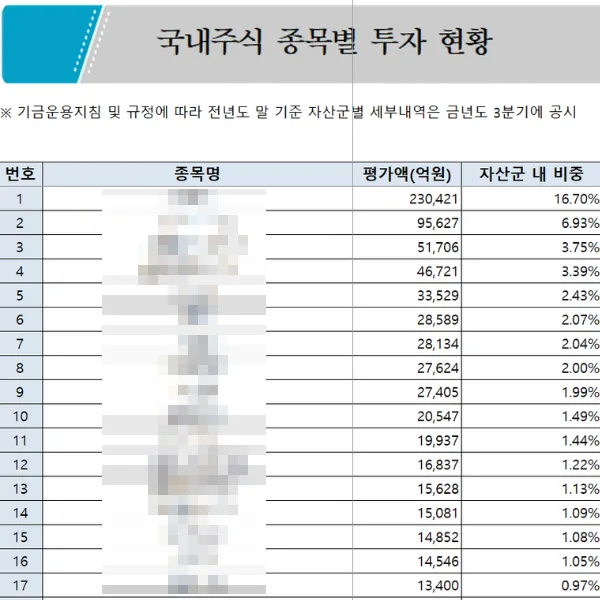
Based on the latest available public disclosures from late 2024, Samsung Electronics stands as the undisputed top domestic holding for the NPS, valued at approximately $17.3 billion USD (23.02 trillion KRW). This single stock represents a significant 16.7% of the NPS's domestic stock portfolio. Following Samsung, SK Hynix is the second-largest holding at about $7.2 billion USD (9.56 trillion KRW), with LG Energy Solution and Samsung Biologics also featuring prominently, valued at roughly $3.9 billion USD (5.17 trillion KRW) and $3.5 billion USD (4.67 trillion KRW) respectively. Other major companies like Hyundai Motor, Kia, and Naver are also part of the top holdings. Given the stock performance of Samsung Electronics and SK Hynix since late 2024, their current valuation within the NPS portfolio is likely even higher, underscoring the fund's focus on large-cap, blue-chip Korean companies.
Which Overseas Tech Giants Does the NPS Invest In?
In its international stock portfolio, the NPS heavily favors leading US tech giants. Apple holds the top position with an estimated value of $15.5 billion USD (20.63 trillion KRW). NVIDIA follows closely at approximately $13.5 billion USD (17.95 trillion KRW), with Microsoft rounding out the top three at about $12.4 billion USD (16.50 trillion KRW). Notably, the Invesco MSCI USA ETF ranks sixth with an investment of roughly $4.6 billion USD (6.11 trillion KRW). This ETF alone accounts for a substantial 54.2% of the NPS's total overseas stock investments, demonstrating a strategic blend of direct stock picking in major tech firms and broad diversification through ETFs. As the NPS continues to increase its overseas allocation, investments in global tech leaders and diversified ETFs are expected to remain a core strategy.
What Should US Investors Consider About the NPS Portfolio?
It's important to note that real-time tracking of the NPS's specific stock holdings is not possible. Due to fund management guidelines, detailed holdings are disclosed only once a year, with a significant time lag, typically in the third quarter of the following year. However, monthly updates on the total scale and asset class proportions are available on the NPS Fund Management Committee's website. Furthermore, simply mirroring the NPS's investment choices does not guarantee profits for individual investors. The NPS operates with a long-term, diversified investment horizon, which differs from the short-term trading perspectives of many retail investors. While the NPS's investment trends can serve as a valuable reference point, they are not a substitute for personalized investment strategies. The shift towards a higher overseas stock allocation (35.6% vs. 24.5% domestic as of February 2026) reflects a strategy for stable performance and risk diversification. US investors can gain insights from this approach, but should always align investment decisions with their personal financial goals and risk tolerance.
English crawl path
Next English reads from this pilot cluster
Continue through the category hub, latest English stories, and related posts so this translated article is not an isolated URL.
Tags
💬Frequently Asked Questions
What should I check first in National Pension Service Portfolio 2026: Top Holdings Analysis?
Does this Finance article link back to the Korean source?
Where can I find similar English stories?
English discovery path
Explore more English K-culture stories
Keep browsing the indexed English pilot cluster so Google and readers can move between this story, the category hub, and fresh discovery pages.
Original Source
Read the Korean original





