Investing in Korea's National Growth Fund requires meeting specific eligibility criteria, including being over 19 (or a working minor over 15) and not having been subject to comprehensive financial income tax in the past three years. This fund offers significant tax advantages, such as up to a 40% income deduction on contributions and a preferential 9% separate taxation on dividend income, making it an attractive option for long-term investors. The fund is accessible through dedicated accounts at 25 partner banks and securities firms, with minimum investment amounts varying by institution.
What is the National Growth Fund and How Does It Differ from Regular Funds?
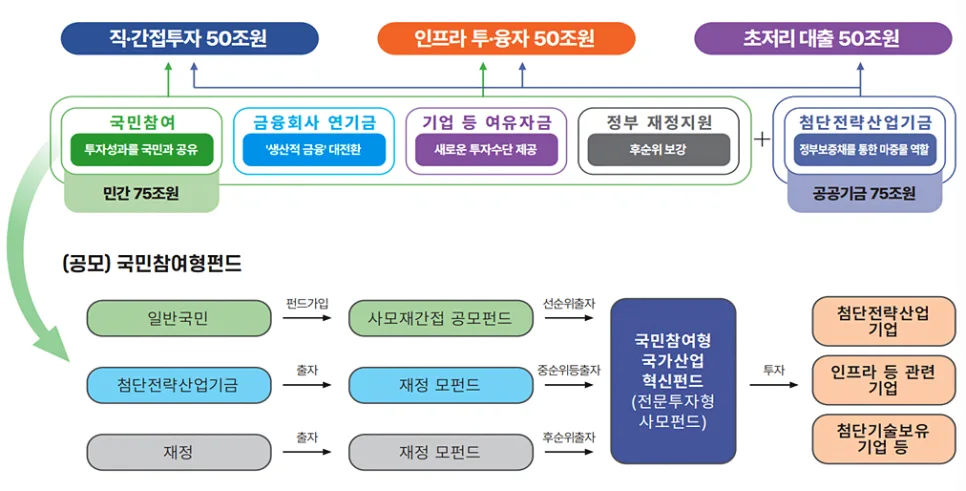
The National Growth Fund is a large-scale public-private financial initiative spearheaded by the Korean government, designed to invest in 12 strategic high-tech industries, including semiconductors, biotech, and AI. Unlike typical mutual funds, its defining characteristic is a 5-year lock-up period, meaning withdrawals before maturity are generally not permitted. It also features a unique 20% subordinate government financial backing structure, which absorbs initial losses, offering investors a degree of risk mitigation despite being classified as a Grade 1 investment product with potential for principal loss. Three asset management firms—Samsung Asset Management, Mirae Asset Management, and KB Asset Management—are managing a total of approximately $450 million (₩600 billion) in public participation funds. Investors will contribute to the same underlying portfolio regardless of the chosen manager. This fund is best suited for individuals who can commit their capital for the entire term, as liquidity is limited, and selling on an exchange after listing may incur losses.
What Are the Eligibility Requirements for the National Growth Fund?
To qualify for the tax benefits associated with the National Growth Fund, investors must meet several criteria. Firstly, at the time of investment, you must be at least 19 years old, or if you are 15 or older, you must have earned income from employment. Secondly, you must open a dedicated account specifically for the National Growth Fund, which is designed for these exclusive investments. Thirdly, you must not have been subject to comprehensive financial income tax assessment in any of the three tax years preceding the fund's launch year (2023, 2024, and 2025). Finally, you must commit to maintaining the fund contract for a minimum of three years to secure the tax benefits. Failure to meet these conditions means you can still invest but without the preferential tax treatment, with a maximum individual investment limit of $22,500 (₩30 million). Self-employed individuals and freelancers with earned income can also apply the deductions to their overall taxable income.
How Can I Invest in the National Growth Fund and Where is it Available?
The National Growth Fund can be accessed through a network of 25 partner banks and securities firms in Korea. The application process can be completed online or in person at these financial institutions. In addition to standard fund subscription documents, you may need to provide proof of income or relevant certifications. Crucially, opening a dedicated National Growth Fund account is mandatory to receive the tax benefits, so confirm this requirement when applying. Minimum investment amounts can vary by institution; for example, some banks may set a minimum of $750 (₩1 million). The list of participating financial institutions includes major commercial banks and securities firms. The fund began accepting subscriptions on May 22, 2026, so interested investors should act promptly to secure their investment, as popular funds can fill up quickly.
How Are the Tax Benefits Applied for the National Growth Fund?
The National Growth Fund offers significant tax advantages for eligible investors who meet the holding period requirements. The primary benefits include income tax deductions and separate taxation on dividend income. Investors who open a dedicated account and maintain their investment for at least three years can deduct up to 40% of their contributions from their taxable income, with an annual limit of $9,000 (₩12 million). Furthermore, any dividend income generated by the fund is taxed at a low rate of 9% separately from other income. This is particularly advantageous for individuals who might otherwise fall into higher tax brackets due to substantial financial income. For instance, those earning over $15,000 (₩20 million) in annual financial income can benefit from this separate taxation. It is essential to review the specific regulations and consult with a financial advisor to understand how these benefits apply to your individual tax situation.
What Are the Differences Between the 'Subordinate' and 'General' National Growth Fund Tiers, and What's the Investment Strategy?
The National Growth Fund is offered in two tiers: the 'Subordinate' (or 'Low-Income') tier and the 'General' tier. The Subordinate tier has a dedicated allocation of $90 million (₩120 billion) and is typically designed for investors with lower to moderate income levels, potentially involving stricter eligibility criteria related to income or asset size. The General tier is open to a broader range of investors and operates on a first-come, first-served basis without specific allocation limits. While both tiers invest in the same high-tech strategic industries, they differ in allocation size and subscription timelines. Investors should assess their financial standing and investment goals to choose the appropriate tier. If eligible for the Subordinate tier, it's advisable to apply there first. If unsuccessful or if the tier is fully subscribed, consider the General tier. Missing the subscription window means waiting until next year, so careful planning is key.
English crawl path
Next English reads from this pilot cluster
Continue through the category hub, latest English stories, and related posts so this translated article is not an isolated URL.
Tags
💬Frequently Asked Questions
What should I check first in Korea's National Growth Fund 2026: Tax Benefits & How to Invest?
Does this Finance article link back to the Korean source?
Where can I find similar English stories?
English discovery path
Explore more English K-culture stories
Keep browsing the indexed English pilot cluster so Google and readers can move between this story, the category hub, and fresh discovery pages.
Original Source
Read the Korean original