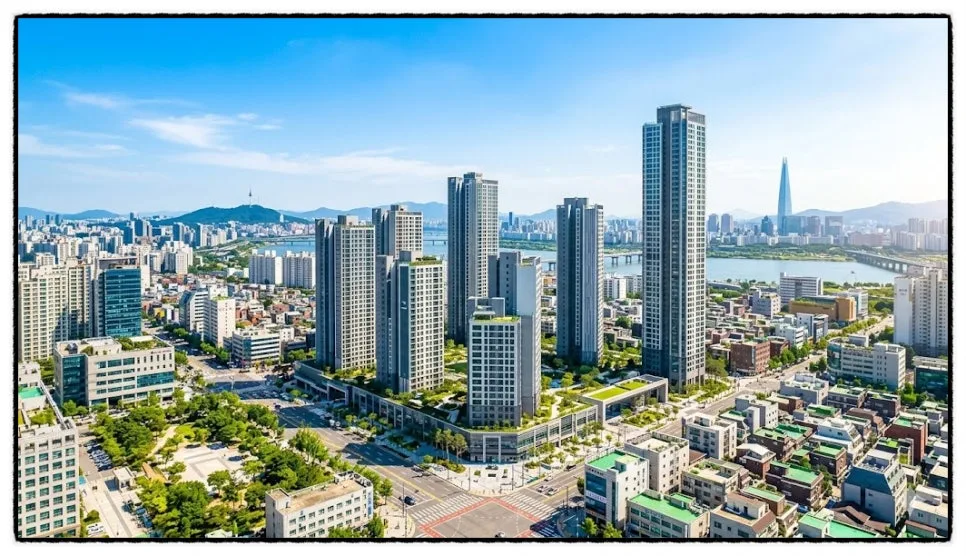

In 2026, a surge of 44 urban development projects across Seoul, including those in the prestigious Gangnam districts, signals a significant shift in the city's housing supply. This unprecedented participation is driven by the government's aggressive deregulation, offering enhanced zoning, relaxed donation requirements, and extended legal deadlines, making these projects highly attractive to residents.
Why Are 44 Seoul Districts Participating in the 2026 Urban Development Projects?

As of May 2026, amidst a widening real estate market polarization, the government-led 'Urban Public Housing Complex Project' (Urban Development Project) is injecting new vitality into Seoul's urban renewal sector. Unlike private redevelopment and reconstruction projects often bogged down by complex interests and construction cost disputes, this government initiative offers substantial incentives. This has led to an overwhelming response from residents in aging urban areas across Seoul. Notably, the participation of the Gangnam 3 districts (Gangnam, Seocho, Songpa), which have historically been hesitant towards public development, marks this initiative as a critical turning point that could reshape Seoul's new apartment supply landscape. Real estate experts anticipate this large-scale participation will bring about significant changes to the supply structure of the Seoul housing market.
Seoul Districts Submit Proposals for 60,000 Units Across 16 Districts
According to the Ministry of Land, Infrastructure and Transport, the public offering for urban development projects targeting Seoul, which closed on May 8, 2026, received resident proposals for 44 sites across 16 districts, totaling approximately 60,000 housing units. This figure significantly exceeds initial expectations, highlighting the strong desire among residents of Seoul's older urban areas for new apartments and improved living environments. Gangseo district submitted the most proposals with 7 sites, followed by Yeongdeungpo-gu with 6, Dongjak-gu with 5, and Eunpyeong-gu and Seocho-gu each with 4. Crucially, proposals were also received from Gangnam-gu and Songpa-gu, demonstrating that public development is emerging as a viable alternative to private housing initiatives. Of the 44 sites, 27 have a resident interest rate exceeding 30%, indicating strong resident commitment and organizational capacity for project advancement.
What Deregulation Measures Are Maximizing the Profitability of Urban Development Projects?
The primary catalyst for such widespread resident participation is the government's package of unprecedented deregulation and incentives. In contrast to private development projects facing challenges with high construction costs and regulatory hurdles, the Urban Development Project offers the following advantages. Firstly, the scope for applying relaxed zoning (floor area ratio) has been significantly expanded. This now extends beyond transit-oriented development zones to include areas within low-rise residential zones and commercial zones, allowing for an increase in the number of publicly offered units and reducing the additional financial burden on existing residents. Secondly, donation requirements have been eased. The criteria for securing parks and green spaces have been extended from sites over 50,000 square meters to those over 100,000 square meters, enabling more housing construction within the project area. Furthermore, the mandatory installation ratio for non-residential facilities has been reduced, boosting project profitability. Thirdly, the legal sunset clause has been extended by three years to the end of 2029, ensuring the continuity of the program and alleviating resident concerns.
What Should Be Considered When Pursuing Urban Development Projects?
While the Urban Development Project offers significant benefits, there are several factors to consider during its implementation. Firstly, resident participation is a critical element for project success. Although a resident interest rate exceeding 30% earns maximum points, low participation can lead to project difficulties. Therefore, thorough communication and consensus among residents are essential. Secondly, understanding the characteristics of different development types is crucial. For instance, 'Residential-Commercial High-Density Zones' for high-density development around transit hubs, 'Housing Supply Revitalization Zones' for developing aging residential areas, and 'Residential-Industrial Convergence Zones' for creating complex spaces in semi-industrial areas require tailored planning. Thirdly, continuous attention to government policy changes is necessary, as regulations and incentives related to urban development projects can be altered. Decisions regarding participation should be made cautiously based on individual financial situations and investment goals, and consultation with experts is recommended when necessary. This is not financial advice. Consult a licensed financial advisor.
For more details, check the original source below.





