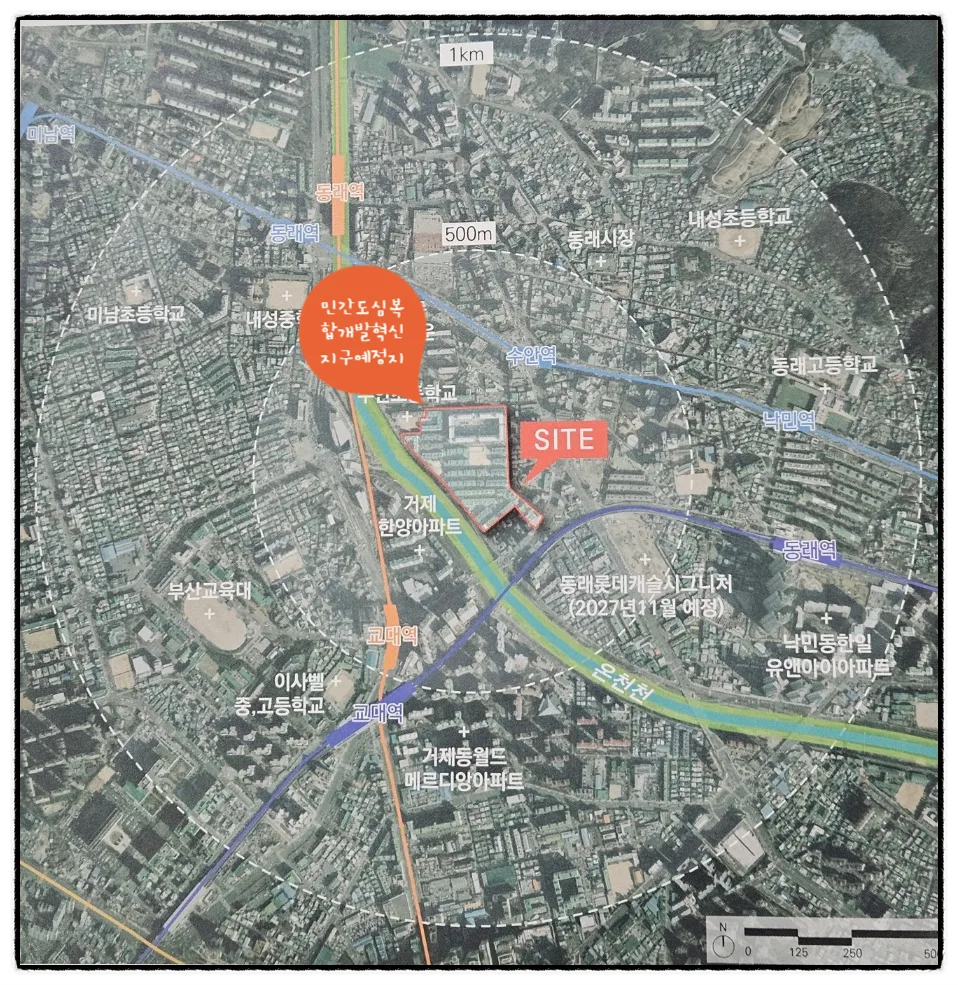
The private urban regeneration project around Suan Station in Busan's Dongnae-gu district is a significant development to watch. Formerly known as the 'Suan 2 Reconstruction Zone,' this area is now emerging as a prime location for private urban regeneration, promising faster project timelines than traditional redevelopment. With new legislation set to streamline processes and offer density bonuses, the project's viability and potential value are significantly enhanced, making it a key focus for 2026.
Why Private Urban Regeneration is Faster Than Redevelopment
Traditional redevelopment projects in Korea often face lengthy delays due to numerous procedural steps, from establishing a promotion committee to obtaining final approvals. However, the new Private Urban Regeneration Support Act, fully effective from early 2025, introduces a more efficient model. This system facilitates integrated reviews, simplifies permits, centralizes project management with a trust company, and offers density incentives. My analysis indicates that this acceleration in project timelines is a critical factor in maximizing profitability, as 'time' is paramount in the competitive real estate development market. This is a very positive signal in an industry where delays can be more detrimental than any other issue.
Suan Station Area: Prime Location for Urban Regeneration
The Suan Station area in Suan-dong, Dongnae-gu, Busan, is strategically located near Suan Station on Busan Subway Line 4, fulfilling a key requirement for private urban regeneration: proximity to a subway station (within 500 meters of the platform). It sits at the heart of the Dongnae district, offering excellent access to essential infrastructure, including administrative services, commercial centers, schools, and transportation networks. My assessment confirms that this area likely meets the criteria for aged building ratios exceeding 40% and a project site area of approximately 57,233 square meters (over 50,000 sq m minimum). Furthermore, with resident consent secured at approximately 72.7% by owner and 61.4% by area, the project's stability is exceptionally high, suggesting potential for a large-scale development akin to building a new town.
Korea Land & Housing Corporation's Role in Project Stability
Korea Land & Housing Corporation (LH) is participating as the prospective project implementer for this private urban regeneration initiative. LH possesses extensive experience and expertise in various urban development sectors, including redevelopment and reconstruction projects. In real estate development, the entity leading the project is often the deciding factor in its success. LH's involvement significantly bolsters the project's stability and execution capabilities. My findings suggest that LH's participation will enhance the project's transparency and efficiency, fostering investor confidence. However, as with all trust-managed projects, it's crucial to remain aware of potential shifts in specific terms during the development process.
Suan Station Urban Regeneration Roadmap for 2026 and Expected Benefits
According to publicly available information, the Suan Station private urban regeneration project is progressing through concrete administrative procedures, beginning with the preparation for the innovation district designation proposal submission in February 2026. The plan includes submitting the innovation district application and obtaining urban planning committee approval, followed by the innovation plan establishment and public announcement by December 2026. The target for project implementation approval is December 2027. If executed as planned, this project is expected to yield a large-scale development of approximately 2,060 units. This could create a new residential hub in the Dongnae area, revitalize local commerce, and increase foot traffic, leading to significant ripple effects. Investors are primarily interested in the project's speed, the rarity of large-scale development in a prime Dongnae station area, and the future value appreciation potential from a new 2,060-unit residential complex.
Key Considerations for Private Urban Regeneration Projects
While private urban regeneration projects offer advantages in speed and efficiency, there are several points to consider. Firstly, as this is an early-stage system, unforeseen variables may arise. Therefore, closely monitoring project progress and staying updated on relevant legal and policy changes is crucial. Secondly, disagreements or conflicts of interest among residents during the project's progression are possible. Ensuring transparency and fairness in the process is vital, making the role of professional entities like Korea Land & Housing Corporation even more critical. Lastly, as with all real estate investments, predicting future value has limitations, necessitating a cautious approach. It is recommended to consult with experts after carefully considering your personal investment profile and financial situation.
For more details, check the original source below.