
Many investors overlook Samyang Foods stock's potential as a defensive play during periods of high oil prices. As of 2026, Samyang Foods has surpassed the ₩1,340,000 (approximately $950 USD) mark, solidifying its position as a leading K-food stock.
What's Driving Samyang Foods' Stock Surge?
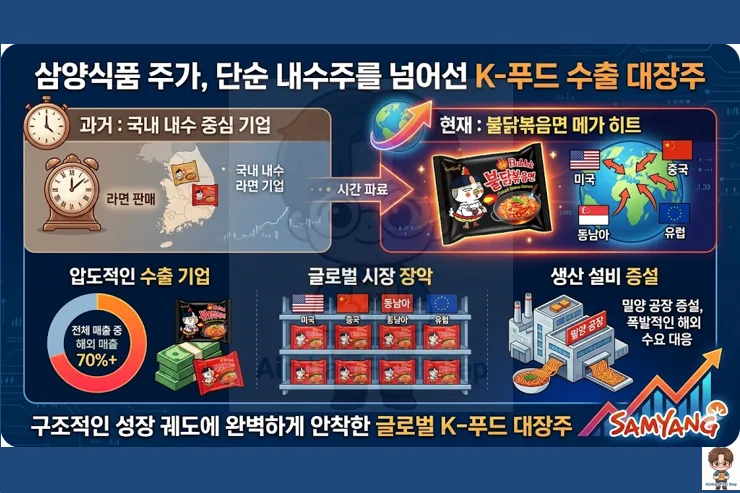
Samyang Foods' stock growth isn't solely based on domestic ramen sales. The company has transformed from a primarily domestic player into an export powerhouse, with its hit product 'Buldak Bokkeum-myeon' (Fire Noodles) generating over 70% of its total revenue from overseas markets. This global success, particularly in the US, China, Southeast Asia, and Europe, positions Samyang as a frontrunner for K-food exports. Strategic investments, such as expanding the Miryang plant to meet growing international demand, have laid a solid foundation for structural growth. This global competitiveness has cemented Samyang Foods' status as a leading K-food export stock, far beyond a simple food company.
Why is Samyang Foods a Defensive Stock in High-Oil and High-Inflation Eras?
Samyang Foods' appeal as a strong defensive stock during high oil and inflation periods can be explained by two key factors. Firstly, its products function as 'recession-resistant consumer goods.' Rising oil prices trigger global inflation, reducing consumers' real income. In such an environment, people tend to cut back on dining out and opt for more affordable yet satisfying meals like ramen. Samyang Foods' ramen offerings align perfectly with this 'recessionary consumption' trend, suggesting sustained demand. Secondly, the company benefits from a 'high-exchange-rate advantage.' During times of economic uncertainty and inflation, there's often a flight to safety, strengthening currencies like the US dollar. Since Samyang Foods earns a significant portion of its revenue in foreign currencies, a high exchange rate translates into substantial profits when converted back to Korean Won. This 'foreign exchange gain' effect can offset rising costs and boost earnings, making it a compelling defensive investment.
Samyang Foods Stock Analysis: Breaking the ₩1,340,000 Mark and Investment Strategy
Given Samyang Foods' favorable fundamentals in a high-inflation and high-exchange-rate environment, let's examine the chart patterns and investment strategies surrounding the ₩1,340,000 (approx. $950 USD) price point. Historically, strong resistance levels that once capped the stock's ascent are now acting as new support. Notably, the stock has decisively broken through and is now firmly holding above the key uptrend line around ₩1,250,000 (approx. $890 USD) on weekly charts. This robust support suggests potential for a continued upward trajectory. However, investors should approach this level cautiously. It's crucial to analyze the remaining upside potential against potential risks, such as rising raw material costs and global competition, to formulate a sound investment plan aligned with your risk tolerance.
What Should Investors Watch Out For When Investing in Samyang Foods?
While Samyang Foods presents an attractive investment case as a defensive stock in a high-oil price environment, investors should be aware of potential risks. Firstly, rising oil prices can directly increase logistics and packaging costs, potentially pressuring profit margins in the short term. Although the high exchange rate can mitigate this, unexpected cost increases could impact profitability. Secondly, intensifying global competition and evolving local regulations in overseas markets pose potential risks. Success in international markets doesn't guarantee domestic success, so close monitoring of regional market dynamics is essential. Lastly, the stock market is inherently volatile. Geopolitical risks, interest rate fluctuations, and significant shifts in economic indicators can impact Samyang Foods' stock price. Therefore, practicing diversification and establishing clear stop-loss strategies are prudent. Investment decisions should always be made in consideration of your personal financial situation and risk appetite, ideally after consulting with a financial advisor.
For more details, check the original source below.





