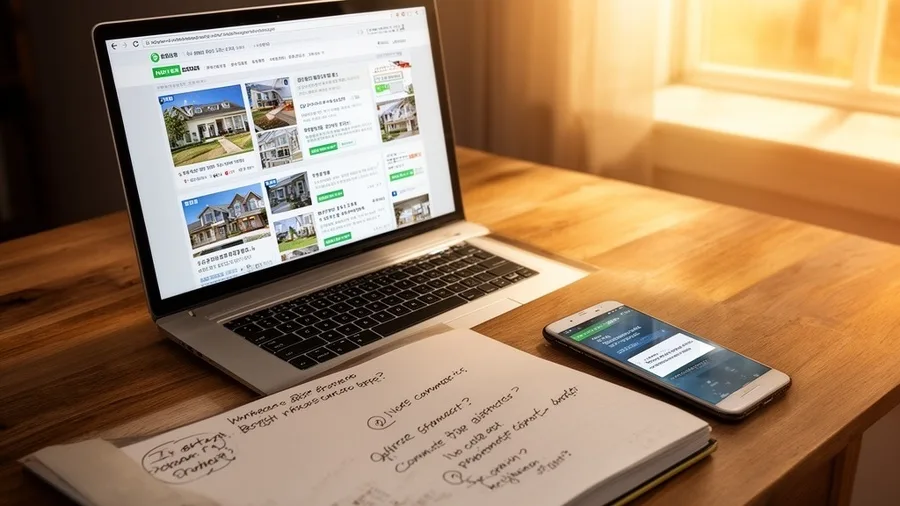
The five essential steps for a Korean real estate inspection (임장 - imjang) are strategic route planning, visiting at different times of day, checking with the management office, speaking with residents, and comparing properties with detailed record-keeping. These steps help uncover a property's true value beyond online listings.
Why is an On-Site Real Estate Inspection Crucial?
Success in real estate investment hinges on the practical information gathered during an on-site inspection, known as 'imjang' in Korea. A mere 5-minute difference in walking distance to a subway station can translate to hundreds of thousands of dollars in price disparity, a nuance only discernible through direct observation. While online platforms like Naver Real Estate provide past transaction data, they fail to capture qualitative aspects such as a property's maintenance status, the demographic of its residents, or noise levels. Analyzing real-world case studies reveals that focusing on key inspection points can significantly maximize investment value.
How to Plan an Efficient Inspection Route?
Effective 'imjang' requires meticulous route planning. Realistically, visiting 5-7 properties per day is optimal to maintain focus and avoid missing critical details. The process involves mapping your target properties and sequencing visits based on travel distance. The core principle is not just to view one property, but to compare competing ones. Even within the same school district or proximity to transit, differences in property management can lead to price gaps of tens of millions of Korean Won (approximately $7,000-$70,000 USD). Observing these discrepancies firsthand and inferring their causes is the essence of 'imjang.' Furthermore, walking between properties allows you to gauge the surrounding commercial activity, pedestrian environment, and inclines, gathering valuable contextual information.
What's the Best Time to Visit for an Accurate Assessment?

Apartment complexes present entirely different characteristics depending on the time of day. Mornings might see more young residents, while evenings can highlight parking shortages. Weekends and weekdays also differ significantly. A complex that appears quiet during weekday afternoons might become crowded with visitor cars or experience noise from nearby commercial establishments on weekends. Therefore, experts recommend visiting at least twice, at different times. An initial visit on a weekday morning can assess the exterior and surrounding environment, followed by a second visit on a weekday evening or weekend to focus on the actual living conditions, such as parking availability, noise levels, and resident activity. Visiting on a rainy day is also crucial. It can reveal issues like leaks in underground parking, drainage system effectiveness, or cracks in retaining walls that might not be apparent on a clear day. An inspection on a rainy day can be more valuable than multiple visits in clear weather.
What Information Can You Get from the Management Office and Residents?
The management office is the most reliable source for accurate, in-depth information about a property. Requesting details on maintenance fees, long-term repair fund balances, and recent repair history is usually met with transparency. Crucially, understanding the status of the long-term repair fund can alert you to potential future costs. For older properties, nearing 30 years or more, upcoming pipe replacements could incur expenses ranging from several thousand to over ten thousand US dollars. Brief conversations with residents encountered in common areas like walking paths or playgrounds can offer invaluable insights into neighborly disputes, management issues, or the actual satisfaction levels with local schools—information often missing from online reviews. For real estate agents, calling ahead to confirm listing status can save considerable time.
Why Are Comparative Analysis and Detailed Records Essential?
The final stage of 'imjang' involves thorough record-keeping and comparison. Document each visited property with photos and notes. After returning home, compile a comparison of key factors: transportation (walking time to the station), school districts (middle school assignments), commercial amenities (distance to supermarkets/hospitals), property maintenance status, and orientation/view. Accumulating these records naturally helps identify the best options within your budget. Someone who has inspected 10 properties will have a far greater decision-making capacity than someone who has only seen three. Inspections without proper documentation are akin to sightseeing rather than strategic investment. Utilizing tools like smartphone notes or Notion to create property scorecards allows for rational decisions based on data, not just emotion. With potential shifts in the Seoul metropolitan real estate market in late 2026, driven by a shortage of rental properties potentially converting to sales demand, now is an optimal time to begin 'imjang' for your future home. This rental shortage often signals a transition to sales demand, which can lead to price increases.
English crawl path
Next English reads from this pilot cluster
Continue through the category hub, latest English stories, and related posts so this translated article is not an isolated URL.
Tags
💬Frequently Asked Questions
What should I check first in Korean Real Estate Inspection: 5 Key Steps for 2026?
Does this Finance article link back to the Korean source?
Where can I find similar English stories?
English discovery path
Explore more English K-culture stories
Keep browsing the indexed English pilot cluster so Google and readers can move between this story, the category hub, and fresh discovery pages.
Original Source
Read the Korean original





