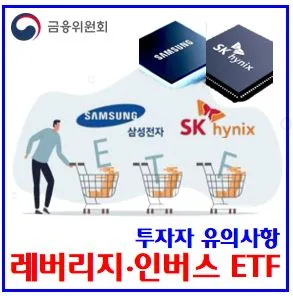

Investing in leveraged and inverse ETFs tied to single stocks like Samsung Electronics and SK Hynix, launching May 27, 2026, requires specific preparation. US investors need to be aware of a $10,000 minimum deposit and a mandatory 2-hour educational course before trading these high-risk products.
What Are Single-Stock Leveraged ETFs and Why Are They Risky?

Launching on May 27, 2026, single-stock leveraged and inverse ETFs focusing on Samsung Electronics and SK Hynix offer a new avenue for investors in the US market, but they come with significant risks. To protect investors, regulatory bodies like the Financial Supervisory Service mandate a minimum deposit of $10,000 (approximately 10 million KRW) and a total of 2 hours of pre-trading education, split into a 1-hour general course and a 1-hour advanced course. This is because, unlike diversified ETFs, these products concentrate risk on a single company's stock performance. Considering the daily price fluctuation limits of +/- 30% for Korean stocks, these leveraged ETFs theoretically could incur up to a 60% loss in a single day. Furthermore, due to the compounding effect, even if the underlying asset recovers, investors can still face cumulative losses on their principal. For instance, in the US market, a stock might gain 18% over a year, but its 2x leveraged ETF could end up with a 20% loss, and a -2x inverse ETF could see an 80% loss. It's crucial to fully understand these risks before making any investment decisions.
Understanding ETF Tracking Error and Expense Ratios
For volatile leveraged and inverse ETFs, a significant difference between the net asset value (NAV) and the market trading price, known as tracking error or dispersion, can frequently occur. This can lead investors to buy these products at a price higher than their actual value. Therefore, it's essential to check the tracking error information on financial data sites like the Korea Exchange statistics before investing. To attract investors in a competitive market, fund managers are also lowering their management fees. For example, Mirae Asset's TIGER ETF series offers fees around 0.0901% annually, lower than Korea Investment Trust Management's ACE (0.091%) or Hana Financial Group's 1Q (0.091%). Shinhan Asset Management's SOL ETF series charges 0.1% for both leveraged and inverse products, while Hanwha Asset Management's PLUS inverse ETF has a relatively higher fee of 0.49%. Factors like brand reputation, expense ratios, and dividend payout policies will likely influence investor choices.
Key Considerations for Single-Stock ETF Investments
Due to their inability to diversify, single-stock leveraged and inverse ETFs are prohibited from using the standard 'ETF' designation in their names and must clearly indicate they are single-stock products. Additionally, executives and major shareholders of the underlying company are required to report their holdings when trading these ETFs. The Korea Exchange plans to implement rule changes in early June 2026, restricting new listings for underlying stocks that do not meet listing requirements and potentially delisting them if the condition persists for over three months. These regulatory enhancements aim to boost investor protection and market stability. Investors must be aware of these regulations and approach trading with caution.
Future Outlook for Samsung Electronics and SK Hynix
Nomura Securities has raised its price targets for Samsung Electronics to ₩590,000 (approx. $430 USD) and SK Hynix to ₩4,000,000 (approx. $2,900 USD), suggesting over 118% upside potential from current prices for both stocks. This optimistic outlook is driven by structural changes in the semiconductor market, with the expansion of AI and increased data center investments expected to fuel a sustained growth in memory demand. Nomura points out that the current 12-month forward P/E ratio for both companies is around 6x, significantly lower than TSMC's 20x, indicating they may be undervalued by the market, which seems to underestimate their earnings sustainability and stability. While this positive forecast might increase interest in single-stock leveraged ETFs, it's crucial not to overlook the inherent high risks previously discussed. A cautious approach tailored to individual risk tolerance and investment goals is advised, and consulting with a financial professional is recommended.
For more detailed investment warnings, check the original source below.





