
If you've made profits from investing in overseas stocks, it's time to get ready for the overseas capital gains tax filing deadline on June 1, 2026. You're required to file if your net annual profit exceeds $1,850 (₩2.5 million). Failure to report can result in penalties. This guide breaks down the filing process and offers tax-saving tips.
Am I Required to File Overseas Stock Capital Gains Tax in 2026?
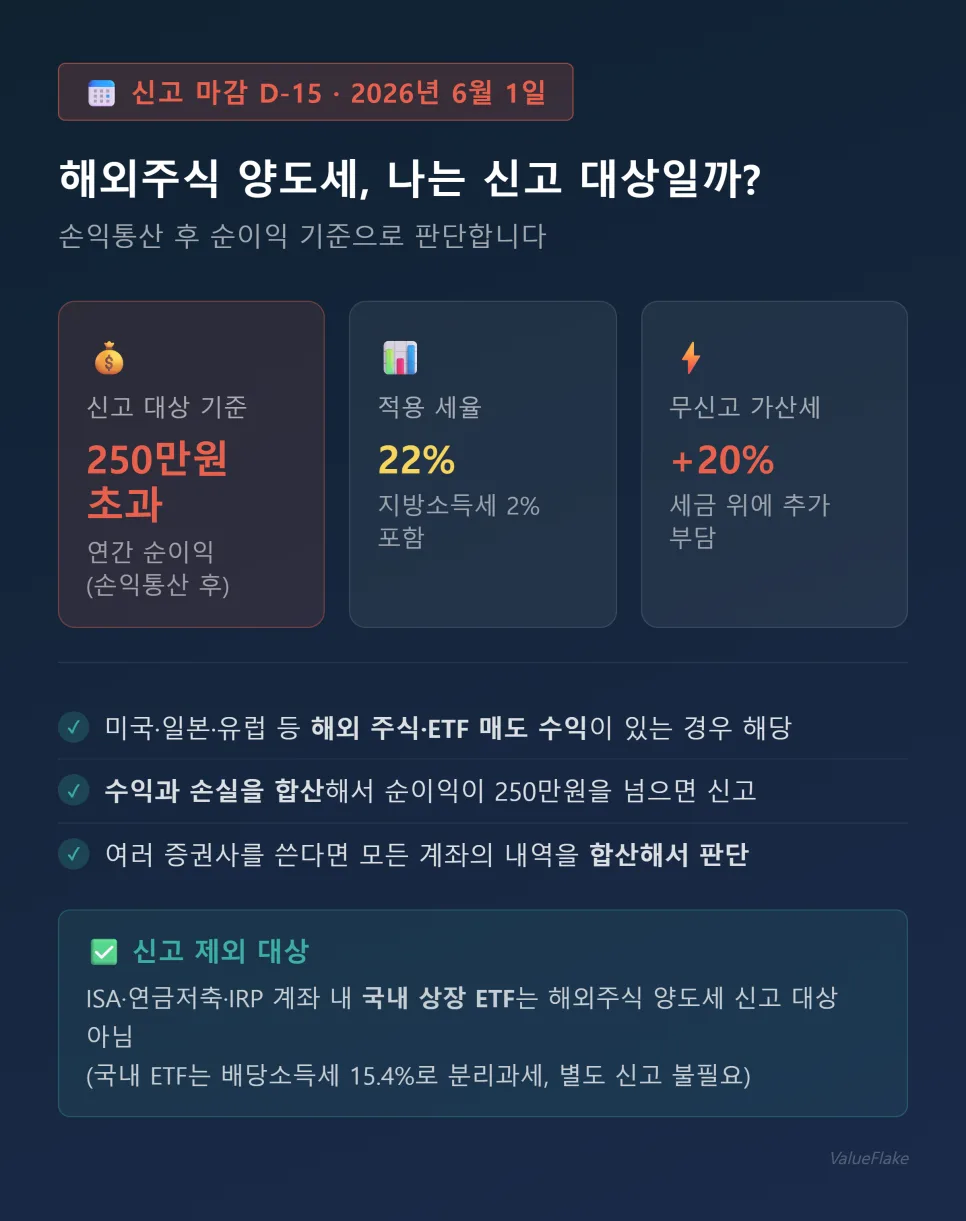
You're generally required to file overseas capital gains tax if you've sold overseas stocks or ETFs and your net annual profit exceeds $1,850 (₩2.5 million). This 'net profit' is calculated by summing up all profits and losses from your overseas stock and ETF trades. For example, if you made $2,200 (₩3 million) in profits through one brokerage and incurred $740 (₩1 million) in losses with another, your net profit is $1,460 (₩2 million), meaning you wouldn't need to file. However, if you earned profits from multiple brokerages, you must sum them up to see if the total exceeds the $1,850 threshold. Note that trades within Korean ISA accounts or domestic ETFs listed on Korean exchanges (like TIGER, KODEX, ACE) are typically exempt from this overseas capital gains tax. Based on personal experience, meticulously summing up transactions across all your brokerage accounts is crucial for an accurate net profit calculation.
What Happens If I Don't File My Overseas Stock Taxes?
Failing to report your overseas capital gains can lead to significant penalties. You'll face a non-filing penalty of 20% of the tax owed. Additionally, a late payment penalty accrues at an annual rate of 8% (0.022% per day). For instance, if you owed $730 (₩990,000) in taxes and didn't file or pay for a year, you could end up owing over $940 (₩1.27 million) including penalties. South Korea's National Tax Service (NTS) automatically receives trading data from brokerages, making it highly likely that unreported gains will be detected, potentially leading to a tax audit in severe cases. Therefore, it's essential to confirm your filing status before the deadline and file accurately if you are subject to the tax.
How Can I Reduce My Tax Burden?
One effective strategy to lower your overseas capital gains tax is by utilizing 'loss harvesting' or 'sonik tongsan' (손익통산). This involves selling stocks that have incurred losses before the tax deadline to offset your realized gains. For example, if you have $7,400 (₩10 million) in profits and $2,960 (₩4 million) in losses, offsetting them reduces your taxable income to $4,440 (₩6 million), significantly lowering your tax bill. With the June 1st deadline approaching, consider selling any holdings with substantial unrealized losses. Remember, if you use multiple brokerages, summing up profits and losses across all accounts is key. If your total net profit after this calculation falls below $1,850 (₩2.5 million), you may not need to file at all.
Your 5-Step Guide to Filing Overseas Stock Capital Gains Tax
Filing overseas capital gains tax might seem daunting, but it's often straightforward, especially with the tools available through most brokerage mobile trading apps (MTS). The first step is to request your 'Overseas Stock Capital Gains Statement' from your brokerage. You can usually find this under the 'Tax' or 'Inquiry' section of your MTS. The second step is 'Sonik Tongsan' (손익통산), where you aggregate your profits and losses from all trades to calculate your final net profit. The third step involves filing the tax return itself, which can be done through the NTS's Hometax website or often facilitated by your brokerage. The fourth step is paying the tax due, typically via bank transfer or through the Hometax portal. Finally, the fifth step is to confirm your filing has been successfully processed and accepted by the tax authorities.
For more details, check the original source below.





