
Many Americans miss a crucial detail about Korea's K-Growth Fund (국민성장펀드) for 2026: understanding the tax benefits and individual investment limits is key. This policy-driven fund invests in strategic industries, offering potential income tax deductions and preferential tax treatment on dividends for eligible investors.
What is the K-Growth Fund? (2026 Overview)
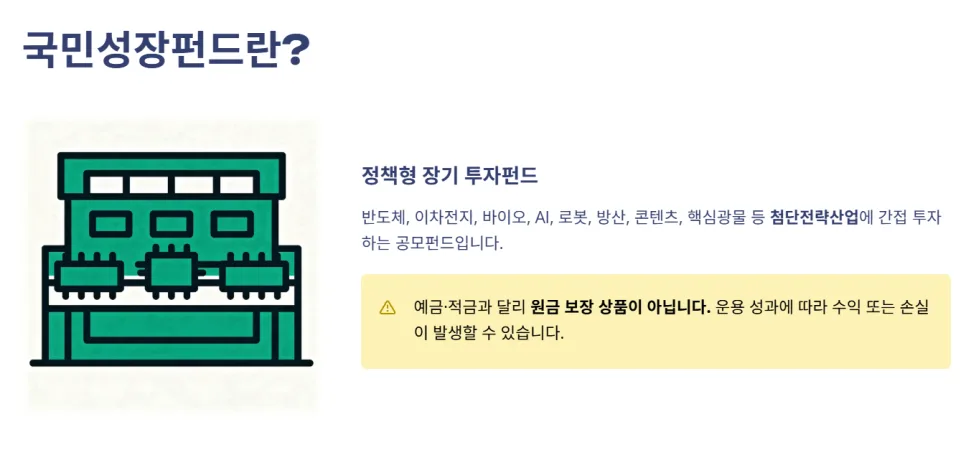
The 2026 K-Growth Fund is a government-backed investment vehicle designed to channel long-term capital into strategic industries driving Korea's economic growth. The 'National Participation Type' (국민참여형) K-Growth Fund allows individual investors to participate indirectly by investing in high-growth sectors like semiconductors, batteries, biotech, AI, robotics, defense, content, and critical minerals. Unlike traditional savings accounts, this is not a fixed-interest product. Your investment is pooled and diversified across various sub-funds, meaning returns can fluctuate based on market performance, leading to potential gains or losses. However, due to its policy objectives, the fund includes a structure where the government may absorb some initial losses, differentiating it from typical private funds. It's crucial to remember that this is not a principal-protected investment.
K-Growth Fund Eligibility: Who Can Invest? (2026 Update)
To be eligible for the National Participation Type K-Growth Fund, you generally need to be an individual aged 19 or older. If you are 15 or older and have earned income, you may also qualify to invest through a dedicated account. However, there are specific restrictions for accessing the tax-advantaged dedicated account. Individuals who were subject to comprehensive financial income tax (금융소득종합과세) in any of the three years prior to the fund's launch are ineligible for the dedicated tax-benefit account. Comprehensive financial income tax applies when the total of your interest and dividend income exceeds a certain threshold. Additionally, a portion of the fund's total offering is prioritized for lower-income individuals. If your earned income is below $50,000 USD (approx. ₩65 million) or your total income is below $38,000 USD (approx. ₩50 million), be prepared to provide income verification documents, such as a certificate of income, as proof of eligibility for preferential allocation.
K-Growth Fund Benefits and Investment Limits (2026)
The most attractive aspects of the National Participation Type K-Growth Fund are its income tax deductions and preferential dividend tax treatment. By investing through a dedicated account and meeting certain holding periods, investors can receive income tax deductions based on their investment amount. For example, investments up to $23,000 USD (approx. ₩30 million) may receive a 40% deduction, investments between $23,000 and $38,000 USD (approx. ₩30-50 million) a 20% deduction, and investments between $38,000 and $54,000 USD (approx. ₩50-70 million) a 10% deduction, potentially reaching up to $13,800 USD (approx. ₩18 million) in total deductions. Furthermore, dividends are subject to a low-rate separate taxation, meaning they are not aggregated with your general financial income, which is beneficial for those with existing investment income. However, these tax benefits come with strict conditions, including maintaining the dedicated account, meeting minimum holding periods, and adhering to investment requirements. The investment limit for the dedicated account is up to $154,000 USD (approx. ₩200 million) over five years, with a per-person annual fund subscription limit of $77,000 USD (approx. ₩100 million). Investing through a general account limits you to $23,000 USD (approx. ₩30 million) annually. Note that minimum investment amounts may vary by selling institution.
K-Growth Fund: Important Considerations and How to Invest (2026 Essential Info)
You can invest in the K-Growth Fund through designated banks and securities firms. Currently, major institutions like Busan Bank, Woori Bank, and Hana Bank, along with numerous securities firms, are offering the fund. Investment is possible both in-person at branches and online. Since the fund has a limited offering and is sold on a first-come, first-served basis, it's crucial to research the minimum investment amount, online subscription availability, and estimated closing dates for each selling institution. Remember, this fund does not guarantee principal. Market conditions, company performance, and fund management outcomes can lead to losses. It's advisable to consult with a financial professional to ensure this investment aligns with your personal financial situation and risk tolerance before investing.
For more details, check the original source below.





