When considering Nvidia (NVDA) versus Google (GOOGL) for 2026 investments, understanding their roles in the AI revolution is key. Nvidia provides the essential infrastructure, while Google leverages AI to generate revenue. This analysis breaks down their growth drivers, investment potential, and risks for American investors.
Why is Nvidia Called the 'Pick and Shovel' of the AI Era?
Nvidia designs the GPUs essential for AI computation, making it the backbone of global AI infrastructure. In the last three years, the company has seen an explosive growth rate, with average net profit increasing by 264%. Nvidia's chips are critical for training and running AI models like ChatGPT and Gemini, earning it the nickname 'the pick and shovel' of the AI gold rush – any successful AI company will need Nvidia's hardware. Furthermore, Nvidia has built a formidable software ecosystem with CUDA, creating a moat that competitors struggle to breach. While recent quarterly earnings exceeded expectations, with EPS up 82% and revenue up 73%, this also brings pressure to consistently deliver market-beating results.
How Does Google Monetize Its AI Prowess?
Google is a powerhouse in its own right, boasting strong competition in search, YouTube, cloud services, and its own AI chips (TPU). Its ability to generate profits and its cash reserves are among the world's highest. While Google maintains solid revenue and profit growth, it doesn't match Nvidia's extraordinary 264% average net profit increase over three years. This difference stems from Nvidia's direct benefit from the AI infrastructure investment cycle, whereas Google's model focuses on leveraging AI for revenue generation. From a long-term perspective, Google's growth potential is significant, but Nvidia is positioned for more direct gains in the current AI infrastructure boom.
What Are Nvidia's Growth Drivers and Investment Appeal?
Nvidia's primary growth engine is the mass production of its next-generation Blackwell architecture (B100, B200), which promises to quadruple AI training speeds and increase inference speeds by 30 times. Tech giants like Microsoft, Google, and Amazon are placing substantial orders for Blackwell, with demand outstripping supply. The expansion into the inference market – crucial for running AI services in real-time – represents a significant new revenue stream for Nvidia. Its CUDA software ecosystem, cultivated over two decades, acts as a powerful barrier to entry for competitors. Considering these factors, Nvidia stands out as a highly attractive investment, firmly positioned as a key enabler of the AI era.
When is the Right Time to Invest, and How to Manage Risk?
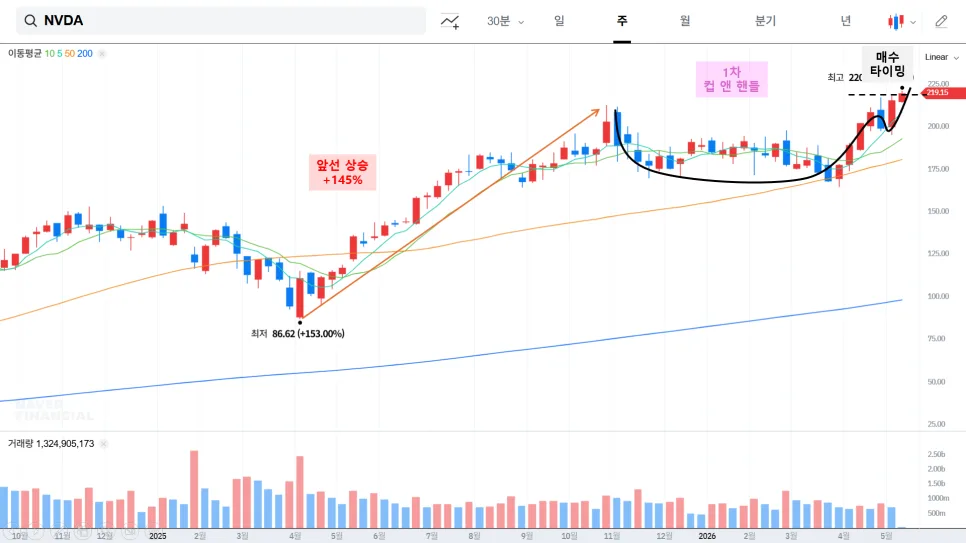
Nvidia's stock has surged approximately 145% from its recent low and is currently attempting to break through its previous all-time high, forming a bullish cup-and-handle pattern on charts. This suggests it might be an opportune moment for entry, offering a favorable risk-reward ratio. However, the significant price increase also raises concerns about potential volatility. A classic investment strategy involves waiting for a confirmed breakout above the previous high, accompanied by strong trading volume, before initiating a phased entry. Nvidia faces the challenge of meeting high market expectations with every quarterly earnings report, making its stock susceptible to significant price swings. Additionally, the rapid pace of AI technological advancement necessitates continuous monitoring of industry shifts.
For more details, check the original source below.





