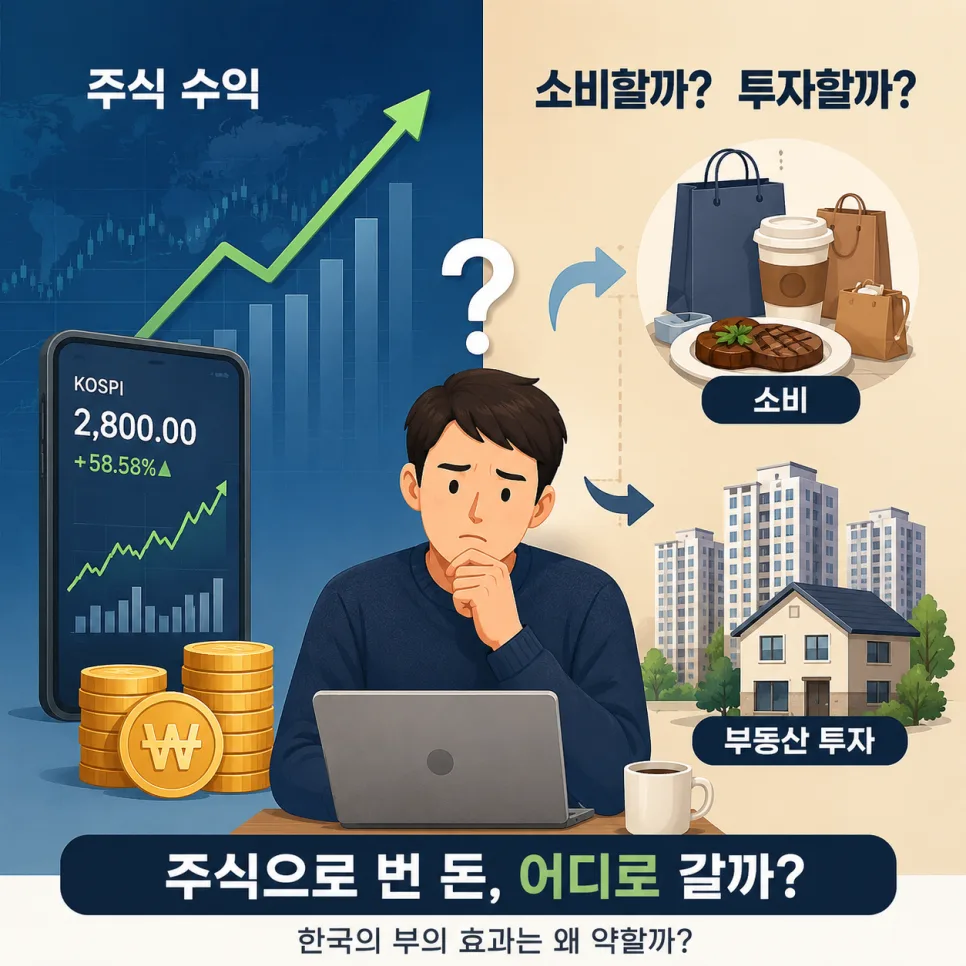
Despite significant stock market gains, consumer spending in South Korea doesn't increase proportionally due to a weaker 'wealth effect.' This phenomenon means the typical economic principle where rising asset prices lead to increased spending operates differently in Korea. As of 2026, we'll explore the root causes of this trend and its potential for future change.
Why is Korea's Wealth Effect Different from the US?
In economics, the 'wealth effect' describes how rising asset prices make individuals feel wealthier, prompting them to spend more. For example, when home or stock prices climb, people often feel more secure and increase spending on items like cars, luxury goods, or travel. This effect is particularly strong in the US, where stock market rallies frequently translate into consumer spending boosts. However, analysis from the Bank of Korea indicates that for every ₩1 increase in stock assets in Korea, consumer spending rises by only about ₩0.013. This is roughly 30% of the effect seen in the US or Europe (around ₩0.032-0.038). This disparity, evident even with recent surges in the KOSPI index seeing only a 2% rise in consumer spending, reflects not just economic conditions but also Korea's unique asset structure and investment psychology.
Why Don't Koreans Spend Their Stock Profits?
Several complex reasons explain why stock market profits in Korea don't readily translate into increased consumer spending. Firstly, many individual Korean investors view stock gains not as immediate spending money, but as 'seeds for the next investment.' Having experienced high volatility and prolonged market stagnation in the past, they often feel a sense of insecurity that profits could disappear quickly. This leads to a strong tendency to reinvest gains or shift them into real estate. Secondly, Korean society still holds a deeply ingrained, real estate-centric culture. It's common for money earned from stocks to be allocated towards purchasing apartments in Seoul, securing 'jeonse' (long-term lease deposits), or accumulating down payments for homeownership. Data from the Bank of Korea shows an increasing proportion of funds for Seoul housing purchases come from selling stocks and bonds. This highlights a preference for asset accumulation over immediate consumption.
Future Anxiety and Korea's Investment Culture
South Korea experiences high levels of future anxiety compared to other OECD countries, driven by factors like elevated housing and private education costs, retirement concerns, and job insecurity. Individuals in their 30s to 50s often face a triple burden of supporting children's education, repaying mortgages, and preparing for retirement. Consequently, even when stock investments yield profits, the funds are more likely to be directed towards future security measures like savings accounts, insurance, loan repayments, or further investments, rather than immediate consumption like travel or luxury purchases. This contrasts sharply with the consumption-driven investment culture seen in the US. While American investors often have strong links between pensions and the stock market, fostering a culture where asset growth directly fuels spending, Korean investors tend to engage in more short-term trading, prioritize real estate, and invest partly out of a fear of 'falling behind,' weakening the link to increased consumption.
Could Korea's Wealth Effect Change in the Future?
Recent shifts in Korea's asset market show signs that the wealth effect could gradually strengthen. Firstly, investment culture among younger generations (20s-30s) is rapidly evolving, with growing interest in US ETFs, pension investments, and long-term systematic investments. This marks a departure from the past focus on short-term speculation. Secondly, the expansion of the retirement pension market, including workplace pensions, IRPs (Individual Retirement Pensions), and ISAs (Individual Savings Accounts), could be a key factor in structurally changing the Korean asset market long-term. This may lead to increased stock holdings, stable asset formation, and ultimately, an improvement in consumer sentiment. Thirdly, the recent restructuring of the Korean stock market around structurally growing industries like semiconductors, AI, and power infrastructure is fostering a perception that the market is more suitable for long-term investment than before. These developments hold the potential to gradually enhance Korea's unique wealth effect.
Key Takeaways for Individual Investors
Realizing profits from stock investments is crucial for them to have true meaning. Many investors focus solely on paper gains, but it's essential to create actual cash flow and balance spending with life goals. Instead of absolute consumption restraint, setting a rational spending plan aligned with your investment objectives and financial situation is necessary. Furthermore, the magnitude of the wealth effect can vary based on individual investment tendencies and financial circumstances. Consulting with a financial advisor to establish a personalized financial plan is a wise approach.
English crawl path
Next English reads from this pilot cluster
Continue through the category hub, latest English stories, and related posts so this translated article is not an isolated URL.
Tags
💬Frequently Asked Questions
What should I check first in Why Stock Gains Don't Boost Spending: Korea's Weak Wealth Effect (2026)?
Does this Finance article link back to the Korean source?
Where can I find similar English stories?
English discovery path
Explore more English K-culture stories
Keep browsing the indexed English pilot cluster so Google and readers can move between this story, the category hub, and fresh discovery pages.
Original Source
Read the Korean original