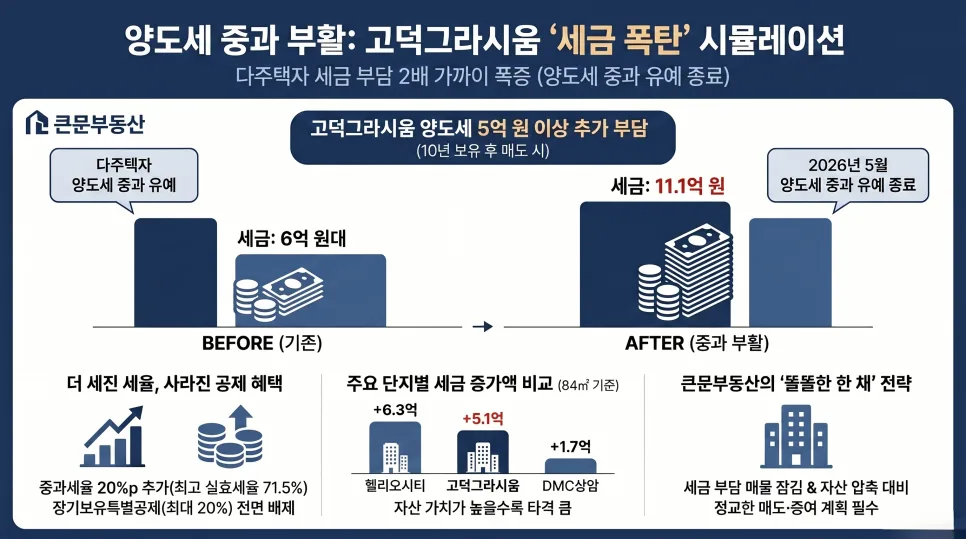
Starting May 9, 2026, the temporary suspension of increased capital gains taxes for multiple property owners in South Korea will end, significantly raising tax burdens for those holding several properties in regulated areas. For those with two homes in designated adjustment zones, the effective tax rate could reach up to 71.5%, with the elimination of long-term holding special deductions further exacerbating the financial impact.
How Much More Will Multi-Property Owners Pay in Capital Gains Tax?
The end of the capital gains tax deferral for multi-property owners will hit hardest in two key ways. First, an additional 20%p surcharge will be applied to multi-property owners. For a homeowner with two properties in a designated adjustment zone, this means the highest basic tax rate of 45% will be increased by the 20%p surcharge, reaching a maximum of 65%. Including the 10% local income tax, the effective tax rate climbs to a staggering 71.5%. Second, the long-term holding special deduction (up to 20%) will be completely removed. This means individuals who have held property for over 10 years and realized substantial capital gains will face a significantly higher tax bill due to the loss of this deduction. Therefore, if you're considering selling, it's crucial to compare holding costs against the increased capital gains tax to determine the optimal time to sell.
How Do Capital Gains Tax Burdens Differ by Property Location and Value?
Assuming a sale after approximately 10 years of ownership for an 84㎡ (34-pyeong) unit, the changes in capital gains tax burden for major complexes in different regions are as follows. For Gangdong-gu's Godeok Gracioum, estimated to sell for 2.5 billion KRW (approx. $1.8 million USD) with an acquisition cost of 800 million KRW (approx. $580,000 USD) 10 years ago, the tax would increase by about 500 million KRW (approx. $360,000 USD) under the new surcharge rules, rising from roughly 600 million KRW (approx. $435,000 USD) during the deferral period to approximately 1.11 billion KRW (approx. $805,000 USD). Songpa-gu's Helicity (estimated sale price 2.8 billion KRW, approx. $2 million USD) is expected to see a tax increase of about 600 million KRW (approx. $435,000 USD), while Mapo-gu's DMC Sangam Central Park (estimated sale price 1.2 billion KRW, approx. $870,000 USD) anticipates an increase of around 170 million KRW (approx. $123,000 USD). This indicates that properties with larger capital gains, like Godeok Gracioum and Helicity, will face tax increases in the hundreds of thousands of dollars. Conversely, properties under 1.5 billion KRW (approx. $1.1 million USD) like DMC Sangam Central Park, while having lower absolute tax amounts, may see a proportionally larger increase in tax burden, potentially accelerating asset liquidation.
What Are the Differences in Loan Limits Based on Housing Price Tiers?
The new regulations also increase the difficulty for buyers by differentiating loan limits based on housing price tiers. For properties under 1.5 billion KRW (approx. $1.1 million USD), such as Mapo-gu's DMC Sangam Central Park, up to 600 million KRW (approx. $435,000 USD) in mortgage loans may be available, making it relatively more accessible for genuine buyers. However, for properties between 1.5 billion KRW and 2.5 billion KRW (approx. $1.1 million - $1.8 million USD), like Gangdong-gu's Godeok Gracioum, loan limits are capped at 400 million KRW (approx. $290,000 USD), and the stricter Stress DSR 3.0% regulation will apply, making loan conditions more stringent. For luxury homes exceeding 2.5 billion KRW (approx. $1.8 million USD), such as Songpa-gu's Helicity, the loan limit drops sharply to a maximum of 200 million KRW (approx. $145,000 USD). This means purchasing a Helicity-level property would require approximately 2.6 billion KRW (approx. $1.9 million USD) in pure cash, effectively reshaping the high-end housing market into a realm for the ultra-wealthy.
What Is the Outlook for the Real Estate Market Moving Forward?
The reinstatement of increased capital gains taxes and stricter loan regulations are expected to intensify a 'lock-in' effect in the real estate market. As multi-property owners face higher tax burdens, many will likely opt to hold onto their properties rather than sell, leading to a significant decrease in the supply of quality listings. Furthermore, the preference for owning a single, high-value property ('똘똘한 한 채' - a strong, single asset) is likely to grow. This trend might push owners of multiple properties in outlying areas to consolidate into one prime asset like Godeok Gracioum or Helicity, further concentrating demand in top-tier locations. This is not financial advice. Consult a licensed financial advisor before making investment decisions.





