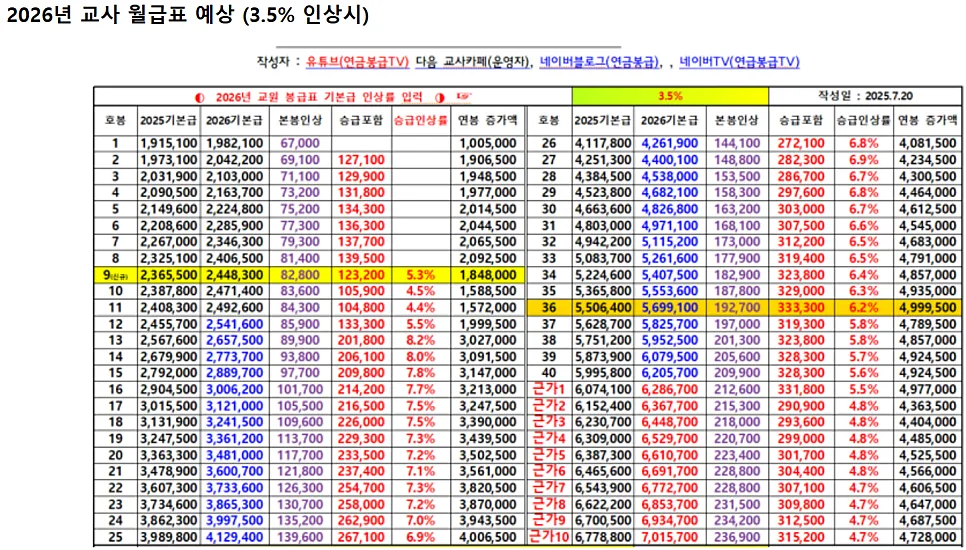
In 2026, US teachers can expect a median salary around $62,000, while South Korean teachers, particularly those with 21 years of experience, might see a take-home pay of approximately $2,800-$3,500 USD per month after deductions. This analysis breaks down the expected salary increases, additional allowances for specialized roles like school nurses, and common deductions impacting the final take-home pay for Korean educators.
Understanding Korean Teacher Salary Scales in 2026
The base salary for Korean teachers is projected to increase by 3.5% in 2026, aligning with inflation and cost of living adjustments. Unlike the US system where salaries can vary significantly by district and state, Korea uses a more standardized pay scale based on years of service (ho-bong). A teacher with 21 years of experience (21호봉) might have a base salary around ₩3,600,700 (approximately $2,600 USD). This base pay is then augmented by various allowances and bonuses. For instance, a school nurse (보건교사) receives an additional monthly allowance of ₩40,000 (about $30 USD) for their specialized role, reflecting a similar concept to specialized stipends in US school districts for roles like special education or advanced placement instructors.
Special Allowances for Korean School Nurses and Other Bonuses
Korean school nurses (보건교사) receive a special allowance known as '교직수당가산금' (teaching allowance supplement) amounting to ₩40,000 (around $30 USD) per month. This is in addition to the standard teaching allowance (교직수당) of ₩250,000 (approx. $180 USD) and a meal allowance (정액급식비) of ₩160,000 (approx. $120 USD) that all teachers receive. Long-service bonuses, called '정근수당', are paid twice a year (January and July). Teachers with over 10 years of service receive 50% of their base salary as this bonus; for a 21-ho봉 teacher, this could mean an additional ₩1,800,000 (approx. $1,300 USD) per payment. Other potential income includes overtime pay (around ₩100,000 or $75 USD per month when not on vacation) and research allowances (교원연구비), which vary based on experience level.
Deductions and Final Take-Home Pay for Korean Teachers
Before reaching the take-home pay, several deductions are made from a Korean teacher's gross salary. These include income tax and local income tax (estimated at ₩160,000-₩170,000, or $120-$130 USD per month), national pension contributions (공무원연금, around 9% of base salary, approximately ₩421,090 or $300 USD), health insurance premiums (건강보험료) and long-term care insurance (노인장기요양보험료), totaling around ₩190,000 ($140 USD), and contributions to the Teachers' Pension Fund (교직원공제회비) for long-term savings, typically ₩150,000 ($110 USD). After these deductions, a 21-ho봉 school nurse's monthly take-home pay in 2026 is estimated to be between ₩3,800,000 and ₩4,500,000 (roughly $2,800 - $3,300 USD), depending on specific service years and other factors.
When Do Korean Teachers Receive Higher Paychecks?
Korean teachers experience several months with higher paychecks throughout the year due to specific bonuses. The '정근수당' (long-service bonus) is paid in January and July, significantly boosting those months' income. Additionally, bonuses related to holidays like Lunar New Year (설) in February and Chuseok (추석) in September/October, along with performance-based bonuses (성과급) typically disbursed in April, mean that teachers can expect around six months with increased pay. While the US system often sees salary paid out evenly across 12 months, this bonus structure in Korea provides lump sums that can impact budgeting and financial planning for educators.
English crawl path
Next English reads from this pilot cluster
Continue through the category hub, latest English stories, and related posts so this translated article is not an isolated URL.
Tags
💬Frequently Asked Questions
What should I check first in Teacher Salary 2026: US Teacher Pay vs. Korean Scale?
Does this Finance article link back to the Korean source?
Where can I find similar English stories?
English discovery path
Explore more English K-culture stories
Keep browsing the indexed English pilot cluster so Google and readers can move between this story, the category hub, and fresh discovery pages.
Original Source
Read the Korean original





