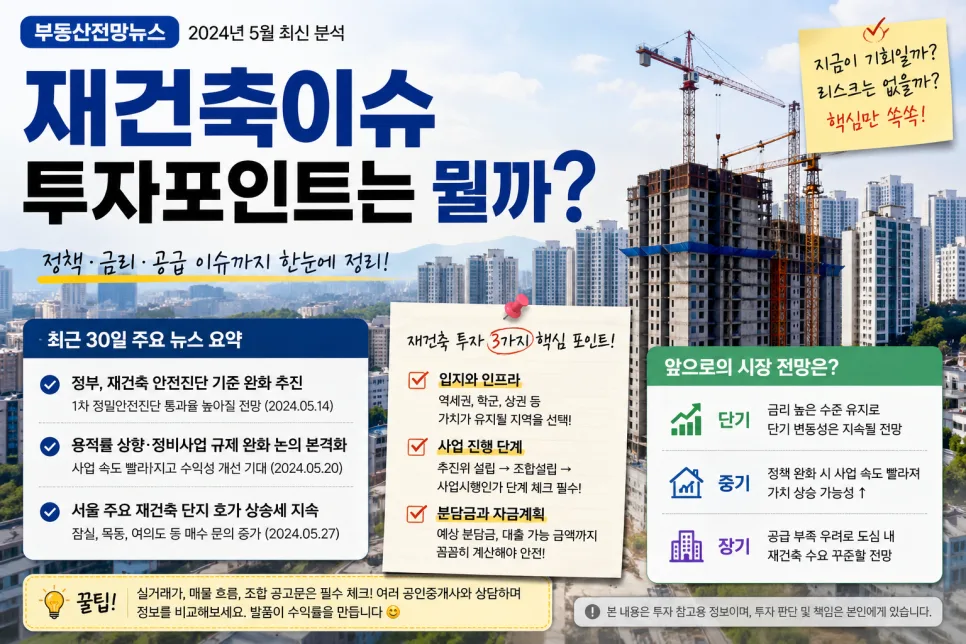
In 2026, the Korean redevelopment market is poised for potential investment opportunities driven by policy shifts like relaxed safety assessments and increased building density allowances. Key investment factors include location, project stage, and potential additional costs, alongside careful consideration of macroeconomic trends such as interest rates and loan regulations. This guide breaks down the essential elements for navigating this complex market.
What are the Key Issues for Korean Redevelopment Investment in 2026?
The Korean redevelopment market is buzzing with activity, particularly in Seoul and surrounding metropolitan areas, where anticipation alone is driving up property values. For 2026, government policy changes are expected to be the main catalyst, including relaxed safety inspection standards and higher permissible building density ( 용적률 - Yongjeokryul). These adjustments are designed to encourage more redevelopment projects. We're already seeing instances where the mere establishment of a project committee has led to significant price increases, underscoring the critical role of timing in real estate investment. Navigating this environment requires a blend of cautious analysis and strategic opportunity-seeking.
What are the 3 Core Factors for Successful Redevelopment Investment?
To achieve success in redevelopment investments, a thorough analysis of three core factors is essential. Firstly, location is paramount. Proximity to subway stations, quality school districts, and convenient access to amenities like supermarkets, hospitals, and parks directly impact resident satisfaction and future property value. A prime location provides a solid foundation for significant price appreciation post-redevelopment. Secondly, understanding the project stage is crucial. Whether the project is in the pre-combination establishment phase, has received project execution approval, or is in the management disposition phase significantly alters investment risk and potential returns. Early stages offer higher potential returns but come with more variables. Thirdly, the additional cost (추가 분담금 - Chuga Bundamgeum) must be carefully evaluated. Even with a low initial investment, unexpected additional costs can severely diminish overall returns. Therefore, it's vital to scrutinize the estimated additional costs during the project planning phase. These three elements are indispensable for successful redevelopment investment.
Is it Too Late to Invest in Redevelopment Apartments Now?
Determining if it's too late to invest in redevelopment apartments depends heavily on the specific region and complex. Blindly following news headlines without considering macroeconomic factors like rising interest rates or stricter loan regulations can be risky. It's crucial to analyze current transaction prices and the inventory of available properties. Consulting with multiple local real estate agents can provide a diverse perspective on market conditions. If a project is still in its early stages, there may still be viable investment opportunities. However, for complexes that are already well into their development process or have a high premium, a more cautious approach is advised. Prioritize a realistic assessment of your personal financial plan and borrowing capacity.
What are Common Mistakes and Precautions in Redevelopment Investment?
A frequent mistake in redevelopment investment is the 'blind faith' approach – assuming all redevelopments will automatically increase in value. This can lead to funds being tied up for years if a project faces delays. Instead of concluding it's too late to invest, focus on identifying projects in their initial stages. Meticulous financial planning is key; if using loans, thoroughly calculate potential interest rate fluctuations and your repayment ability. Rather than rushing into a contract based solely on news or hearsay, it's wise to verify transaction prices and property flow trends yourself, and to synthesize opinions from various experts. A prudent approach tailored to your investment style and financial situation is essential.
English crawl path
Next English reads from this pilot cluster
Continue through the category hub, latest English stories, and related posts so this translated article is not an isolated URL.
Tags
💬Frequently Asked Questions
What should I check first in 2026 Korean Redevelopment Investment: Key Issues & Strategies?
Does this Finance article link back to the Korean source?
Where can I find similar English stories?
English discovery path
Explore more English K-culture stories
Keep browsing the indexed English pilot cluster so Google and readers can move between this story, the category hub, and fresh discovery pages.
Original Source
Read the Korean original





