In 2026, tenant protection rights in Korean real estate auctions refer to a tenant's ability to assert their lease agreement and continue residing in a property even after ownership changes due to an auction. These rights are established by meeting specific requirements of actual residency and registered address (jeonip-sin-go), and their priority relative to the cancellation basis right is the key factor for auction investors.
What Are Tenant Protection Rights and Why Do They Matter in Korean Real Estate?
Tenant protection rights, or 'imchain daehangryeok' in Korean, grant tenants the legal standing to enforce their lease terms against third parties, including new property owners. Essentially, if a property is auctioned, a tenant who meets certain criteria can continue living in the home. This is critically important for real estate auction investors in Korea. Failing to properly identify and understand properties with tenant protection rights can lead to unexpected difficulties and financial losses, such as being obligated to assume the tenant's deposit or facing complex eviction processes. In my experience, understanding property rights analysis is far more crucial than simply finding a low price in auctions. Accurately identifying the existence of protected tenants and the timing of their rights is the first step to a successful investment.
What Are the Requirements and Timing for Establishing Tenant Protection Rights?
For a tenant to establish protection rights, two core conditions must be met. First, the tenant must be actually residing in and occupying the property. Simply having a lease agreement without physical occupancy does not grant these rights. Second, the tenant must complete a formal address registration (jeonip-sin-go) according to the resident registration law. Tenant protection rights are acquired from the moment both these conditions are fulfilled. The crucial factor here is the relationship between the timing of acquiring these rights and the establishment date of the cancellation basis right (e.g., the date of the first mortgage or provisional seizure). If a tenant's protection rights were established before the cancellation basis right, the tenant can assert their lease against the auction's successful bidder. In such cases, the bidder may be required to assume the tenant's deposit.
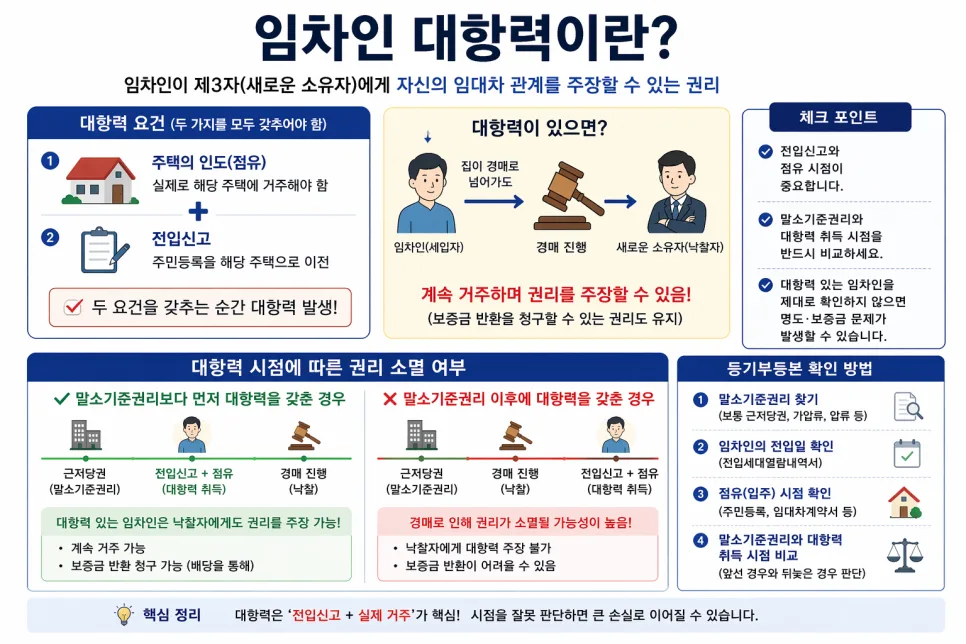
However, if the tenant acquired their rights after the cancellation basis right was established, the lease agreement is likely to be terminated during the auction process, and the tenant will become subject to eviction. Therefore, it is essential to accurately verify the tenant's registered address date and the start date of their actual occupancy when considering an auction property.
How Do Tenant Protection Rights Interact with the Cancellation Basis Right in Auctions?
The relationship between a tenant's protection rights and the cancellation basis right is the most critical determinant of a successful bidder's rights and obligations in a Korean real estate auction. The cancellation basis right typically refers to the earliest registered right on the property (e.g., the date of the first mortgage registration) before the auction begins. Most rights established after this date are usually extinguished by the auction. If a tenant established their protection rights (through actual residency and address registration) *before* the cancellation basis right, they are considered a 'protected tenant.' In this scenario, the successful bidder must honor the tenant's lease agreement and may be obligated to take over the tenant's security deposit. Conversely, if the tenant established their rights *after* the cancellation basis right, they are considered an 'unprotected tenant.' Their lease agreement is typically terminated by the auction, and they become subject to eviction. Therefore, meticulously comparing the cancellation basis right's establishment date with the tenant's registered address date on the property's title deed is paramount for auction investors.
What Precautions Should Be Taken When Identifying Tenants with Protection Rights?
Overlooking or misjudging tenants with protection rights can lead to significant risks. A common mistake is assuming protection rights based solely on the registered address date. Without verifying actual residency, a tenant might have filed for registration without truly living there. Additionally, even a protected tenant might not be able to claim their full deposit from the new owner if they fail to file for dividend distribution by the deadline for claims (baedang-yogu jonggi-il). While some rights, like preferential repayment rights (choi-u-seon-byeonje-gwon), may still apply, the ability to claim the entire deposit against the new owner can be jeopardized. If multiple tenants are involved, it's crucial to accurately determine each tenant's protection rights acquisition date and deposit amount. Especially if a tenant holds both protection rights and preferential repayment rights, the likelihood of the successful bidder having to assume the deposit increases. Therefore, during auction due diligence, it's vital to analyze the tenant's actual residency, registration date, dividend claim status, and its relationship with the cancellation basis right from multiple angles. Seeking professional legal advice is recommended for accurate assessment, as legal interpretations can vary based on individual circumstances. This is not financial advice. Consult a licensed financial advisor.
For more details, check the original source below.