Planning to launch a labor dispatch business in Korea? This comprehensive guide breaks down the 2026 licensing requirements, legal entity criteria, and application procedures, offering insights crucial for success in the Korean market. We cover everything from capital requirements to operational standards.
What are the essential requirements for a Korean labor dispatch business license?
To successfully establish a labor dispatch business in Korea, several key criteria must be met. First, your business's purpose must be clearly defined. Your company's articles of incorporation and business registry must explicitly state that the business objective is labor dispatch or staffing services. You are also required to directly employ at least five regular employees, separate from any dispatched workers, and they must be enrolled in the four major social insurance programs. This demonstrates the business's stability and reliability. Based on our experience, failing to meet these requirements can lead to rejection of your license application. Additionally, the company's paid-in capital must be at least 100 million KRW (approximately $75,000 USD), verifiable through the business registry. A dedicated office space is also mandatory, with a minimum exclusive area of 20 square meters (approx. 215 sq ft). This is thoroughly checked during on-site inspections. Finally, the CEO, executives, and the dispatch business manager must have no disqualifying criminal records or legal impediments, and a dedicated dispatch business manager must be appointed. This ensures transparent and responsible operation of the dispatch service.
What is the application process for a Korean labor dispatch business license?

Related Articles
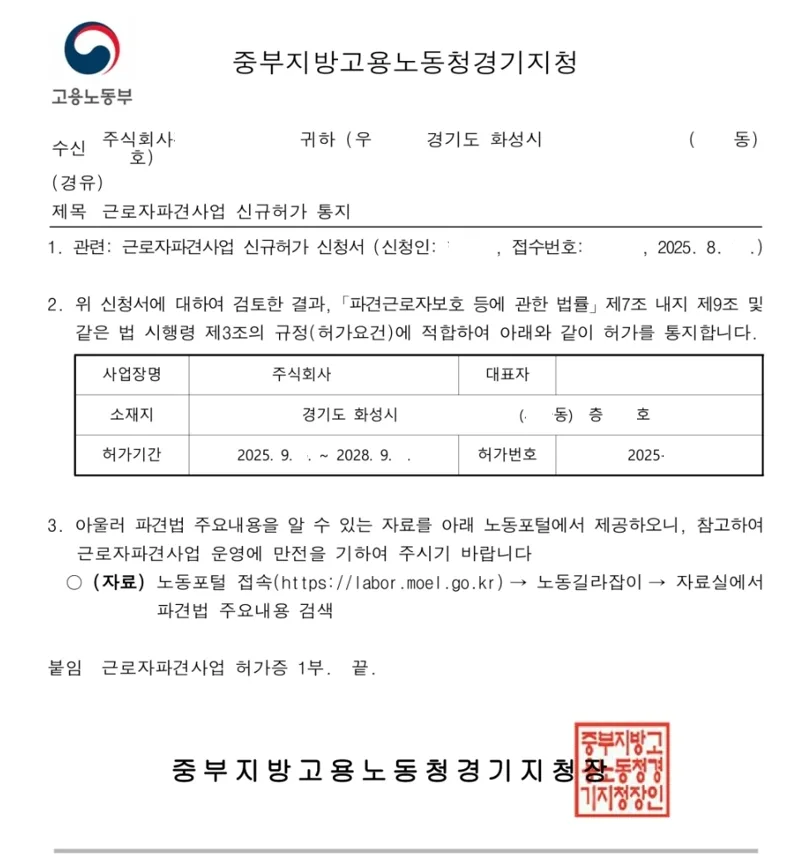
The application for a labor dispatch business license can be submitted either in person at the relevant regional Employment and Labor Office (고용지청) or online through the Ministry of Employment and Labor's portal. Along with all the supporting documents proving you meet the aforementioned requirements, you must submit a detailed business plan. Clearly articulating your strategy for building a nationwide dispatch network and your human resource management approach is crucial for passing the document review. In our experience, logically demonstrating that your business plan is suitable for national-level operations significantly aids in the approval process. Following document submission, a review will be conducted, including background checks for disqualifying factors and criminal records. If any documentation needs to be supplemented, you will be notified to complete the process. Once the document review is passed, an on-site inspection will verify that your office space meets the functional requirements. This inspection typically checks the office signage and exclusive area. Upon successfully passing this inspection, your license will be issued. The entire process can typically take several weeks.
What are the mandatory obligations for labor dispatch business owners?
To maintain your labor dispatch business license, you must adhere to various obligations outlined in the "Act on the Protection of Dispatched Workers, etc." (파견근로자 보호 등에 관한 법률). The most fundamental is clearly stating the nature of the dispatch service when recruiting workers. You must also prominently display your license in your office. Furthermore, you are legally required to execute separate contracts: a labor dispatch agreement between the dispatch business owner and the client company (user employer), and an employment contract between the dispatch business owner and the dispatched worker. These contracts are essential for legal stability within the dispatch relationship. Beyond the specifics mentioned in Article 8 of the Enforcement Rule of the Act on the Protection of Dispatched Workers, you must strictly comply with regulations concerning dispatch periods, limitations, and prohibited work types. Violating these obligations can result in penalties such as fines, so it is crucial to stay updated on the latest legislation. Specific regulations may vary based on individual circumstances, so seeking professional advice when necessary is recommended.
What are common mistakes made when applying for a labor dispatch business license?
Many prospective business owners make several common errors during the labor dispatch business license application process. Firstly, they often fail to clearly distinguish between permissible and prohibited dispatch work. For example, while dispatching computer specialists is generally allowed, dispatching workers for certain manufacturing production processes or for security and cleaning roles is typically prohibited. Therefore, accurately identifying the scope of permissible dispatch work during the planning phase is vital. Secondly, the requirement for the number of regular employees is frequently misunderstood. Many confuse the dispatched workers with the minimum of five regular employees that the business owner must directly hire. Thirdly, basic requirements such as insufficient company capital or inadequate office space can lead to rejection. These fundamental deficiencies can cause the application to be denied from the outset. Lastly, attempting to operate a labor dispatch business alongside businesses in prohibited sectors, such as food service, lodging, or matchmaking services, is a common pitfall. These types of businesses are legally restricted from engaging in labor dispatch activities. Recognizing and preparing for these common mistakes in advance can significantly streamline the licensing process.
For more details, check the original source below.