Planning to buy a home in Korea's 3rd New Town developments starting in May 2026? With prices around $500,000 (700 million KRW), these public-private partnership projects offer potential for high returns. However, securing financing is crucial. You'll need a solid funding plan that accounts for debt-to-income ratio (DSR) regulations and mandatory residency requirements, as renting out the property won't be an option.
What are the key 3rd New Town developments launching in 2026?
The main phase of the 3rd New Town housing developments in South Korea is set to begin in May 2026, with approximately 7,500 units planned for this year. Two highly anticipated projects are 'Wangsuk Atera' in Namyangju Wangsuk 2 District and 'Wooriin Granity' in Goyang Changneung District. The Wangsuk 2 District A-1 block, developed by Kumho E&C, will offer 812 units and is scheduled for its main contract in May. Similarly, Goyang Changneung District's S1 block, by Woori E&C, will also have its main contract in May, featuring 494 units conveniently located near the GTX-A Changneung Station. Later in the year, an additional 3,300 units are expected in Goyang Changneung Districts S2-S4, with 663 units also slated for Incheon Gyeyang A6. These projects utilize a public-private partnership model, combining the stability of public development with the quality and design of private builders, offering a compelling proposition for homebuyers.
Why are 'Public-Private Partnership' developments called 'Lottery Homes'?
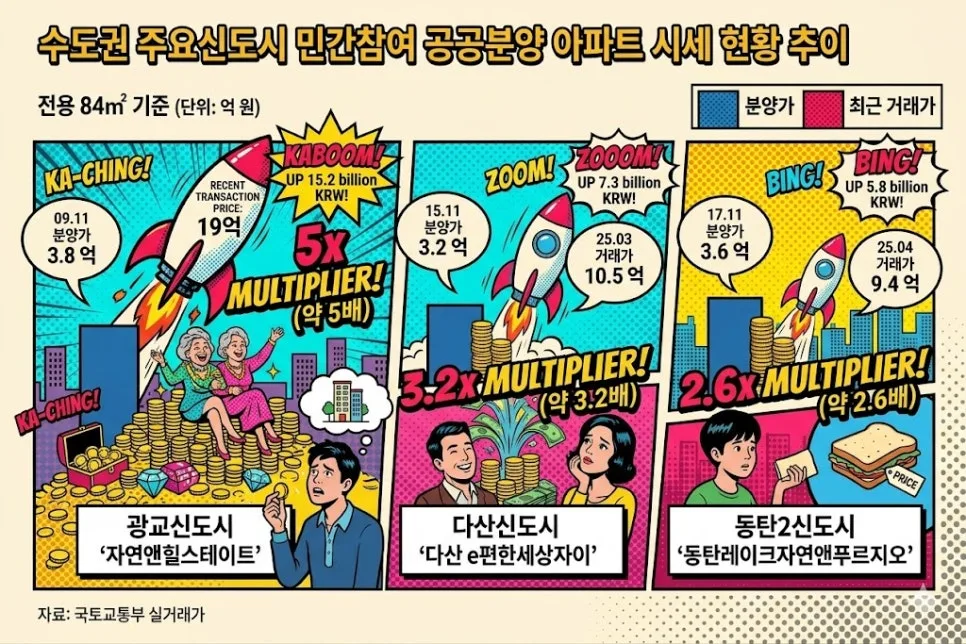
Developments under the public-private partnership model are often dubbed 'lottery homes' due to their significant potential for capital gains. This model works by having public entities provide the land, which helps to lower the overall sale price, while private construction companies handle the design and building, ensuring high-quality construction and amenities. This combination aims to deliver 'affordable yet premium branded apartments.' Historically, similar projects have shown remarkable price appreciation. For instance, the Gwanggyo Natural Hillstate, initially sold for approximately $280,000 (380 million KRW), later traded for as high as $1.4 million (1.9 billion KRW). Likewise, the Dasan e-편한세상자이, bought for around $240,000 (320 million KRW), saw its value climb to $780,000 (1.05 billion KRW). These proven examples clearly illustrate why these developments are considered highly lucrative opportunities, akin to winning a lottery.
How should you plan your finances for a 3rd New Town housing application?
Even with a high application score, securing the necessary funds for the down payment and final balance is critical for successful homeownership. It's essential to consider the Debt Service Ratio (DSR) regulations, which limit the total amount you can borrow based on your income. Understanding your maximum loan eligibility at the time of move-in is crucial, especially as interest rates can fluctuate, significantly impacting monthly payments. Furthermore, the 3rd New Town developments typically come with mandatory residency requirements, meaning you cannot rent out the property to cover your mortgage. Therefore, accurately calculating the total funds needed from the initial deposit to the final payment, based on your personal financial situation, is absolutely essential for a realistic plan. Failing to do so could jeopardize your ability to move into your new home.
What are the key considerations when applying for a 3rd New Town property?
Applying for a 3rd New Town property requires more than just luck; it demands thorough research and meticulous financial planning. Instead of relying solely on chance, diligently analyze the typical winning scores for these applications and realistically assess your borrowing capacity. It's vital to thoroughly research the specific location, planned transportation networks, and local amenities of each development. Calculate your potential mortgage amount based on your income and existing debts. Beyond the base sale price, remember to factor in additional costs such as optional upgrades (like built-in air conditioning or wardrobes) and moving expenses to determine the total capital required. If you're uncertain about your financial readiness, it's wiser to approach the application cautiously rather than overextending yourself. Consulting with a financial advisor can provide clarity on loan limits tailored to your income and debt profile.
English crawl path
Next English reads from this pilot cluster
Continue through the category hub, latest English stories, and related posts so this translated article is not an isolated URL.
Tags
💬Frequently Asked Questions
What should I check first in 3rd New Town Korea 2026: $500K Home Prices & Funding Plan?
Does this Finance article link back to the Korean source?
Where can I find similar English stories?
English discovery path
Explore more English K-culture stories
Keep browsing the indexed English pilot cluster so Google and readers can move between this story, the category hub, and fresh discovery pages.
Original Source
Read the Korean original