While many are asking if IonQ could be the next Nvidia, its true value lies in groundbreaking technical achievements and significant revenue growth. In 2026, IonQ is poised to become a critical infrastructure player, moving beyond a mere thematic investment. This analysis explores its potential to revolutionize industries.
How Did IonQ Break Through Technical Barriers in 2026?
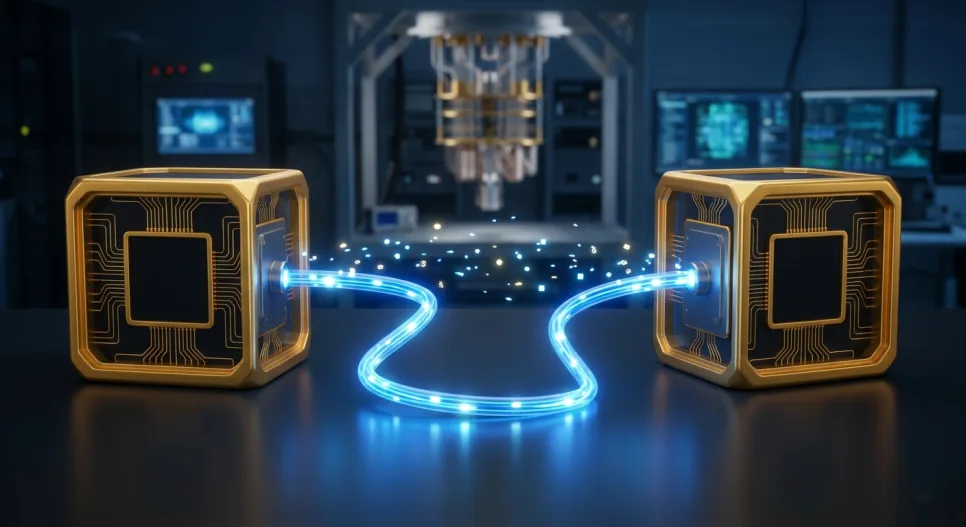
Initially, I was skeptical about the commercial viability of quantum computing. However, IonQ's announcement on April 14, 2026, of successfully connecting two independent quantum computers via an optical network was a game-changer. This marked the dawn of 'quantum networking,' a development that could exponentially enhance quantum computer scalability and processing power, akin to the evolution from single-core to multi-core CPUs. The subsequent 15% stock surge validated this shift, signaling that the market now views IonQ as an infrastructure builder rather than just a research firm. These advancements will solidify quantum computing's role in solving complex scientific and industrial challenges.
What Does IonQ's 81% Revenue Growth in 2026 Mean?
As an investor, I prioritize financial performance. IonQ projects an 81% year-over-year revenue increase to $235 million in 2026. While still operating at a loss, this mirrors Nvidia's early growth phase, focusing on market share and technological dominance over immediate profitability. Key developments include a major contract with the U.S. Department of Defense (DARPA) and the supply of an on-premise system to the Korea Institute of Science and Technology Information (KISTI). These milestones indicate that enterprises are beginning to build their own quantum computing infrastructure, proving IonQ's business model is gaining traction in the real market.
Why is IonQ Called the 'Brain' of Future Industries?
Just as Nvidia provided the 'rice'—the computational power—for the AI revolution, IonQ has the potential to be the core 'brain' solving future complex problems. Its proprietary ion trap technology offers a cost advantage over superconducting methods and has higher potential for room-temperature operation, giving it a significant technological edge. Furthermore, IonQ is actively collaborating with major cloud providers like Amazon (AWS), Microsoft, and Google, and recently partnered with Nvidia to lead the quantum-AI hybrid ecosystem. This robust network positions IonQ at the center of future computing environments. Despite recent short-seller attacks, stock rebounds following technical breakthroughs underscore market interest and IonQ's growth potential.
What's the Guiding Principle for Investing in IonQ?
I've experienced the volatility of IonQ's stock, including drops below $10. Yet, I always return to the question: 'Can we imagine a future without quantum computing?' Solving problems like drug discovery, battery efficiency, and financial modeling in minutes—tasks that would take supercomputers millennia—makes quantum computing a necessity, not a luxury. Therefore, a long-term perspective focused on securing a stake in future infrastructure is crucial, rather than reacting to short-term price fluctuations. While IonQ remains a high-volatility growth stock requiring careful consideration, quantum computing is no longer science fiction; it's a tangible, transformative wave. I encourage you to observe IonQ's journey as it aims to become the next Nvidia. I hope this analysis provides valuable insights for your investment decisions.
For more details, check the original source below.





