
The Hwaseong H-Techno Valley's management plan received its first amendment on April 17, 2026, officially expanding its scope and enhancing its focus on smart logistics and eco-friendly energy industries. This strategic update aims to solidify its position as a critical hub for South Korea's burgeoning semiconductor and future automotive sectors, attracting significant investment and fostering innovation within the region.
What are the key updates to the Hwaseong H-Techno Valley management plan?
The first amendment to the Hwaseong H-Techno Valley General Industrial Complex management plan was finalized on April 17, 2026, under Hwaseong City Notice No. 2026-427. The core of this amendment involves extending the project timeline, increasing the overall complex area, and reconfiguring industry zones to support future growth engines. The business period has been extended by two years, from 2025 to 2027, ensuring a more stable development phase. The total land area has grown by 580 square meters to 736,617 square meters. Crucially, to meet corporate demand, the industrial facility zone has been expanded by 3,766 square meters. Furthermore, zones dedicated to smart logistics and eco-friendly energy industries have seen significant increases of 22,060 square meters and 4,949 square meters, respectively, accelerating the development of future-oriented industrial ecosystems. To enhance the working environment, parking space has been increased by 1,446 square meters and green space by 2,074 square meters. In line with ESG (Environmental, Social, and Governance) principles, a new regulation mandates that companies within the industrial facility zone must install a minimum of 2.5kW of solar power generation facilities per 1,000 square meters of land.
Why is H-Techno Valley emerging as a key hub for semiconductors and future mobility?
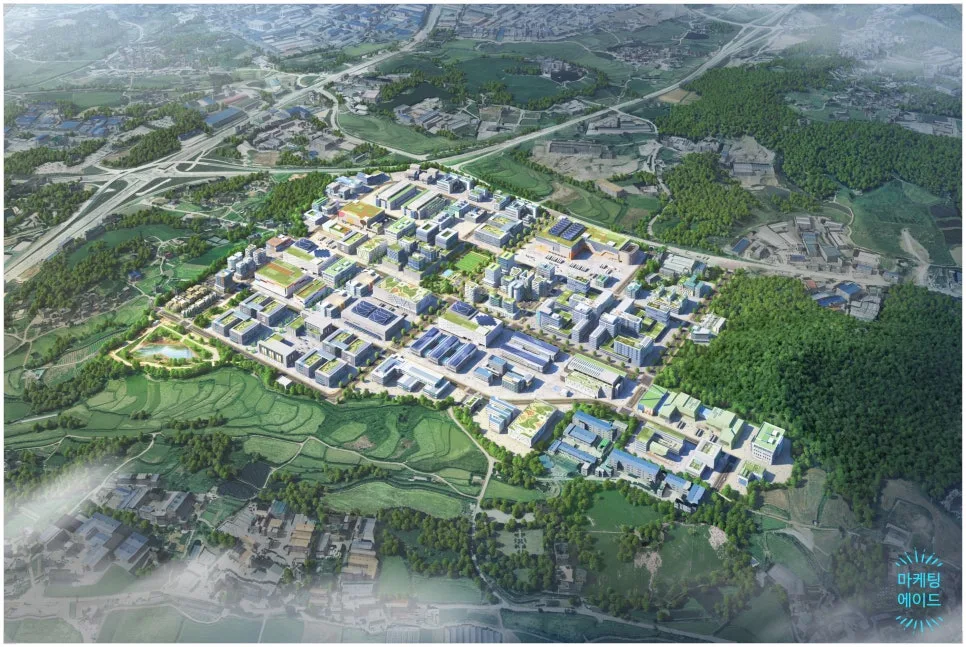
Located in Hwaseong City, Gyeonggi Province, the H-Techno Valley is strategically positioned to become a powerhouse in advanced industries. Its prime location offers excellent connectivity, being adjacent to National Roads 39 and 82, just a minute from the Yodang IC, and five minutes from the Cheongbuk IC of the Pyeongtaek-Jecheon Expressway, facilitating nationwide logistics. It's also situated just 15 minutes from the world's largest Samsung Electronics Godeok campus and in close proximity to Hyundai and Kia Motors' industrial infrastructure, placing it at the heart of South Korea's advanced industrial value chain. The nearby Hyangnam New City, with a population of 1.48 million, and the Hyangnam Station on the West Coast Line, provide access to a skilled workforce and convenient commuting options for employees. These geographical advantages are expected to significantly boost corporate value and operational efficiency.
What are the specific land use zones and eligible industries within H-Techno Valley?
H-Techno Valley offers a diverse range of land use zones tailored to various business needs. The core industrial facility zones are designated as hubs for the semiconductor, future mobility, and smart logistics sectors, with eligible industries including metal processing, electronic components, electrical equipment, general machinery, and automotive manufacturing. Building regulations within these zones permit a maximum floor area ratio (FAR) of 350%, a building coverage ratio (BCR) of 70%, and a maximum building height of 5 stories (20 meters), allowing for efficient and modern factory designs. Notably, Industrial Block 12 is a dedicated smart logistics zone where warehouse facilities are permitted, with building heights allowed up to 50 meters, making it ideal for large-scale automated logistics operations. The complex also includes mixed-use and support facility zones to provide essential amenities for businesses and their employees.
What are the ESG and environmental regulations for businesses operating in H-Techno Valley?
H-Techno Valley is committed to leading in the era of ESG management and carbon neutrality through enhanced environmental regulations. The recent amendment mandates that companies within the industrial facility zones install a minimum of 2.5kW of solar power generation facilities per 1,000 square meters of land. This initiative aims to increase the utilization of renewable energy and reduce carbon emissions. The expansion of green spaces by 2,074 square meters contributes to a more pleasant industrial environment, while the significant growth in smart logistics and eco-friendly energy zones fosters a forward-thinking industrial ecosystem. These environmental policies are designed to support the sustainable growth of businesses and promote coexistence with the local community.
For detailed information, refer to Hwaseong City Notice No. 2026-427.





