If your investment portfolio is heavily weighted towards tech stocks, consider adding three stable consumer staples companies in 2026 to balance your holdings. Costco, Procter & Gamble (P&G), and PepsiCo offer resilience against economic downturns, helping to mitigate investment risk.
What Are the Risks of a Tech-Heavy Portfolio in 2026?
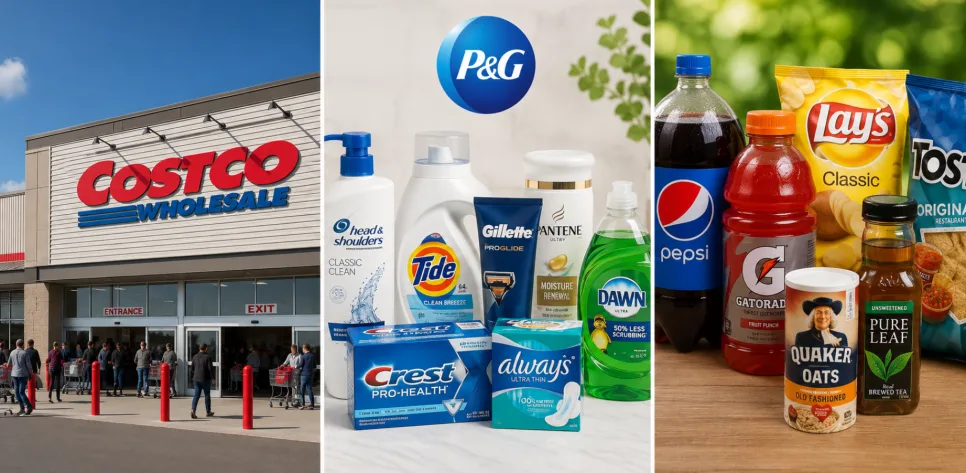
Many investors' portfolios remain unprepared for high volatility and uncertainty. Over-allocating to tech stocks, AI, semiconductors, and cloud-related companies can make a portfolio vulnerable to external shocks like economic recessions or interest rate fluctuations. 2026 could be the year many investors realize they have too much exposure to tech. Without sufficient diversification, there's a significant risk of substantial losses due to sharp financial market movements. A proven strategy to enhance portfolio resilience is to incorporate consumer staple stocks, which are known for their defensive qualities. These companies tend to maintain relatively stable revenues and cash flows even during economic slowdowns or inflationary periods.
Which Consumer Staples Companies Can Withstand a Recession?
Leading consumer staples companies that offer recessionary resilience and contribute to long-term portfolio stability include Costco, Procter & Gamble (P&G), and PepsiCo. Costco attracts and retains customer loyalty through its bulk discounts and private label 'Kirkland Signature.' Its high member renewal rate (92.1% in the U.S. & Canada) is a testament to this loyalty. With net sales up 13% year-over-year as of April 2026 and plans to open 28 new stores by year-end, Costco shows strong growth potential. P&G, owner of essential household brands like Gillette and Crest, benefits from consistent demand regardless of economic conditions. Its status as a 'Dividend King,' with 69 consecutive years of dividend increases, underscores its robust financial health and stability. PepsiCo generates stable revenue through a diverse portfolio including Pepsi-Cola, Gatorade, and Quaker Oats. Its 54 consecutive years of dividend increases and a dividend yield of approximately 3.7% make it a valuable defensive asset.
What Makes Costco, P&G, and PepsiCo Attractive Investments?
Costco's robust membership business model fosters strong customer loyalty, reflected in its stock performance, which has surged 160% over the past five years, significantly outperforming the S&P 500's 77% gain. While its dividend yield is modest at around 0.5%, its substantial stock appreciation potential is a key draw. P&G's remarkable 69-year streak of increasing dividends signals consistent cash flow and a commitment to shareholder returns, offering a dividend yield of approximately 2.9%, appealing to income-focused investors. PepsiCo boasts the highest dividend yield at about 3.7% and, with 54 consecutive years of dividend increases, serves as a strong portfolio stabilizer. Unlike Coca-Cola, PepsiCo's diversified portfolio extends beyond beverages to snacks and cereals, contributing to a larger overall revenue base.
What Should Investors Watch Out For with Consumer Staples Stocks?
While consumer staples are generally less sensitive to economic cycles, they are not immune to risks such as rapid shifts in consumer behavior, rising raw material costs, or increased competition. For instance, Costco's growth could be impacted by its membership fee structure or the pace of new store openings. P&G faces challenges from the competitive landscape of its diverse brands and the success of new product development. PepsiCo must navigate competition from Coca-Cola and adapt to evolving health trends in the beverage market. Therefore, thorough analysis of each company's financial health, competitive environment, and growth strategies is crucial before investing. Diversifying your portfolio beyond just consumer staples, and including growth stocks like tech, is essential for long-term risk management. Consulting with a financial advisor to align investment strategies with personal goals and risk tolerance is highly recommended.
For more details, check the original source below.