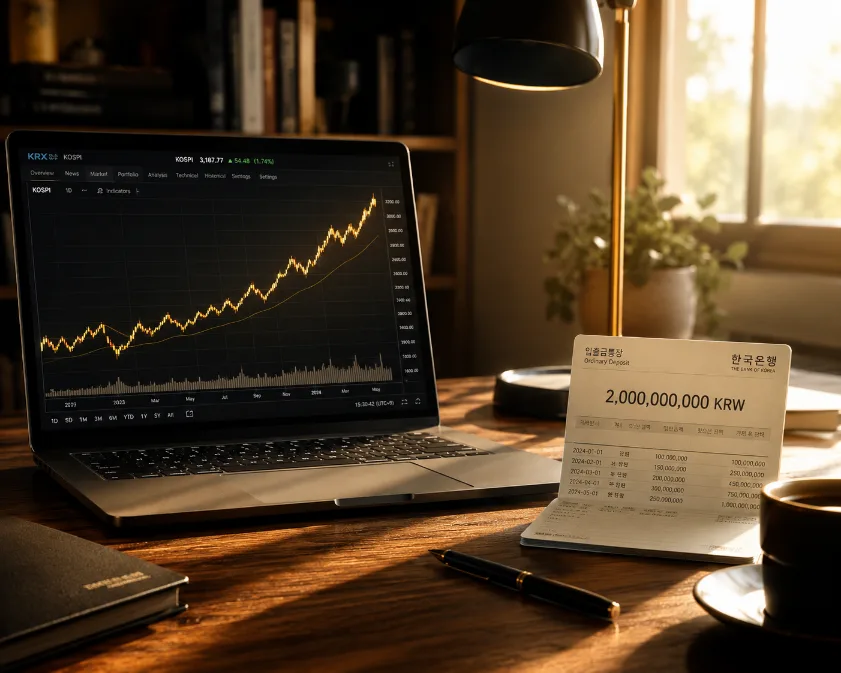
The only surefire way for an average employee to build a $2 million retirement fund by age 60 is to ride the market's growth and stay invested over time. By investing $1,000 per month with an assumed 10% annual return for 30 years, you can accumulate approximately $2.2 million. The key is to leverage broad market index ETFs that track major U.S. indices, allowing you to capture the growth of capitalism without the risk of individual stock picking.
What's the ETF Strategy for Average Employees to Reach $2 Million by 60?

The core principle is to align with market growth and remain invested for the long haul, rather than trying to outsmart the market. Assuming a 10% annual return, investing $1,000 monthly for 30 years can lead to roughly $2.2 million. This strategy hinges on achieving that 10% return and maintaining the 30-year investment horizon. While individual stocks carry the risk of delisting and require constant monitoring, ETFs that track major U.S. indices automatically adjust their holdings, reflecting the broader economic growth. Many employees are successfully using the power of compounding to steadily grow their wealth through this approach.
Should You Choose S&P 500 or Nasdaq 100 ETFs?
S&P 500 ETFs (like VOO, IVV, SPY) offer diversification across 500 of the largest U.S. companies, covering various sectors such as tech, finance, and healthcare. This makes them relatively stable and suitable for building 'standard wealth.' In contrast, Nasdaq 100 ETFs (like QQQ) are heavily weighted towards technology stocks (Microsoft, Apple, Nvidia), offering higher growth potential but also greater volatility during market downturns. A common recommendation is the '7:3 strategy,' allocating 70% to S&P 500 ETFs and 30% to Nasdaq 100 ETFs. However, it's crucial to adjust this ratio based on your personal investment style and risk tolerance.
What Are the Benefits of Dollar-Cost Averaging During Market Downturns?
Dollar-cost averaging (DCA) turns market downturns into buying opportunities. For instance, if you invest $1,000 when a stock is at $10, you buy 100 shares. If the price drops to $5, that same $1,000 buys 200 shares. When the market recovers, having acquired more shares at lower prices significantly amplifies your returns. This strategy of 'scaling in' by lowering your average cost basis is incredibly powerful for long-term wealth accumulation.
How Can You Save on Taxes Using IRP and Pension Savings Accounts?
For employees, prioritizing tax savings is crucial. By contributing up to $9,000 annually to a Pension Savings Account (similar to a Traditional IRA) and an Individual Retirement Pension (IRP, similar to a 401(k) or self-employed IRA), you can receive tax deductions of up to $1,485, depending on your income bracket. Furthermore, you benefit from tax deferral, meaning you don't pay taxes on investment gains (like dividends or capital gains) until withdrawal. This deferred tax amount can be reinvested, significantly boosting long-term compound growth and potentially creating hundreds of thousands of dollars more in your retirement fund over 30 years.
How Can You Utilize the Tax Benefits of an ISA Account?
An Individual Savings Account (ISA) is often called a 'tax-efficient all-in-one account.' It allows you to earn up to $2,000 in investment income tax-free annually (or $4,000 for eligible low-income individuals). Additionally, it offers a 'net loss offset' feature, where losses within the account can be used to reduce taxable gains. This is particularly beneficial when investing in U.S. ETFs listed on Korean exchanges (like TIGER U.S. S&P 500) through an ISA. Opening and utilizing an ISA is highly recommended for maximizing investment returns.
Recommended ETF Portfolios by Age Group (30s-50s)
Investment goals and risk tolerance vary by age, so portfolio allocation should adapt accordingly. For individuals in their 30s, aggressive growth can be pursued by allocating 60% to Nasdaq 100 ETFs and 40% to S&P 500 ETFs. In your 40s, a balanced approach might involve 50% S&P 500, 30% Nasdaq 100, and 20% in dividend-focused ETFs like SCHD. For those in their 50s, prioritizing income and capital preservation could mean allocating 40% to S&P 500, 40% to dividend ETFs like SCHD, and 20% to bonds or cash equivalents. Tailoring your portfolio to your age ensures effective long-term wealth management.
Why Is Long-Term ETF Investing Essential?
Significant stock market gains are often concentrated within a few 'best days.' Missing just the top 10 best performing days over the past two decades could cut your overall returns in half. Therefore, attempting to time the market by selling at peaks and buying at troughs is a risky strategy. It's more effective to adopt the mindset of a patient farmer rather than a speculative astrologer. Consistently investing with a long-term perspective and allowing the market to grow is the most reliable path to maximizing your returns. This is not financial advice. Consult a licensed financial advisor before making investment decisions.
English crawl path
Next English reads from this pilot cluster
Continue through the category hub, latest English stories, and related posts so this translated article is not an isolated URL.
Tags
💬Frequently Asked Questions
What should I check first in Build $2 Million Retirement Fund: ETF Investing 2026?
Does this Finance article link back to the Korean source?
Where can I find similar English stories?
English discovery path
Explore more English K-culture stories
Keep browsing the indexed English pilot cluster so Google and readers can move between this story, the category hub, and fresh discovery pages.
Original Source
Read the Korean original