In May 2026, over 200 million shares from 56 companies are set to have their mandatory holding periods expire. This influx of shares could significantly increase market liquidity, so investors need to pay close attention. Keep an eye on major stocks like Ecopro Materials and Hanwha Aerospace, as their large volume expirations warrant careful consideration.
What Stocks Are Expiring Lock-Up Periods in May 2026?

According to Korea Securities Depository (KSD) data, a total of 202.42 million shares from 56 listed companies are scheduled for mandatory holding period expiration in May 2026. This event is expected to bring a substantial increase in tradable shares to the market. The expirations are spread across the KOSPI (Korea Stock Exchange) with 7 companies releasing 46.252 million shares, and the KOSDAQ with 49 companies releasing 156.166 million shares. Notably, Ecopro Materials will see 32.445 million shares (46% of its total issued shares) unlocked, which could have a significant market impact. Hanwha Aerospace will also release 1.715 million shares (3% of its total issued shares). Such large-scale expirations can lead to increased stock volatility due to the rise in available shares, making it crucial for investors to check the expiration dates of these stocks before making investment decisions.
Why Should You Be Cautious About Lock-Up Expirations?
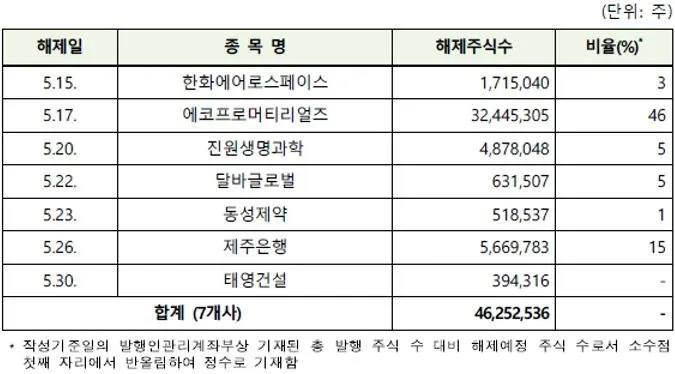
The expiration of mandatory holding periods signifies that these shares can now be freely traded on the market. This can create downward pressure on stock prices in the short term due to the increased supply. The impact can be even more pronounced for stocks where the unlocked volume represents a high percentage of the total issued shares. For instance, with Ecopro Materials, nearly half of its total shares will become available, potentially leading to significant price fluctuations. Therefore, investors must closely monitor the trading volume and price movements of these stocks around their expiration dates. Even if the unlocked shares are not immediately sold, they can still create psychological pressure in the market. KSD also emphasizes the need to be aware of the potential volatility arising from increased market liquidity.
Understanding Lock-Up Periods, Custody, and Commitments
In the stock market, terms like 'mandatory holding period' (의무보유등록), 'custody' (보호예수), and 'holding commitments' (의무보유확약) are often used interchangeably, but they have distinct meanings. A mandatory holding period is a regulatory requirement that restricts the sale of shares held by major shareholders for a specific period, primarily to protect general investors. Custody, on the other hand, refers to the physical deposit of shares with a depository institution like KSD for a certain period, thereby restricting their sale. A holding commitment, typically made during an Initial Public Offering (IPO), is a voluntary promise by institutional investors to hold their allocated shares for a specified duration, often in exchange for preferential allocation. Self-imposed holding commitments involve major shareholders voluntarily promising to hold shares for a certain period after listing. Each of these systems differs in its purpose, the parties involved, and the method of execution, necessitating a precise understanding.
What Are the Reasons for Lock-Up Period Expirations?
Mandatory holding period expirations primarily occur due to regulatory compliance. According to KSD data, the largest portion of shares expiring in May 2026 falls under the 'KOSDAQ Market Listing Regulations,' amounting to 104.86 million shares. Following this, 64.01 million shares are set to expire under the 'Regulations on Securities Issuance and Disclosure.' Additionally, 33.08 million shares will expire under the 'KOSPI Market Listing Regulations,' and 0.47 million shares under other legal provisions. These regulations are designed to ensure management stability in newly listed companies, prevent unfair trading practices, and protect general investors. Therefore, the expiration of mandatory holding periods occurs when the legally stipulated duration has been met.
For more details, check the original source below.





