When choosing between the TOEIC and TOEIC Speaking tests for your resume, consider your timeline and career goals. If you need a quick score, TOEIC Speaking is often more efficient, requiring about one month for preparation versus 3-6 months for TOEIC. The tests differ significantly in format, study approach, and the type of English proficiency they measure, making one potentially more advantageous for your specific needs in 2026.
TOEIC vs. TOEIC Speaking: Key Differences for US Job Seekers
Navigating the world of English proficiency tests can be confusing, especially when job applications list requirements like TOEIC 700+ or TOEIC Speaking 130+. Many US-based companies, particularly those with international operations or diverse workforces, value standardized English scores. However, the choice between the traditional TOEIC (Test of English for International Communication) and TOEIC Speaking can significantly impact your preparation time and effectiveness. If you're on a tight schedule, attempting to study for both simultaneously is highly inefficient. TOEIC Speaking offers a faster path to a target score for many, given its focused format and the potential for rapid improvement through targeted practice. This makes it a strategically sound choice for individuals needing to quickly bolster their resumes with a verifiable English speaking qualification.
Why TOEIC Speaking Offers Faster Results Than TOEIC
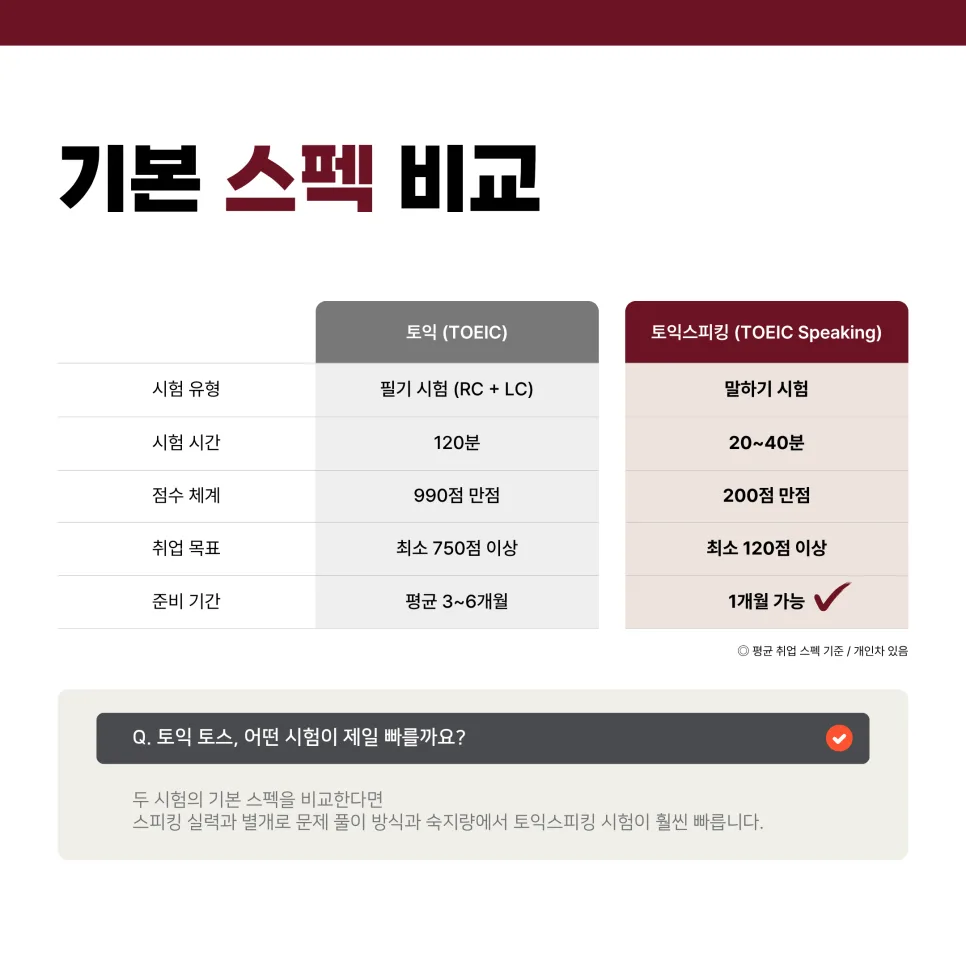
TOEIC Speaking often allows test-takers to achieve their desired scores more rapidly than the standard TOEIC for several key reasons. Firstly, the scope of TOEIC Speaking is considerably narrower and more defined. It consists of just 11 questions, with a predictable sequence of tasks. In contrast, achieving a high TOEIC score (e.g., 800+) requires mastering a broad range of skills, including extensive vocabulary, grammar, reading comprehension, and listening comprehension, demanding a much larger volume of study. Secondly, TOEIC Speaking lends itself well to score improvement through memorizing specific patterns and templates. Mastering these pre-defined structures can lead to a target score within a shorter timeframe. Lastly, it requires less intensive study of broad vocabulary and complex grammar rules compared to TOEIC. Speaking skills often show rapid improvement through repetition and practice, making it possible to gain proficiency faster than through the more academic approach needed for TOEIC's reading and listening sections.
TOEIC 950 vs. TOEIC Speaking 140: Which Score Impresses US Employers More?
While a TOEIC score of 950 is exceptionally high and indicates strong overall English proficiency, it primarily measures passive skills like reading and listening. In today's globalized business environment, many US companies and international organizations are placing a greater emphasis on active communication skills. Consequently, a TOEIC Speaking score of 140 or higher is increasingly favored by employers who prioritize practical, real-world English conversation abilities. While a high TOEIC score is valuable, it doesn't directly demonstrate your ability to communicate effectively in spoken English. For roles requiring frequent client interaction, presentations, or team collaboration, a strong TOEIC Speaking score can be a more compelling indicator of readiness. It's important to note that self-study for TOEIC Speaking can be challenging; refining pronunciation, intonation, and avoiding common speaking pitfalls requires expert guidance to ensure you don't inadvertently develop bad habits that could lead to lower scores.
How to Ace TOEIC Speaking in 30 Days for Your US Career
To maximize your chances of achieving your target score on the TOEIC Speaking test within a 30-day timeframe, a personalized approach is crucial. Consider enrolling in 1:1 coaching sessions tailored to your current English level and specific score goals. These sessions can help customize practice scripts, provide targeted feedback on pronunciation and intonation to sound more natural, and build confidence through timed practice drills. Focusing on the specific question types and response structures for each part of the test is essential. For instance, practicing describing images, following directions, answering direct questions, and presenting opinions using effective templates will be key. Consistent practice, ideally with feedback from an instructor or native speaker, will help you internalize the required speaking patterns and improve your fluency and accuracy within the tight deadline.
For more details, check the original source below.





