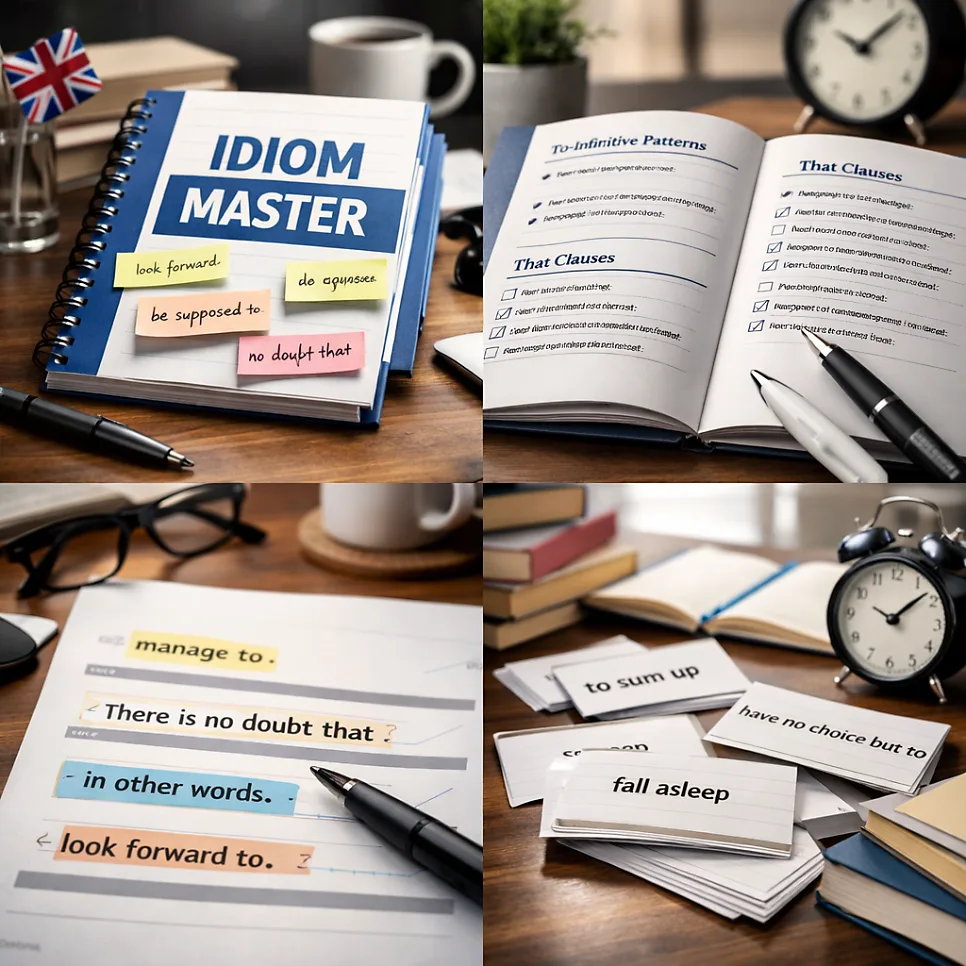
Mastering English idioms and phrases is key to boosting your English proficiency in 2026. Many learners struggle with sentence interpretation despite knowing individual words, often due to a lack of systematic understanding of these expressions and sentence structures. This guide focuses on essential idiomatic expressions to help you overcome these challenges.
Why Are English Idioms Crucial and How Should You Study Them?
Idiomatic expressions in English are like secret codes that unlock deeper meaning. Often, simply combining the definitions of individual words won't give you the full picture of a sentence. For instance, 'look forward to -ing' means 'to anticipate something eagerly.' If you don't recognize 'to' as a preposition here, you might mistakenly interpret it as part of an infinitive, leading to misinterpretation. These expressions are frequently tested in exams like the SAT and TOEIC, and are essential for natural communication in everyday English conversations. Therefore, it’s crucial to go beyond simple memorization and learn how these idioms are used within context. Based on my own learning experiences, systematically organizing and repeatedly reviewing these idiomatic phrases significantly improves reading speed and comprehension.
Understanding Key Sentence Structures: Gerunds, Infinitives, and That-Clauses
Related Articles
Mastering idiomatic expressions related to gerunds, infinitives, and that-clauses is vital for grasping English sentence structure. For example, the structure 'spend time/money -ing' means 'to use time/money doing something,' and 'have trouble (in) -ing' signifies 'to experience difficulty doing something.' The phrase 'be supposed to-V' indicates an obligation or expectation, while 'manage to-V' implies succeeding in something difficult. Expressions like 'There is no doubt that ~' convey strong certainty, and 'It turns out that ~' reveals a final outcome. Understanding these structures allows for clearer interpretation of complex sentences. Acquiring these core structures enhances your ability to quickly comprehend lengthy sentences.
Connectors and Prepositional Phrases: The Key to Logical Writing and Reading
Connectors and prepositional phrases are crucial for understanding the logical flow between sentences and paragraphs. 'However' indicates contrast, 'therefore' shows a cause-and-effect relationship, and 'in other words' is used for restatement. Phrases like 'to sum up' help summarize and conclude content. Additionally, prepositional phrases like 'look forward to -ing' can be confusing; it's important to remember that 'to' functions as a preposition here. Accurately understanding and using these connectors and prepositional phrases sharpens your logical thinking and improves your ability to follow the overall argument of a text. In English writing and presentations, using these connectors effectively helps convey your logic more clearly.
Idioms, Phrasal Verbs, and Participle Clauses: Advanced Expression Mastery
Beyond basic sentence structures, idioms and phrasal verbs add richness and nuance to the English language. Idioms like 'break a leg' (good luck) or 'bite the bullet' (face a difficult situation with courage) are common in everyday conversation. Phrasal verbs, such as 'give up' (quit) or 'look into' (investigate), combine a verb with a preposition or adverb to create a new meaning. Mastering these requires understanding their figurative meanings, not literal ones. Participle clauses, like 'Having finished the project, he went home,' can condense information and create more sophisticated sentence structures. Learning these advanced elements allows for more natural and effective communication, mirroring how native English speakers express themselves.
Effective Strategies for Mastering English Expressions
To effectively master English expressions, a systematic approach is essential. Firstly, utilize structured learning materials, such as comprehensive PDF guides or online courses like Talk To Me In Korean (TTMIK) or Duolingo, which offer clear explanations and examples. Secondly, focus on understanding the context in which these expressions are used. Reading books, watching K-dramas with English subtitles, or listening to English podcasts can provide real-world examples. Thirdly, consistent review and active practice are vital. Use flashcard apps like Anki to memorize new phrases, and try incorporating them into your own writing and speaking. For those preparing for exams like TOPIK (Test of Proficiency in Korean) or the SAT, focusing on common test-specific phrases and practicing with past papers is highly recommended. Remember, consistent effort is the most effective strategy for long-term retention and fluency.
For more details, check the original source below.





