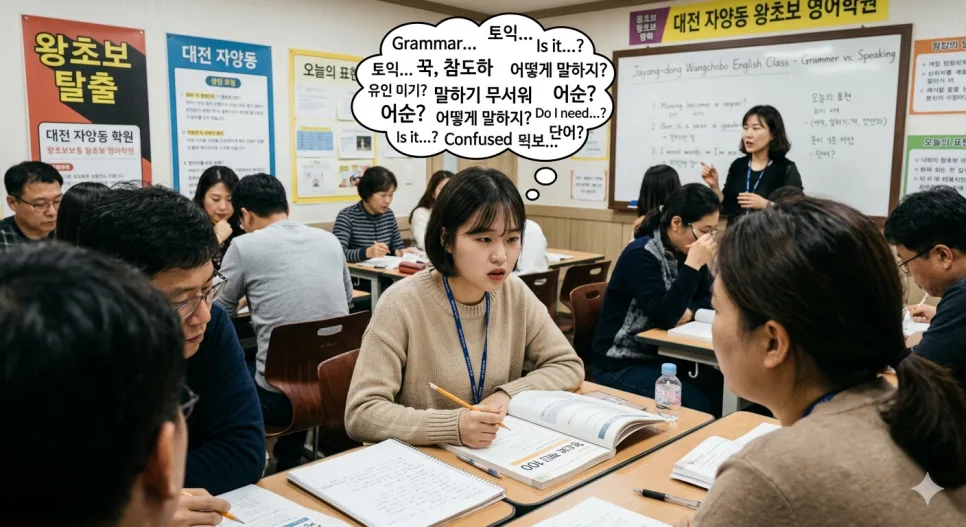
In 2026, the main reason many struggle to speak Korean, even after classes, is an over-reliance on 'knowledge-based' learning. Without real conversation practice, memorizing grammar and vocabulary won't translate into fluency. The key is mastering pattern-based speaking drills, which can unlock your ability to speak Korean, even for absolute beginners.
Why Does 'Knowledge-Based' Learning Hinder Korean Speaking Skills?
Many adult learners mistakenly view Korean as just another subject to acquire knowledge in. While memorizing vocabulary, solving grammar exercises, and reading comprehension can boost test scores, they don't directly build conversational ability. Korean, like any language, is a skill that requires muscle memory developed through consistent practice, not just theoretical understanding. This is why learners often get stuck after 'Annyeonghaseyo' or stumble through even a simple self-introduction. Accumulating theoretical knowledge without practical speaking experience can actually impede progress.
How to Start Pattern-Based Speaking Drills for Korean Beginners

For absolute beginners, the first crucial step is to create sentence structures that allow you to speak without overthinking. This is achieved by repeatedly saying simple phrases like '저는 [이름]입니다' (Jeoneun [name]imnida - I am [name]), '저는 괜찮아요' (Jeoneun gwaenchanayo - I'm good), or '저는 스포츠를 좋아해요' (Jeoneun seupocheureul joahaeyo - I like sports) until they become second nature. While self-study has its limits – difficulty in checking pronunciation, lack of correction, and trouble connecting phrases in real conversations – focusing on 'speaking more' is more important than 'knowing more' for beginners. A learning environment that combines easy pattern repetition, immediate feedback, and actual conversation practice is vital.
Addressing Challenges in Pattern Speaking Practice with 1:1 Native Speaker Coaching
The biggest hurdles in practicing Korean pattern speaking alone include the inability to verify pronunciation accuracy and the lack of immediate correction for mistakes. Furthermore, applying practiced sentences in actual conversations often proves difficult, leaving many learners stalled at the 'speaking' stage. To overcome these obstacles, 1:1 native speaker coaching is highly effective. Through conversations with native speakers, you can learn natural pronunciation and intonation, receive real-time feedback, and improve your overall conversational skills. For beginners, the 'experience of speaking' is far more critical than the sheer volume of knowledge acquired.
Real-Life Success Stories and the Core Principle of Korean Language Acquisition
Consider a learner who was initially hesitant to even say 'Hello' and feared making mistakes. After just 2-3 weeks of focused pattern-based speaking practice, they began to naturally utter simple phrases like 'I'm good' and respond to questions, albeit briefly. They experienced the gradual increase in their speaking time. This fundamental shift represents the transition from 'knowledge in the head' to 'words out of the mouth.' The core principle is that fluency isn't achieved by speaking perfectly from the start; rather, you improve by speaking. Therefore, for beginners, consistent repetition of simple sentences and active speaking are paramount.
For more details, check the original source below.





