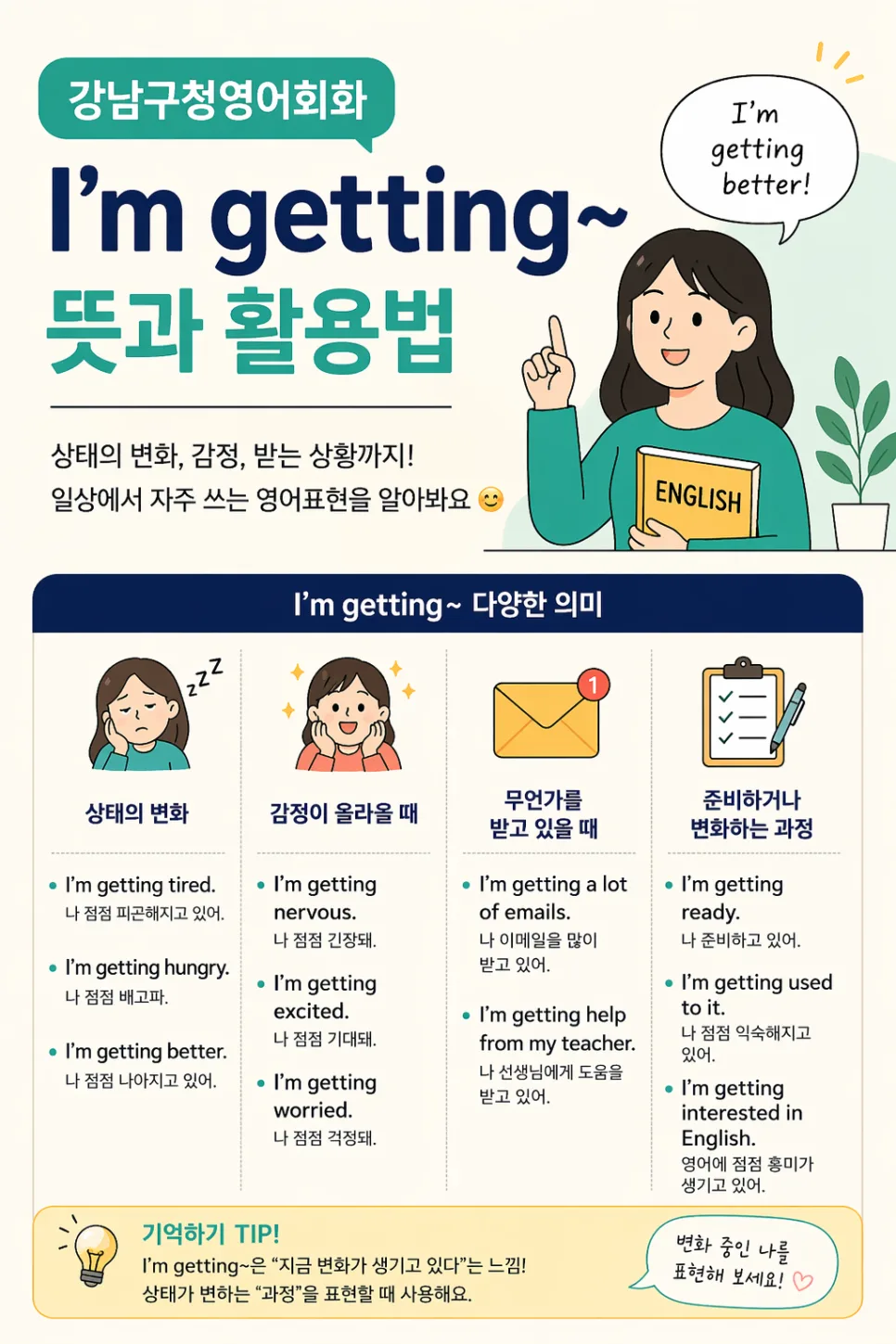
The 'I'm getting~' English pattern is easily mastered by beginners and can be used in various ways, such as indicating a gradual change in state, expressing feelings, receiving something, or describing a shifting situation. Learning this expression for change will make your English conversation much more natural.
Why the 'I'm Getting~' Pattern is Crucial for English Fluency
In English conversation, the verb 'get' is incredibly versatile, with meanings ranging from 'to receive,' 'to become,' 'to feel,' to 'to arrive,' depending on the context. The 'I'm getting~' structure, specifically, uses the present continuous tense to effectively convey that 'something is currently in the process of changing.' This offers a much more dynamic and vivid nuance compared to the static state described by 'I am ~.' For instance, while 'I am tired' simply states a current condition, 'I'm getting tired' emphasizes the process of becoming increasingly fatigued, adding depth to the conversation. For learners aiming for natural everyday dialogue, mastering this pattern is key to expressing evolving situations and feelings more accurately.
How to Specifically Utilize the 'I'm Getting~' Pattern

The 'I'm getting~' pattern can be broadly applied in four main ways. Firstly, it's used to describe changes in state. You'll frequently hear it in phrases like 'I'm getting tired,' 'I'm getting sleepy,' or 'I'm getting hungry,' indicating a shift in physical or mental condition. Secondly, it expresses changes in emotion. It's useful for conveying a gradually intensifying feeling, such as 'I'm getting nervous,' 'I'm getting excited,' or 'I'm getting worried.' Thirdly, it signifies that you are currently receiving something. This applies to situations like 'I'm getting a lot of emails' or 'I'm getting help from my teacher,' whether the reception is physical or abstract. Learning these diverse applications will significantly broaden your English conversational range.
Useful Everyday Sentences with the 'I'm Getting~' Pattern
Several 'I'm getting~' pattern sentences are frequently used in real English conversations and are particularly beneficial for learners to adopt. 'I'm getting better' is highly effective for expressing self-improvement in skills, boosting motivation for language study. 'I'm getting used to it' is useful for describing the process of adapting to a new environment or situation. Additionally, 'I'm getting ready' is a simple and convenient way to indicate you're preparing to go out or start something. 'I'm getting interested in English' is perfect for expressing a growing fascination with the language during your learning journey. Consistently practicing these short yet highly applicable sentences can greatly aid your English proficiency.
Tips for Learning the 'I'm Getting~' Pattern Without Confusion
The easiest way to understand the 'I'm getting~' pattern is to focus on the 'process of change' rather than a 'completed state.' For example, while 'I am tired' describes a fixed current condition, 'I'm getting tired' signifies a dynamic state where fatigue is gradually increasing. Remembering that 'getting' emphasizes change over time is crucial. Furthermore, this pattern typically indicates some form of change, whether positive or negative. It's most effective when you want to explain a process rather than just describe a current situation. By recognizing these nuances and practicing consistently, you can naturally master the 'I'm getting~' pattern. Continuous practice tailored to your individual learning pace and circumstances is key.
For more English pattern learning, check the original source below.





