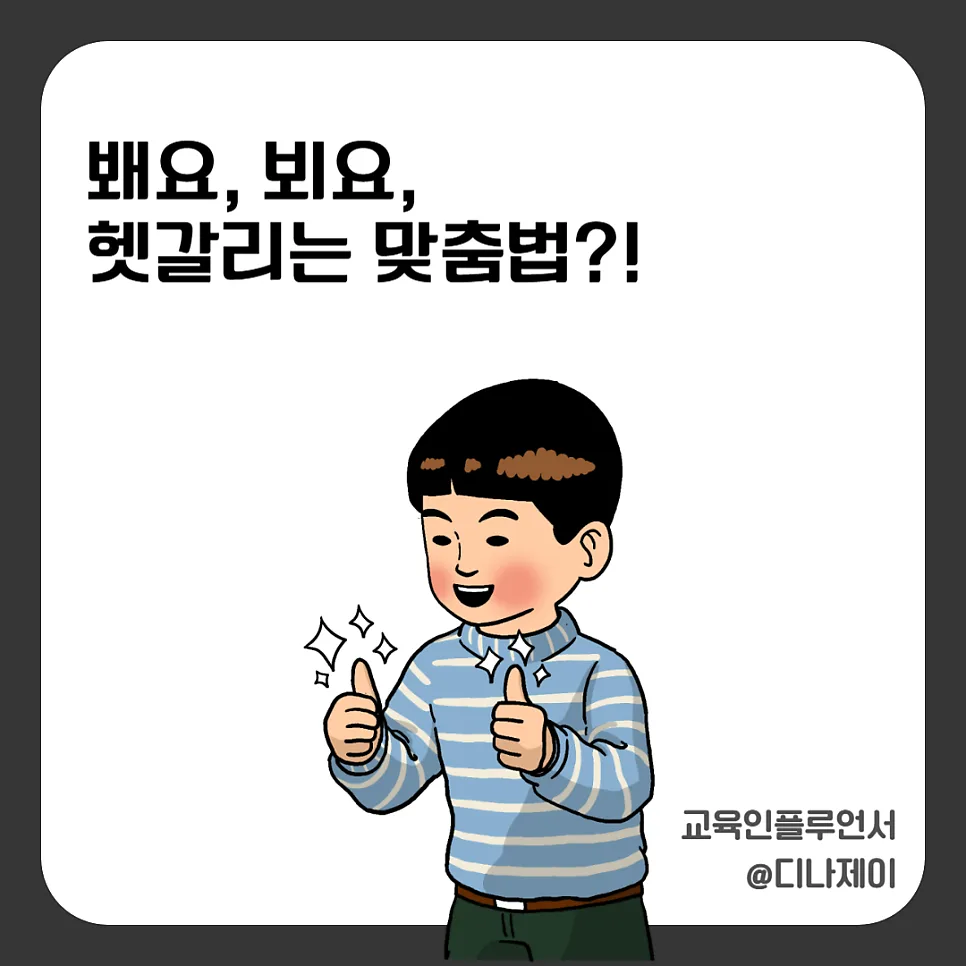
The key to mastering Korean spelling for '봬요' (bwaeyo), '뵈요' (boeyo), and '뵐게요' (bwelgeyo) in 2026 is understanding their origins and usage. '봬요' is the correct contraction of '뵈어요' (bo-eo-yo), while '뵈요' is incorrect. For future actions, '뵐게요' is the right form, derived from the verb '뵈다' (bweda) plus the future tense ending '-ㄹ게요' (-lgeyo); '뵐께요' (bwelkkeyo) and '봴게요' (bwelgeyo) are both incorrect. A simple trick is to substitute '뵈어요' for '봴요' or recall the base verb '뵈다' for future tense expressions.
Navigating Tricky Korean Spelling: 'Bwaeyo' vs. 'Boeyo' Explained
In Korean, spelling errors can significantly impact the credibility of your writing, and '봬요' (bwaeyo) versus '뵈요' (boeyo) is a common pitfall for learners. The correct expression is '봬요', which is a shortened form of '뵈어요' (bo-eo-yo). To check if you're using it correctly, try replacing '봬요' with '뵈어요'. If the sentence still makes sense, then '봬요' is the right choice. For instance, if you want to say 'See you tomorrow,' you'd use '내일 봬요' (naeil bwaeyo). This works because '내일 뵈어요' (naeil bo-eo-yo) is also grammatically sound. However, if you were to use '내일 뵈요' (naeil boeyo), replacing it with '내일 뵈어요' would sound awkward, indicating '뵈요' is incorrect. Consistent practice with this substitution method helps solidify the distinction between these two terms.
'Bwelgeyo', 'Bwelkkelyo', 'Bwelgeyo': Which Korean Future Tense is Correct?
Another common point of confusion for those learning Korean is the correct way to express future intentions, specifically with '뵐게요' (bwelgeyo), '뵐께요' (bwelkkeyo), and '봴게요' (bwelgeyo). Out of these, only '뵐게요' is the grammatically correct form. It's constructed by taking the verb '뵈다' (bweda - to see/meet) and adding the future tense ending '-ㄹ게요' (-lgeyo). Many learners mistakenly write '뵐께요' because it sounds similar when spoken, but Korean spelling adheres to grammatical rules, not just pronunciation. The form '봴게요' is entirely incorrect and doesn't exist in standard Korean. Remembering the base verb '뵈다' and the future tense suffix '-ㄹ게요' is the most reliable way to ensure you're using the correct form, '뵐게요'. For example, you would say '다음에 찾아 뵐게요' (da-eum-e chaja bwelgeyo - I will see you next time) or '시간 되면 뵐게요' (sigan doemyeon bwelgeyo - I will see you if I have time).
The Surefire Strategy for Confusing Korean Spelling

Even minor spelling mistakes can undermine the professionalism and trustworthiness of your written Korean, making it crucial to master common confusions like '봬요/뵈요' and '뵐게요/뵐께요/봴게요'. The most effective strategy, as mentioned, is the substitution test. For '봴요' and '뵈요', always try replacing the word with '뵈어요'. If it sounds natural, '봴요' is correct. For future tense expressions like '뵐게요', simply recall the infinitive verb '뵈다' and attach the future tense ending '-ㄹ게요' to form '뵐게요'. Mastering these two core principles will significantly reduce your spelling errors. For instance, when expressing gratitude for meeting someone, you'd say '만나서 반갑습니다' (mannaseo bangapseumnida - Nice to meet you), and if you were to use a future meeting context, you'd say '다음에 또 뵐게요' (da-eum-e tto bwelgeyo - I'll see you again next time).
Practical Tips to Reduce Korean Spelling Mistakes
If you lack confidence in your Korean spelling, it can make the entire writing process feel daunting. However, adopting a few practical habits can help you overcome these challenges and improve your accuracy. First, make it a habit to read your writing aloud after you've finished. This helps you catch awkward phrasing and incorrect spellings that you might otherwise miss. Second, keep a dedicated notebook or digital file for frequently misspelled words and their correct forms. Regularly reviewing your personal 'spelling error log' is highly effective. Third, utilize online Korean spell checkers and grammar tools, but don't rely on them blindly. Take the time to understand *why* a correction is suggested. This deeper understanding is key to long-term improvement and building confidence in your Korean writing skills.
For more details, check the original source below.





