Before your child dives into English studies this new school year, learn 5 common Konglish phrases to correct. Mastering accurate English expressions is crucial to prevent your child from feeling flustered during real conversations with native speakers.
Why Correcting Konglish is Crucial Before Starting English Studies in the New School Year?
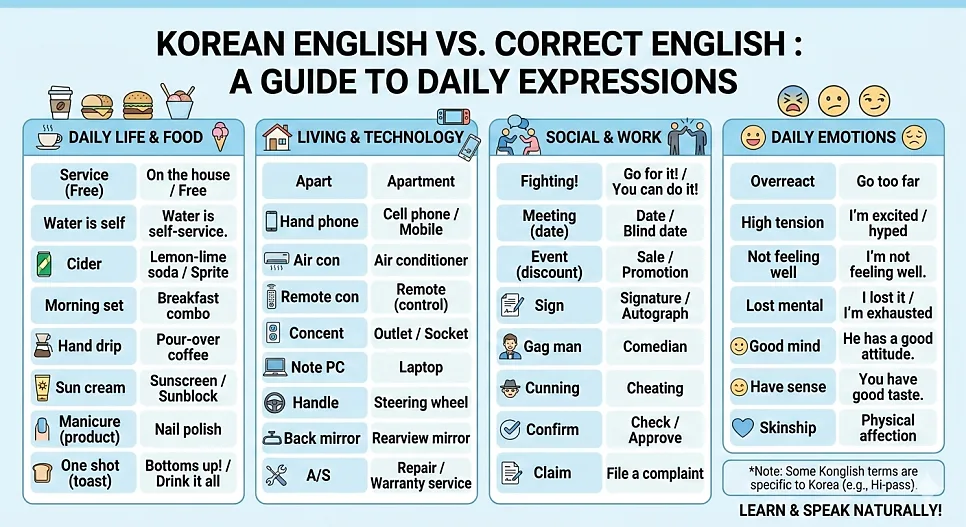
As the new academic year kicks off, interest in children's English education naturally surges. However, many kids stumble during real-life conversations with foreigners due to their unconscious use of 'Konglish'—English words or phrases influenced by Korean. For instance, asking for 'service' at a cafe might be misunderstood as a request for labor. Similarly, saying 'Water is self' can sound awkward. These Konglish expressions can chip away at a child's confidence and hinder effective communication. Therefore, it's paramount to address these incorrect phrases before embarking on new English studies. This goes beyond simple memorization; it cultivates a habit of understanding and using language accurately, significantly boosting your child's English proficiency. Correcting Konglish is an essential step in a child's language learning journey, providing motivation to stay engaged and learn consistently.
Common Konglish Phrases in Daily Life & Their Correct English Equivalents
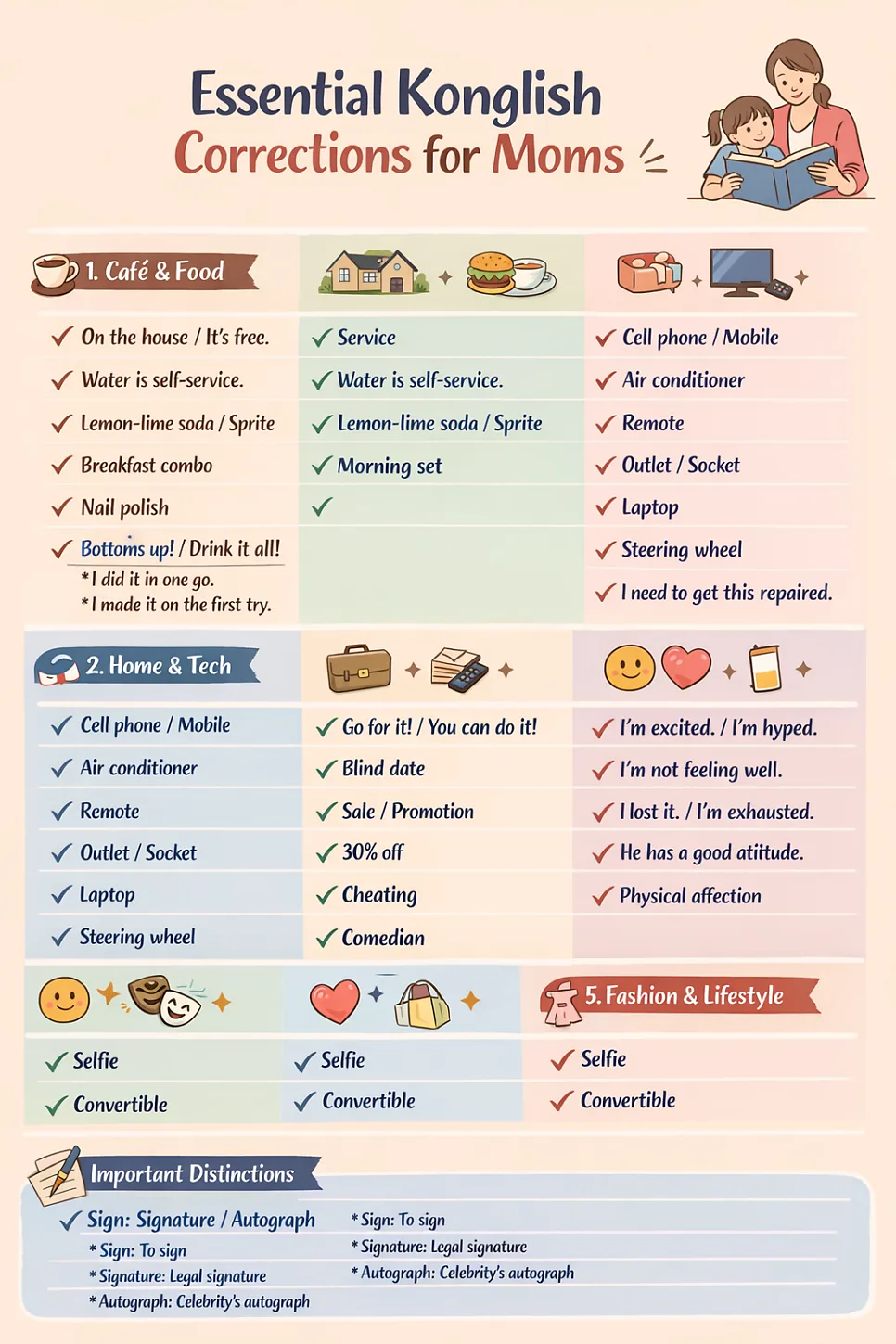
Many expressions we use daily are actually Konglish. At cafes, instead of asking for 'service,' it's more natural to say 'On the house' or 'Free.' For 'Water is self,' the correct phrase is 'Water is self-service.' In housing and appliance contexts, use 'Outlet' or 'Socket' instead of '콘센트' (consent), and 'Rearview mirror' instead of '백미러' (back mirror). In social situations, encouraging someone with 'Go for it!' or 'You can do it!' is better than '화이팅!' (Hwaiting!). A date or blind date is the appropriate term for '미팅' (meeting, in the context of a blind date). When expressing emotional distress, 'I lost it' or 'I'm exhausted' is more fitting than '멘탈 나갔다' (mental went out). 'Physical affection' is the correct term for '스킨십' (skinship). In fashion, 'Dress' is used for '원피스' (one-piece dress), and 'Plastic bag' for '비닐봉지' (vinyl bag). Mastering these accurate expressions helps reduce confusion for children when communicating with native speakers.
The Secret to Boosting Your Child's English Confidence Through Konglish Correction?
Correcting Konglish plays a pivotal role in enhancing a child's English confidence. When children use accurate English expressions, they feel more assured in conversations with native speakers and become more proactive in their communication efforts. This leads to positive experiences in English learning, further strengthening their motivation. Moreover, accurate language use helps children perceive English not just as a subject to memorize, but as a practical tool for real-world communication. These experiences encourage children to enjoy learning English and contribute to long-term skill improvement. Therefore, paying attention to the English expressions your child uses at home or in educational settings, and gently correcting Konglish when you notice it, is crucial. Guiding your child to find and use the correct expressions independently is highly effective.
What to Keep in Mind During Konglish Correction?
When correcting Konglish, there are a few key points to remember. Firstly, avoid being overly critical or accusatory when your child uses an incorrect phrase, as this can dampen their enthusiasm for learning English. Instead, it's important to naturally introduce the correct expression in a positive environment. Secondly, focus on correcting the most frequently used or impactful Konglish phrases that might hinder communication, rather than striving for absolute perfection immediately. This approach is more effective. Lastly, make the correction process engaging and fun, perhaps through quizzes or games, to prevent boredom. For example, using a list of common Konglish phrases presented today to play a quiz game with your child can be a great way to help them learn accurate English expressions enjoyably.
English crawl path
Next English reads from this pilot cluster
Continue through the category hub, latest English stories, and related posts so this translated article is not an isolated URL.
Tags
💬Frequently Asked Questions
What should I check first in Fix Konglish for Kids: 5 Essential English Corrections 2026?
Does this Language Learning article link back to the Korean source?
Where can I find similar English stories?
English discovery path
Explore more English K-culture stories
Keep browsing the indexed English pilot cluster so Google and readers can move between this story, the category hub, and fresh discovery pages.
Original Source
Read the Korean original





