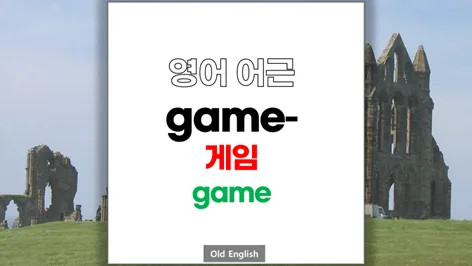
The English words 'gamble,' 'gambling,' and 'boardgame' trace their roots back to the Old English word 'gamen' or 'gamenian,' meaning 'joy,' 'pleasure,' or 'play.' These terms evolved from their origins as words for enjoyment and games into their modern associations with betting and gaming.
What's the Etymology of 'Game' and 'Gambling'? The Journey from Old English 'Gamen'
The English word 'game' originates from the Old English words 'gamen' or 'gamenian,' which originally carried positive connotations of 'joy,' 'pleasure,' 'play,' and 'amusement.' Over time, this concept of 'play' expanded to encompass activities involving stakes and competition, leading to modern terms like 'game' and 'gambling.' For instance, 'gamble' itself is derived from the root 'game,' illustrating how the meaning shifted from simple amusement to an activity involving risk. Understanding this etymological journey allows for a deeper appreciation of how word meanings evolve with societal and cultural changes.
What's the Etymological Link Between 'Gamble' and 'Gambling'?

The word 'gamble' stems from the Old English 'gamenian,' meaning 'to play,' 'to joke,' or 'to tell riddles.' The root 'gamb' is believed to share the same origin as 'game,' signifying 'play.' The '-le' suffix likely served to form verbs. Thus, 'gamble' initially meant 'to play' and gradually evolved to signify 'to bet' or 'to gamble,' involving stakes of money or possessions. 'Gambling' is formed by adding the '-ing' suffix to 'gamble,' denoting the act of gambling itself. While these words began with the core meaning of 'joy,' they now describe activities that often involve risk and uncertainty. This semantic shift is a prime example of how language adapts to reflect evolving human activities and societal norms.
How Did 'Boardgame' Become a Category of 'Game'?
'Boardgame' is a compound word formed from 'board' and 'game,' literally meaning 'a game played on a board.' Since the word 'game' itself originates from the Old English 'gamen,' 'boardgame' shares the fundamental meaning of 'pleasure' or 'play.' Boardgames encompass a wide range of activities played on a defined surface according to set rules, such as chess, Go, checkers, and Monopoly. These games are not just for entertainment; they also serve as valuable tools for developing strategic thinking, problem-solving skills, and social interaction. The popularity of boardgames has surged in recent years, establishing them as a significant cultural phenomenon enjoyed by people of all ages.
What Should You Watch Out For When Studying English Word Etymology?
When studying English word etymology, it's crucial to go beyond simply memorizing word roots. Understanding the historical and cultural context in which a word developed is key. For words like 'gamble,' tracing the evolution from a positive meaning like 'joy' to a more negative connotation like 'gambling' provides valuable insight into the word's nuances. It's also effective to focus on lemmas—the base or dictionary form of a word—as they serve as the foundation for related vocabulary. Expanding your vocabulary by studying these core lemmas can significantly boost learning efficiency. Finally, cross-referencing etymological information across multiple dictionaries is recommended for accuracy and a comprehensive understanding. Resources like Merriam-Webster, Oxford English Dictionary (OED), and Wiktionary can offer diverse perspectives. Tailoring your approach to your learning style and utilizing various resources will enhance your etymological studies.
English crawl path
Next English reads from this pilot cluster
Continue through the category hub, latest English stories, and related posts so this translated article is not an isolated URL.
Tags
💬Frequently Asked Questions
What should I check first in Gamble & Boardgame Etymology: Korean Word Origins 2026?
Does this Language Learning article link back to the Korean source?
Where can I find similar English stories?
English discovery path
Explore more English K-culture stories
Keep browsing the indexed English pilot cluster so Google and readers can move between this story, the category hub, and fresh discovery pages.
Original Source
Read the Korean original





