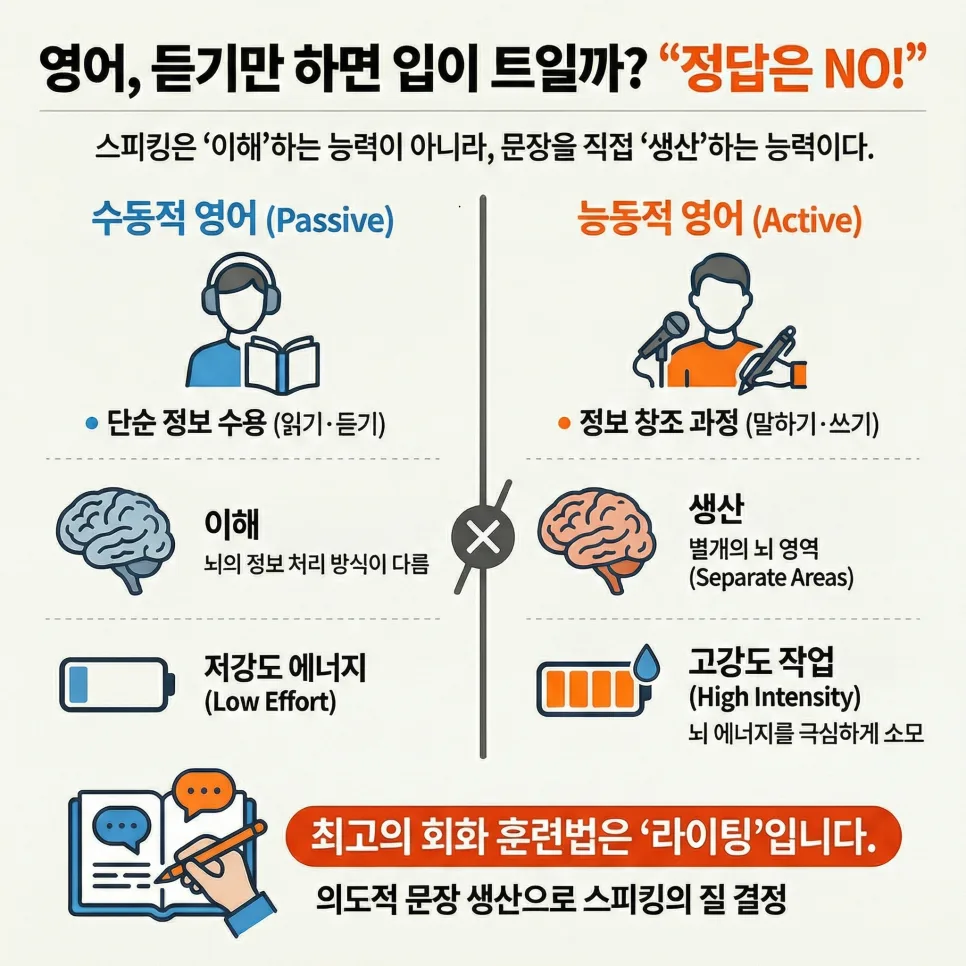
Struggling to speak English fluently even after dedicated study? The key lies in your learning method. Focusing solely on passive learning like reading and listening fails to activate the brain's 'production' areas crucial for speaking. Discover 2026's top brain-based strategies to shift from passive English comprehension to active speaking skills.
Is English Learning Really Organic Across All Four Skills? (Passive vs. Active English)

Many believe English reading, listening, writing, and speaking skills develop together organically. However, true speaking fluency hinges on two critical factors: the speed of recalling words (association) and the speed of assembling them grammatically (combination). English can be broadly categorized by how the brain processes information: 'Passive English,' which involves receiving and understanding external information (reading and listening), and 'Active English,' which involves producing and creating information (writing and speaking). The common struggle with speaking stems from over-reliance on passive learning, neglecting the active training needed for information output. Many Korean learners, for instance, achieve high scores on tests like TOEIC but falter in real conversations, precisely because their brain's 'production areas' remain underdeveloped.
Why 'Tuned Ears' Don't Automatically Lead to 'Open Mouths'
Information reception and production involve distinct cognitive processes in the brain. Therefore, passive learning alone won't automatically translate into active speaking abilities. For example, understanding an English passage about the PyeongChang Winter Olympics closing ceremony is one thing; being able to immediately rephrase it in English is another. This highlights that expanding 'recognition units' is separate from expanding 'production units.' When reading, the brain's production centers aren't engaged, so reading proficiency doesn't naturally transfer to speaking skills. From a neuroscience perspective, this is a predictable outcome. Simply listening more won't guarantee fluent speaking.
Why You Should Feel Exhausted After Speaking Practice
Experiencing significant fatigue immediately after genuine 'active English' learning, such as speaking practice, is normal. The process of recalling words and assembling them grammatically places a much higher load on the brain than simply receiving information. It's akin to how writing a report requires far more energy than just reading its source material. Effective learners often structure their study sessions with this energy expenditure in mind. It's more efficient to focus high-intensity production activities like speaking and writing first, then switch to less demanding receptive activities like reading or listening when the brain is tired. If you don't feel tired after a study session, you likely spent most of your time 'understanding' rather than actively 'producing'.
The Best Strategy for Fluency Isn't Watching Dramas, It's Writing
While many recommend watching American TV shows (like Netflix dramas) to improve English speaking, neuroscience suggests that writing practice is more directly beneficial for enhancing speaking skills. Writing activates the brain's production areas, similar to speaking, as it involves selecting words and constructing sentences. This practice directly improves the associative and combinatorial speeds needed for speaking. Therefore, actively writing down learned expressions or ideas is far more effective for improving speaking ability than passively watching and repeating lines from shows. Consistent writing practice is crucial for strengthening the brain's 'production muscles'.
For more detailed English learning strategies, check the original source below.





