
Mastering a 3-step formula for English self-introductions, complete with practical examples, will boost your confidence in any situation. Learn to structure your introduction logically, covering your name, background, current status, education, experience, interests, personality, and future goals for a polished presentation.
Why Are English Self-Introductions Important, and How Do You Start?
The first question you'll likely face when starting English conversations is, "Can you introduce yourself?" Whether it's for a job interview, the first day of class, a business meeting, or a networking event, a self-introduction is a crucial first impression. However, many people struggle with the order, find their sentences getting tangled, or speak for too long, making it a challenging task. I've personally guided students who initially couldn't even manage a single sentence but, through systematic training, can now confidently introduce themselves in English and even carry on conversations. This process not only enhances your English skills but also brings a significant boost in self-confidence.
What Is the 3-Step Formula for Confident English Self-Introductions?
Related Articles
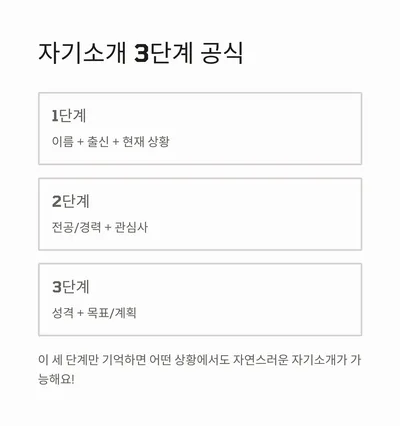
The self-introduction structure we use is divided into three main stages. The first stage is introducing your name, where you're from, and your current situation. For example, you could start with, "My name is Jiwoo, and I’m from Busan. I currently work as a project manager at a tech company. I’ve been living in Seoul for the past 3 years." The second stage involves your major, career, and interests, allowing you to express yourself more deeply. You might say, "I majored in marketing and I’m interested in branding. I have 5 years of experience in customer service. In my free time, I enjoy hiking and watching movies." Finally, the third stage is about your personality, strengths, and future goals. You can conclude with something like, "I’m a very positive and open-minded person. People say I’m good at solving problems. My goal is to work abroad in the future." Remembering these three stages will enable you to deliver a natural and concise self-introduction in any setting.
How Should You Structure and Practice Your English Self-Introduction Script?
Effectively structuring and practicing your self-introduction script is key. In the first stage, clearly state your name, origin, and current occupation. While this part seems simple, awkwardness can easily arise from unnatural intonation, speed, or stress, making pronunciation correction and rhythm training essential. The second stage allows you to broaden the conversation by discussing your major, career, hobbies, and interests. This section should move beyond memorized sentences; practicing reconstructing sentences with your own keywords transforms it into a genuine expression of yourself. For the third stage, you need to practice creating various versions of your personality, strengths, and future goals to adapt to different situations. This practice ensures you can flexibly adjust your self-introduction for interviews, presentations, or even casual meetups.
What Are Real Student Transformation Examples from English Self-Introduction Training?
One student, who initially struggled to say even a single sentence for her self-introduction during her first level test, transformed within a month. She progressed to confidently introducing herself in English at business networking events and even engaging in follow-up conversations. She expressed her surprise, saying, "It's amazing that I can speak without worrying about making mistakes." This transformation isn't just about memorizing phrases; it's the result of a trained structure and repetitive speaking practice. Through a comprehensive training routine—listening to sample self-introduction MP3s, constructing a 3-step self-introduction script, practicing with native instructors, recording and receiving feedback on your performance, and repositioning your introduction for different scenarios—you can significantly accelerate your progress compared to practicing alone.
What Are Common Mistakes to Avoid During English Self-Introductions?
Many people make a few common mistakes when introducing themselves in English. First, using stiff, overly memorized sentences can bore the listener and hinder natural conversation flow. Second, trying to convey too much information at once is a frequent error; your self-introduction is your first impression, so it's crucial to deliver key points concisely. Third, a lack of confidence and unclear pronunciation can leave a poor impression. To minimize these mistakes, it's essential to create your own script based on the 3-step formula presented earlier and practice speaking it aloud consistently. Additionally, practicing with a native-speaking instructor to refine natural intonation and pronunciation will be highly beneficial.
Discover your personalized self-introduction routine on the New English website.





