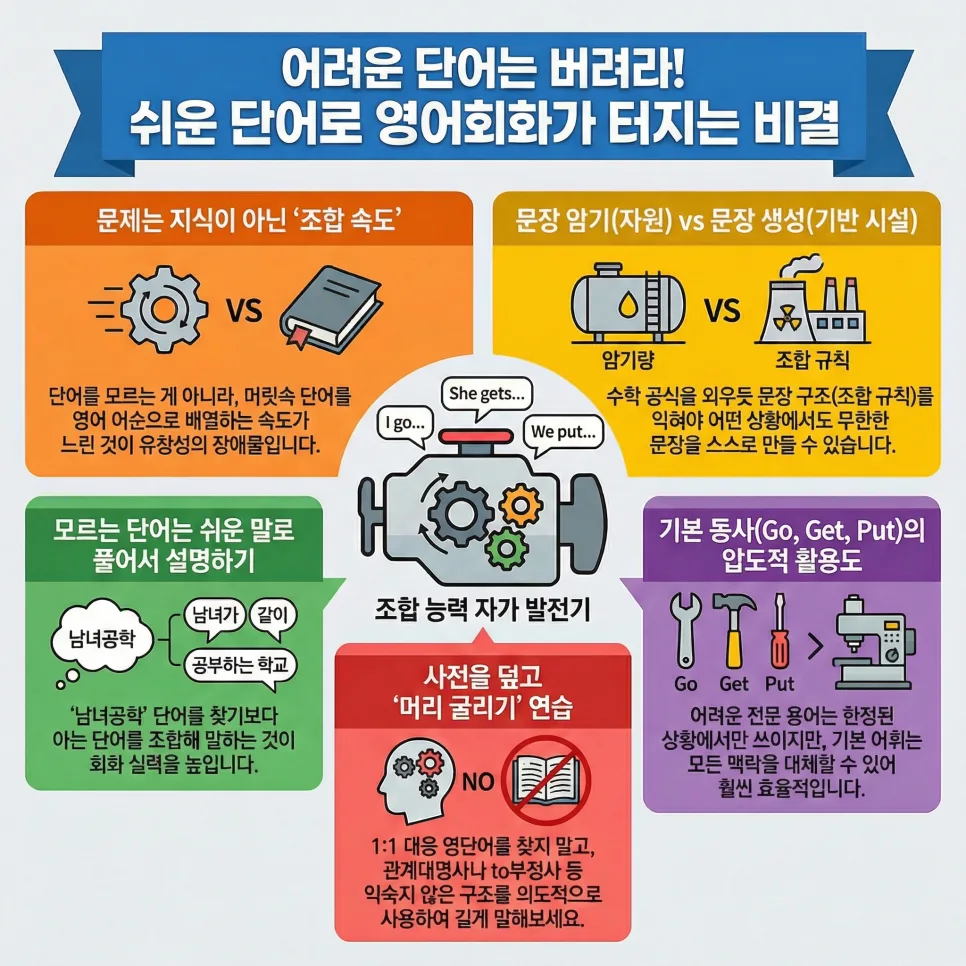
Forget memorizing complex vocabulary! The real secret to fluent English in 2026 lies in mastering how to combine simple words. If you're aiming for a significant leap in your English speaking skills, it's time to completely overhaul your study approach.
Why Focus on Simple Words for English Fluency?
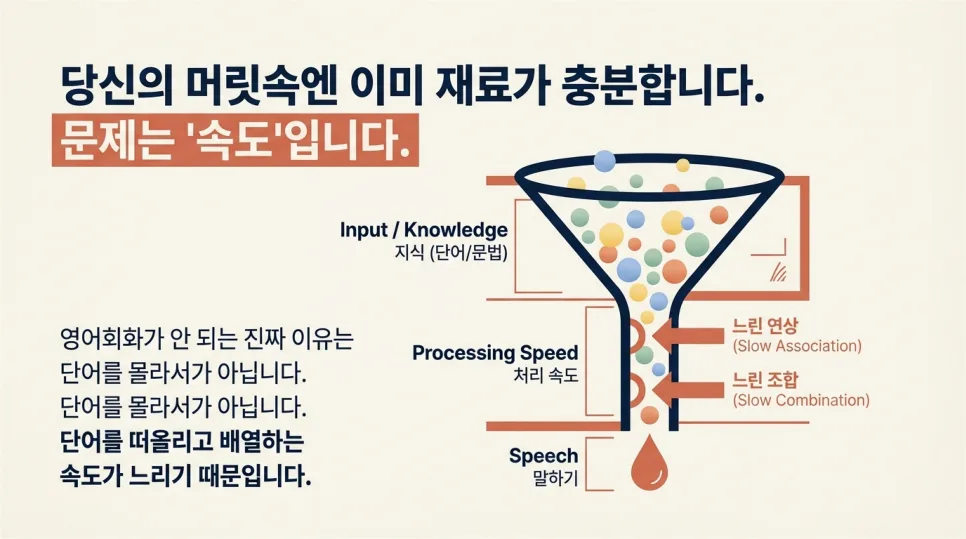
Many learners believe that memorizing countless English sentences is the key to fluency. However, this approach misunderstands the science of the brain and the nature of language. Firstly, most sentences we use are newly created, meaning a finite memorization capacity cannot generate infinite sentences. Secondly, the more sentences you memorize, the harder it becomes to select the appropriate one in real-time, leading to the 'paradox of choice' where you freeze up. Thirdly, simply knowing a word (Know) is vastly different from being able to use it instantly in context (Associate). Mechanical memorization only increases knowledge quantity, doing nothing for the associative speed required in actual conversations. Therefore, to achieve fluent English speaking, it's crucial to build the ability to freely combine simple words and basic sentence structures.
Does English Fluency Really Depend on 'Combination Speed'?
Yes, absolutely. True English speaking proficiency isn't about how many words you know (the 'hardware'), but rather how quickly and accurately you can arrange the words you already know to form sentences (the 'software'). Think of it like math: 'memorization learning' is about finding a fixed answer, while 'combination learning' is about understanding the rules to calculate any problem in real-time. In essence, genuine fluency emerges from the ability to instantly combine words according to English rules, creating new sentences on the fly. Memorizing entire sentences for specific situations offers zero scalability. In contrast, focusing on the 'calculation ability' of mixing words through combination learning enables infinite sentence generation. This is akin to a 'Mental Math' approach.
Why Are 'Basic Vocabulary' and 'Combination Skills' More Important Than Advanced Words?
Many learners obsess over memorizing advanced vocabulary like 'coeducation' or 'incarcerate,' but this actually deprives them of combination practice opportunities. For instance, if you can't recall 'coeducation' immediately, explaining it as 'A school where both male and female students study in the same classroom' provides practical training in combining prepositions, relative clauses, and adjectives. Practicing sentence creation with simple words is far more effective for improving fluency than memorizing a single advanced word. Furthermore, basic verbs like 'put,' 'take,' and 'have' have endless applications. The ability to say 'put the prisoner into the cell' even without knowing 'incarcerate' is the core of true communication and a vital survival skill.
How Can You Build the 'Infrastructure' for English Thinking?
The primary reason we stumble when speaking English is the 'target → Korean → English' translation process. However, once a robust 'combination rule' infrastructure is in place, the Korean translation step naturally disappears, and 'English thinking' becomes subconscious. This is similar to how improving the operational capacity of a mathematical function f(x) allows for infinite output values. Therefore, it's important to repeatedly practice with specific sentence structures as your 'infrastructure.' A key foundational structure is [Subject + Verb + Object + Object Complement] (S + V + O + OC). For example, consistently practice creating your own sentences by substituting various verbs like 'want,' 'help,' 'enable,' 'make,' and 'force' into this structure. Practicing this structure over 1,000 times will make it as natural as riding a bike, eventually becoming an unconscious skill.
What Should You Start Doing Today to Improve Your English Speaking Skills?
To dramatically improve your speaking skills, you must fundamentally change your study method, not just increase study hours. First, when you encounter an unknown word, practice explaining the concept at length using simple words you already know, rather than immediately looking up a one-to-one translation. This greatly enhances your combination ability. Second, instead of memorizing complex sentence structures, focus on learning core basic structures like 'Subject + Verb + Object + Object Complement' and practice creating sentences by plugging in various words. Consistently practicing these 'English usage techniques' will naturally lead to fluent English speaking skills. Remember, the optimal learning strategy can vary based on individual goals and circumstances, so seeking expert guidance when needed is also a good option.
For more details, check the original source below.





