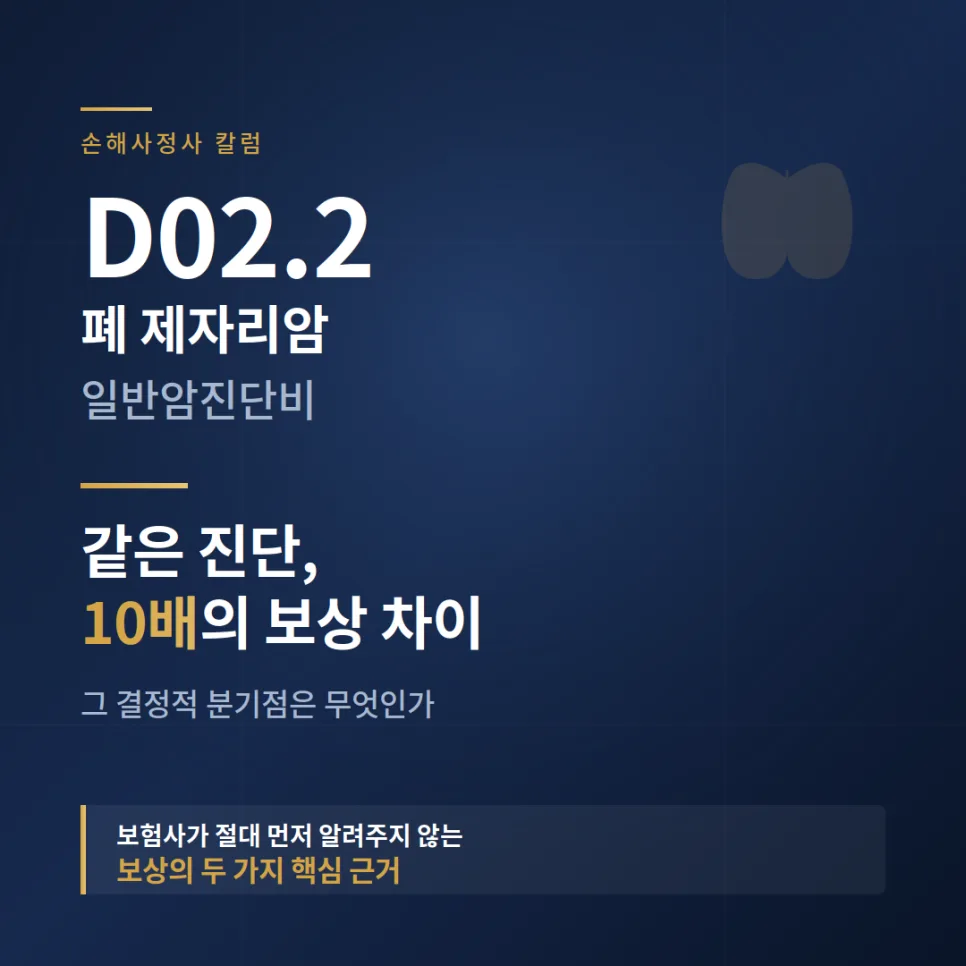
Many people miss a crucial detail when diagnosed with Lung Carcinoma in Situ (D02.2): the potential for a 10x payout difference compared to general cancer diagnoses. Understanding the nuances of insurance policy terms and pathology reports is key to maximizing your insurance benefits for this diagnosis.
How to Potentially Receive a 10x Payout for Lung Carcinoma in Situ (D02.2) Diagnosis?
Receiving a diagnosis of Lung Carcinoma in Situ (D02.2) from a lung nodule found during a health screening can be a complex situation. While medically considered a non-invasive form of cancer, insurance policies often classify it as a 'minor cancer' rather than a 'general cancer.' This distinction can lead to a payout of only 10% of the general cancer diagnosis benefit, creating a significant financial gap. For example, if you have a $50,000 general cancer benefit, a minor cancer classification might only yield $5,000, a difference of $45,000. This disparity is primarily determined by the insurance policy terms at the time of enrollment and specific wording in the pathology report. Insurance companies typically do not proactively provide this information, making it essential for policyholders to understand these details and advocate for themselves. Real-world experiences show that even minor differences in pathology reports can drastically alter insurance payouts.
What are the Critical Turning Points for D02.2 Diagnosis Payouts That Insurers May Overlook?
When filing an insurance claim, insurers meticulously review submitted documents. A claim submitted with only a diagnosis certificate and receipt might be processed under a 'minor cancer' track. However, by submitting supporting documents that analyze policy terms from your enrollment date and interpret pathology findings, you can steer your claim towards a 're-evaluation track,' increasing the possibility of a general cancer classification. Two key factors are crucial here. First, the Korean Standard Classification of Diseases (KCD) system at your policy's inception. While the AIS (Adenocarcinoma in Situ) classification system saw changes after the 8th revision in 2021, insurance policy interpretations are based on the contract date. If you enrolled before 2020, you might benefit from more favorable interpretations under older terms. Second, the microscopic description in your English pathology report. If the English text includes even a single phrase suggesting 'invasion,' it complicates a simple D02.2 classification and opens the door for a general cancer claim. Insurers won't volunteer this information, so policyholders must proactively research and assert their case.
What Are the 4 Key Phrases to Check in a Lung Carcinoma in Situ (D02.2) Pathology Report?
The core of any insurance dispute lies not in the diagnosis certificate but in the tissue examination report (pathology report). It's crucial to obtain the original report and check for the following four phrases within the English microscopic description. First, 'Microinvasion suspected.' This indicates even a less than 1mm invasion, providing medical grounds to review it as a general cancer (C34). Second, 'Foci suspicious for invasion.' This suggests the presence of small areas within the tumor where invasion is suspected, falling into a gray area that makes a definitive non-invasive classification difficult and can be a starting point for dispute. Third, 'Cannot rule out stromal invasion.' When a pathologist cannot completely exclude the possibility of stromal invasion, it provides a strong basis to challenge a D02.2-only classification. Finally, 'With suspicious microinvasive component.' This suggests the tumor has both non-invasive and possibly microinvasive components, increasing the likelihood that it is transitioning beyond a simple in situ state. The presence of even one of these phrases gives you substantial grounds to contest the insurer's classification of D02.2 as a minor cancer.
Can a Lung Carcinoma in Situ (D02.2) Payout Be Increased from $5,000 to $50,000?
In a real-life case, a policyholder diagnosed with D02.2 Lung Carcinoma in Situ initially received an offer of $5,000 from their insurer, as the company classified it as a minor cancer under their general cancer benefit of $50,000. However, the policyholder discovered the phrase 'microinvasion' in their pathology report. Using this as leverage, they contested the insurer's initial assessment. Despite the insurer's initial stance citing current classification standards for carcinoma in situ, the policyholder persisted, emphasizing the medical implications of the report's wording and the policy terms at the time of enrollment. Ultimately, the presence of the microinvasion suspicion in the pathology report led to a reclassification as a general cancer, and the policyholder received the full $50,000 benefit. This case highlights how a single phrase in a pathology report can significantly impact insurance payouts and underscores the importance of policyholders actively asserting their rights. Individual outcomes may vary, so consulting with a professional for accurate diagnosis and claims strategy is recommended.
What Should You Be Cautious About When Filing a Lung Carcinoma in Situ (D02.2) Insurance Claim?
When filing an insurance claim for a D02.2 Lung Carcinoma in Situ diagnosis, several precautions are necessary. Firstly, be strategic about the documents you submit to the insurer. Simply providing the diagnosis certificate and receipts may lead to a minor cancer claim resolution. It's more advantageous to submit supporting evidence, including your policy terms from the enrollment date and the original pathology report (preferably in English), which can help argue for a general cancer classification. Secondly, do not blindly accept the insurer's initial response. If they state it's classified as carcinoma in situ based on current standards, you can still contest this by referencing the policy's terms at the time of contract and specific wording in your pathology report. Thirdly, always verify the English phrasing in the pathology report. Terms like 'Microinvasion,' 'foci suspicious for invasion,' 'cannot rule out stromal invasion,' or 'with suspicious microinvasive component' can be critical for a general cancer claim. If navigating this process feels overwhelming, consider consulting with an insurance claims specialist or a public adjuster for expert assistance.
Tags
Original Source
Read the Korean original