Starting in 2026, South Korea's healthcare system is set to significantly reduce medical expenses for eligible individuals through an expanded 'Lowered Co-payment Benefit' program. This benefit, tied to increases in the median income, will lower out-of-pocket costs for outpatient visits by up to 14%, and for those with rare or intractable diseases, it can be as low as 0%. Inpatient care also sees a fixed co-payment rate of 14%, offering substantial relief for those facing chronic or severe health conditions.
What's Behind the Korean Healthcare Co-payment Benefit?
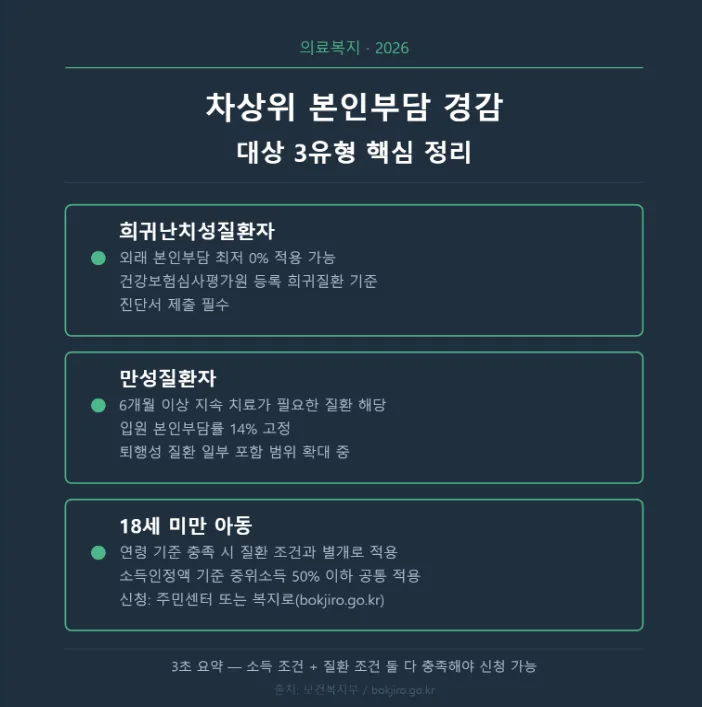
Many assume meeting the income threshold for the 'next lower income bracket' (차상위계층) automatically qualifies them for reduced co-payments. However, this isn't entirely accurate. Unlike general 'next lower income bracket' certifications, the co-payment reduction program requires not only meeting income criteria (below 50% of the median income) but also fulfilling specific 'disease conditions.' This means even if your household income qualifies, you won't receive the benefit unless you have a qualifying illness. To be eligible, you must prove you have a rare or intractable disease, a chronic condition requiring over six months of treatment, or be a child under 18. Without these disease-related documents, you won't be approved, even with a low income. I've seen cases where individuals met the income requirements but couldn't get the benefit due to a lack of proper medical documentation, which is truly unfortunate. This highlights the importance of having the correct medical proof to access these crucial healthcare savings.
Key Changes to the Korean Healthcare Co-payment Benefit in 2026
In 2026, the program will see several key adjustments designed to broaden its reach and enhance its benefits. The median income threshold will increase by 6.51%, meaning more households will qualify based on income. For example, a single-person household can now have an income up to approximately $1,282,119 KRW (around $950 USD) per year, and a four-person household up to $3,247,369 KRW (around $2,400 USD) annually, to meet the criteria. Furthermore, asset assessments will be more lenient; certain vehicles, such as those under 2,000cc or older than 10 years, and trucks used for business, may be excluded or receive reduced valuation. A significant update for 2026 is the reduction of the co-payment rate for long-acting injections for individuals with mental health conditions to just 2%. It's important to note, however, that the 'dependent support' criteria still apply. This means that even if your personal income and assets meet the requirements, you might still be excluded if your supporting family members' income or assets exceed a certain level.
How Much Can You Save on Medical Bills with This Benefit?
For eligible individuals, the savings on medical bills can be substantial. While typical co-payment rates for outpatient visits for the general population can range from 30% to 60%, beneficiaries of this program will see their rates reduced to a maximum of 14%. For those with rare or intractable diseases, the co-payment rate can be as low as 0% for outpatient services. Inpatient care also benefits, with a fixed co-payment rate of 14%, providing a crucial safety net for patients requiring extended hospital stays or surgeries. Beyond direct medical cost reductions, recipients can also access other benefits typically available to lower-income brackets, such as mobile communication fee discounts (up to approximately $16 USD per month) and electricity bill reductions (up to $6-7 USD per month). However, these additional benefits, like communication fee waivers and electricity discounts, are not automatic and require separate applications. It's essential to proactively apply for these to maximize your savings.
Applying for the Korean Healthcare Co-payment Benefit: What You Need to Know
To apply for the Lowered Co-payment Benefit, the most reliable method is to visit your local community center (also known as an Administrative Welfare Center) in person. Before your visit, it's highly recommended to use the online 'Bokjiro' (bokjiro.go.kr) website for a preliminary self-assessment of your eligibility. You can also contact the Ministry of Health and Welfare hotline at 129 for pre-application consultations. It's advisable to call your local community center beforehand to inquire about the specific required documents for the 'Lowered Co-payment Benefit' application. Generally, you will need a medical certificate (진단서) proving your condition, income verification documents, and a family relations certificate. If your living situation involves a practical separation from your dependents, you may need additional documentation to prove this. When you visit the center, be sure to explicitly state that you are applying for the 'Lowered Co-payment Benefit' (차상위 본인부담 경감) and not just a general 'next lower income bracket' certificate. Remember, benefits like communication fee discounts and electricity bill reductions require separate applications, so ensure you complete all necessary steps to receive the full range of support available.
English crawl path
Next English reads from this pilot cluster
Continue through the category hub, latest English stories, and related posts so this translated article is not an isolated URL.
Tags
💬Frequently Asked Questions
What should I check first in Korean Healthcare Benefits 2026: Cut Medical Costs?
Does this Health & Wellness article link back to the Korean source?
Where can I find similar English stories?
English discovery path
Explore more English K-culture stories
Keep browsing the indexed English pilot cluster so Google and readers can move between this story, the category hub, and fresh discovery pages.
Original Source
Read the Korean original