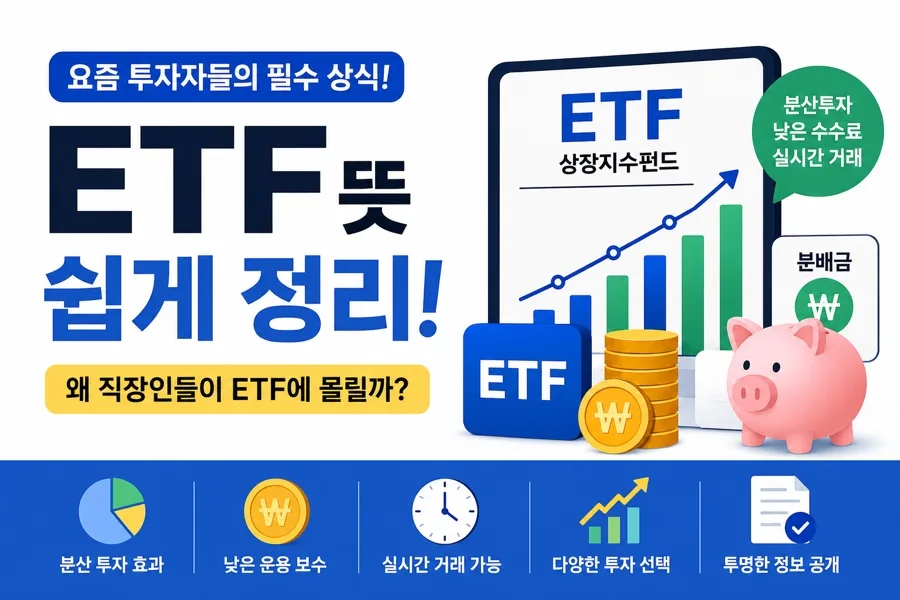
In 2026, Exchange Traded Funds (ETFs) are a popular financial product that allows investors to trade funds tracking specific indexes or assets like stocks. They offer diversification benefits and lower management fees, making them particularly appealing to busy professionals seeking efficient wealth-building strategies.
What Are ETFs and Why Are They Popular with Professionals? (2026 Outlook)
ETFs, or Exchange Traded Funds, are innovative financial products designed to mirror the price movements of a specific market index (like the S&P 500) or asset (such as gold or oil). You can trade them on stock exchanges in real-time, much like individual stocks. Their primary appeal lies in offering the benefits of diversified investing across multiple assets in a single, easily tradable package. For busy professionals who may lack the time to research and invest in individual stocks, ETFs provide a convenient way to invest in the broader market's performance. This demand is expected to grow significantly through 2026.
What Are the Benefits of ETF Investing, and Which Products Will Shine in 2026?
The most significant advantage of ETF investing is 'diversification.' While investing in a single stock carries the risk of substantial losses due to that company's performance or specific issues, ETFs mitigate this risk by holding dozens or hundreds of stocks. This spreads out risk considerably. Furthermore, ETFs typically have much lower management fees compared to traditional mutual funds, maximizing the power of compounding over long-term investments. In 2026, ETFs focused on high-growth sectors like AI, semiconductors, and green energy are expected to attract significant attention. Additionally, ETFs tracking major market indexes, such as the US S&P 500 or Korea's KOSPI 200, are projected to maintain their popularity. Even renowned investors like Warren Buffett recommend index-based ETFs for long-term investing.
How Do You Invest in ETFs, and What Should You Watch Out For in 2026?
Investing in ETFs is straightforward for anyone with a brokerage account. You can select the ETF you want and buy it at the current market price or place a limit order, similar to trading stocks. Unlike traditional mutual funds, ETFs can be traded in real-time during market hours, making them easily convertible to cash. However, not all ETFs are risk-free. Particularly, leveraged ETFs or inverse ETFs, designed for higher returns or betting against the market, have extreme volatility and can lead to significant losses for novice investors. When investing in 2026, it's crucial to carefully select products that align with your investment goals and risk tolerance, and avoid excessive leverage. Also, while ETF distributions (similar to dividends) can be attractive, be aware of 'distribution ex-rights' events where the price may drop, so consider distribution methods alongside price fluctuations.
What Are Common ETF Investing Mistakes and How Can You Avoid Them?
One of the most frequent mistakes ETF investors make is chasing trends or hype without proper research, leading to 'blind' investing. For instance, jumping into semiconductor or secondary battery theme ETFs simply because they are currently surging without understanding the underlying assets or market dynamics can be risky. To avoid this, conduct thorough research on the ETF's holdings, expense ratios, and long-term prospects. Diversifying across different sectors and asset classes, rather than concentrating on a single hot theme, is also a sound strategy. Remember that ETFs are tools, and like any investment, they require informed decision-making and a clear understanding of your financial objectives.
For more details, check the original source below.





